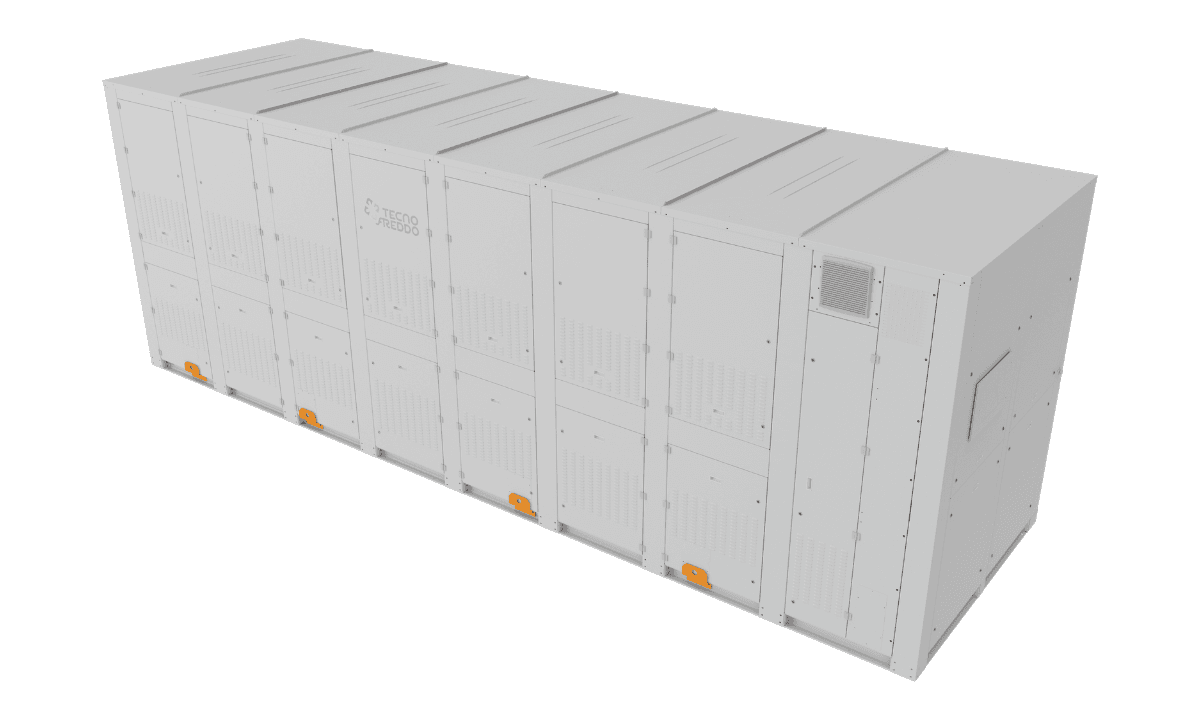
U.S. manufacturer Zero Zone is supplying a 91TR (320kW) transcritical CO2 (R744) refrigeration system for a new grocery fulfillment center in Nashville, Tennessee, according to Director of Industrial Sales John Collins.
With a 50TR (176kW) low-temperature (LT) load and a 41TR (144kW) medium-temperature (MT) load, the system will serve a combination of reach-in cabinets and walk-in cooler spaces. Alessandro Silva, Senior Application Engineer at Bitzer, joined Collins to outline the design and modeling of the large-scale cold storage facility in a presentation at ATMOsphere America Summit 2026. The event, organized by ATMOsphere, publisher of NaturalRefrigerants.com, took place June 2‒3 in Tarrytown, New York.
“The trend we’ve seen towards CO2 refrigeration over the last 15‒20 years – which is not slowing down – comes from delivering more reliability, better efficiency and lower total cost of ownership,” Collins said. “A 90bar [1,305psi] low-side design simplifies installation, improves off-cycle performance and allows more precise control of hot gas defrost to the evaporator.”
The layout: The fulfillment facility, designed to balance employee comfort with rapid delivery requirements, features reach-in freezer cabinets with 377 doors and reach-in cooler cabinets with 93 doors, as well as 3,000ft2 (279m2) of walk-in freezer space and 36,300ft2 (3,370m2) of walk-in cooler space.
- Based on its Genesys platform, Zero Zone developed a CO2 transcritical booster design, using 12 two- and four-cylinder CO2 compressors, two parallel compression racks serving LT and MT loads and two adiabatic gas coolers.
- The nature of the facility with doors constantly opening and closing creates an “extremely high defrost load,” according to Collins. “A four-pipe loop system with reversed-cycle defrost on individual evaporators enables rapid defrost with minimal disruption to operations.”
- Design pressures included 120bar (1,740psi) on the high side and 90bar on the low side, with hot gas defrost supplied on the LT circuits and either hot gas or off-cycle defrost on all the MT circuits.
Additional measures: Zero Zone used internal heat exchangers, a desuperheater and dedicated LT and MT suction accumulators to support system reliability and energy efficiency.
- A flash gas-to-liquid line heat exchanger reduces flash gas formation and throttling losses, while a LT suction-to-liquid line heat exchanger maintains stable LT compressor operation and ensures compressor inlet superheat remains within the Bitzer- recommended 18 to 36°F (−7 to 2°C) range.
- Adding a gas desuperheater on the LT compressor discharge line enables heat recovery and limits discharge gas temperature to below 285°F (141°C), protecting the compressor against thermal stress.
- Accumulators on the LT and MT suction lines improve reliability and service life by preventing liquid CO2 from carryovering to the compressors.
Simulator analysis: Bitzer used its new thermodynamic simulation tool, Fender, to model Zero Zone’s fulfillment-center design.
- The flash gas-to-liquid line heat exchanger increases COP by 3.3%, from 6.1 to 6.3. It also reduces the risk of low-superheat conditions and liquid carryover from the flash tank, particularly during part-load operation.
- “Especially for large applications, any design mistakes cost a lot of money for everybody involved,” Silva said, adding that Fender enables real-world system modeling using a wide range of components and system configurations.
- Available as a web-based platform, Fender evaluates all HVAC&R systems, including those using natural refrigerants CO2, ammonia (R717) and hydrocarbons.
Quotable: “Fender provides a comprehensive view of system performance and interaction between compressors and all other components, helping users design more efficient and reliable solutions,” Silva said. “We often find that systems which aren’t designed efficiently are also not reliable. For compressors, the most important thing is to fix the root cause of the problem. Otherwise the failure will repeat.”
“A 90bar [1,305psi] low-side design simplifies installation, improves off-cycle performance and allows more precise control of hot gas defrost to the evaporator.”
John Collins, Director of Sales at Zero Zone