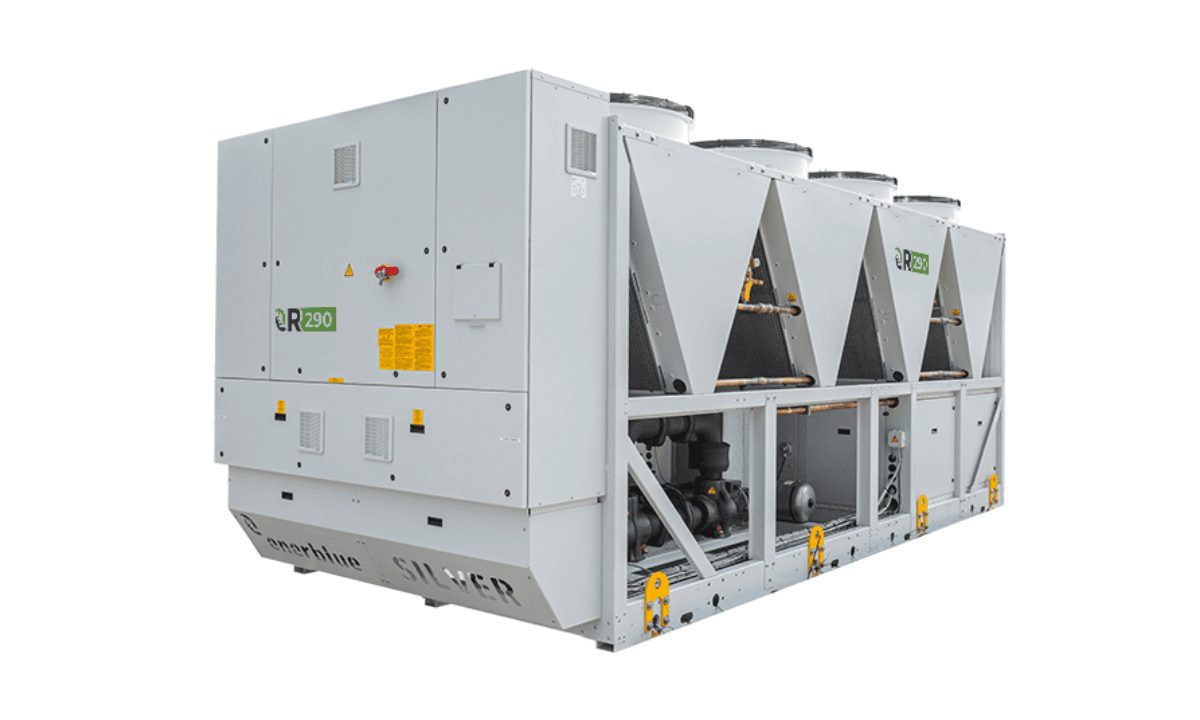
Tecnofreddo is one of many European HVAC&R manufacturers that will be exhibiting its natural refrigerant products at Chillventa 2026, which will be held in Nuremberg from October 12–15. This includes its PERSEO line of propane (R290) heat pumps and the ZEUS IWC, an air-cooled ammonia (R717) chiller for process applications ranging from 200 to 900kW (56.8 to 255TR).
Tecnofreddo is in the midst of a transition to natural refrigerants, which now make up more than half of its product portfolio, according to CEO Osvaldo Asaro. That share is set to increase in the coming years as the company pursues a “natural-first” strategy for every project it takes on. That strategy is already making an impact, according to ATMOsphere, the publisher of NaturalRefrigerants.com.
ATMOsphere approved Tecnofreddo for the 2026 ATMO Approved Natural Refrigerants Label. The company sold natural refrigerant products in 2025 that avoided the lifetime release of 216,000 metric tons of CO2e (GWP20) and 230kg (507lb) of TFA (trifluoroacetic acid), according to estimations made by ATMOsphere as part of the process for approving Tecnofreddo for the label. The assumption is that every product sold prevents the sale of an alternative using f-gases, thus avoiding that product’s lifetime refrigerant-related CO2 and TFA emissions.
NaturalRefrigerants.com recently spoke with Mr. Asaro about Tecnofreddo’s natural refrigerant products and the growth it’s currently seeing and forecasting. This interview has been edited for length and clarity.
Tecnofreddo has a broad portfolio covering natural refrigerants as well as HFC- and HFO-based solutions. What percentage of the company’s business is currently represented by naturals?
Osvaldo Asaro: Natural refrigerants are the direction where we’re concentrating most of our product development: ammonia with our ZEUS series for industrial capacities, propane with PERSEO and R1234ze with NIKE IWC where a technical bridge toward natural refrigerants is needed. Today natural refrigerants represent 50–60% of our portfolio, and the share grows with every new launch.
Which natural refrigerant products are growing the fastest?
OA: Propane is currently the natural refrigerant line with the greatest weight by volume. That’s the PERSEO series, to which the DANAE heat pump has now been added for high-temperature applications. Ammonia, with ZEUS, is the most recent: By number of units it still carries relatively little weight, but it counts for much more in value since these are industrial-scale machines. Then there’s CO2 with the DIONISIO series. Overall, natural refrigerants now account for roughly half of what we produce.
“For us, natural refrigerants aren’t a separate product line but rather the criterion by which we design new machines.”
Osvaldo Asaro,
CEO at Tecnofreddo
What role do you expect natural refrigerants to play in the company’s growth over the next 5–10 years?
OA: For us, natural refrigerants aren’t a separate product line but rather the criterion by which we design new machines: ammonia where industrial scale and continuity are needed and propane where compactness is required. The f-gas phase-down regulation is moving the industry in this direction, and we’re already following it. Every new project in our technical office is now “natural-first,” with HFO remaining an option for specific cases where natural refrigerants aren’t yet the optimal choice or aren’t what the customer requests.
Does Tecnofreddo see a realistic path toward natural refrigerants representing the bulk of its sales or even 100%? If so, on what timeline?
OA: We don’t have a firm date for reaching 100%. The direction is clear, and natural-first is already the default for new medium- to large-capacity projects; HFO remains a tool for applications where space constraints, retrofits or local regulations still make it the more sensible choice. The pace will depend on how quickly regulation and the component supply chain – such as compressors and valves – for ammonia and propane become comparable in cost and availability to synthetic refrigerants.
What would need to change to allow you to phase out your synthetic product lines?
OA: Three things need to happen in parallel: clearer and more uniform local regulations on ammonia safety, especially in mixed urban/industrial areas; more technicians trained in installing and servicing ammonia and propane systems; and a component supply chain for natural refrigerants that reaches the volumes and therefore the costs of HFC. On the authorization side, the toxic gas permitting process for ammonia remains the responsibility of the end customer.
From your perspective, what is currently the main barrier to the wider adoption of natural refrigerant chillers and heat pumps in Europe, and what needs to happen across the industry to overcome it?
OA: The biggest barrier is a matter of perception: the complexity, real or perceived, of ammonia safety compliance and the shortage of trained installers. What’s needed is to demonstrate performance with measured data, not promises, which is why we’re willing to share test/commissioning data instead of generic claims.
Which regions of Europe and which segments are showing the strongest demand for these products?
OA: In Europe, our primary market remains Italy. Outside Italy, the strongest demand comes from France, followed by Switzerland, Ireland, the Netherlands and the United Kingdom. Outside Europe we work in Saudi Arabia, Algeria and the United States. In terms of segments, there is strong demand for process refrigeration. Most of the machines we produce operate at low- and medium-temperature, while high-temperature remains a smaller share.