Frick Industrial Refrigeration, a division of U.S.-based Johnson Controls, has released a new packaged heat pump, SmartPAC, that piggybacks on an ammonia (R717) refrigeration system to provide up to 190°F (87.8°C) hot water for industrial processing.
The new unit replaces boilers ‒ typically used for heating water for industrial sanitary cleaning processes ‒ by using the saturated ammonia leaving the refrigeration system’s condensers as a heat source, Nevin Forry, Senior Product Manager at Frick, told NaturalRefrigerants.com in an interview at the Refrigerating Engineers and Technicians Association (RETA) 2024 Conference. The event was held October 21‒24 in Grapevine, Texas.
“An ammonia refrigeration system normally consists of a traditional compression stage followed by a booster high-stage,” Forry explained. “The SmartPAC adds a third stage of compression, with the ammonia in the refrigeration system going through the heat pump to produce hot water.”
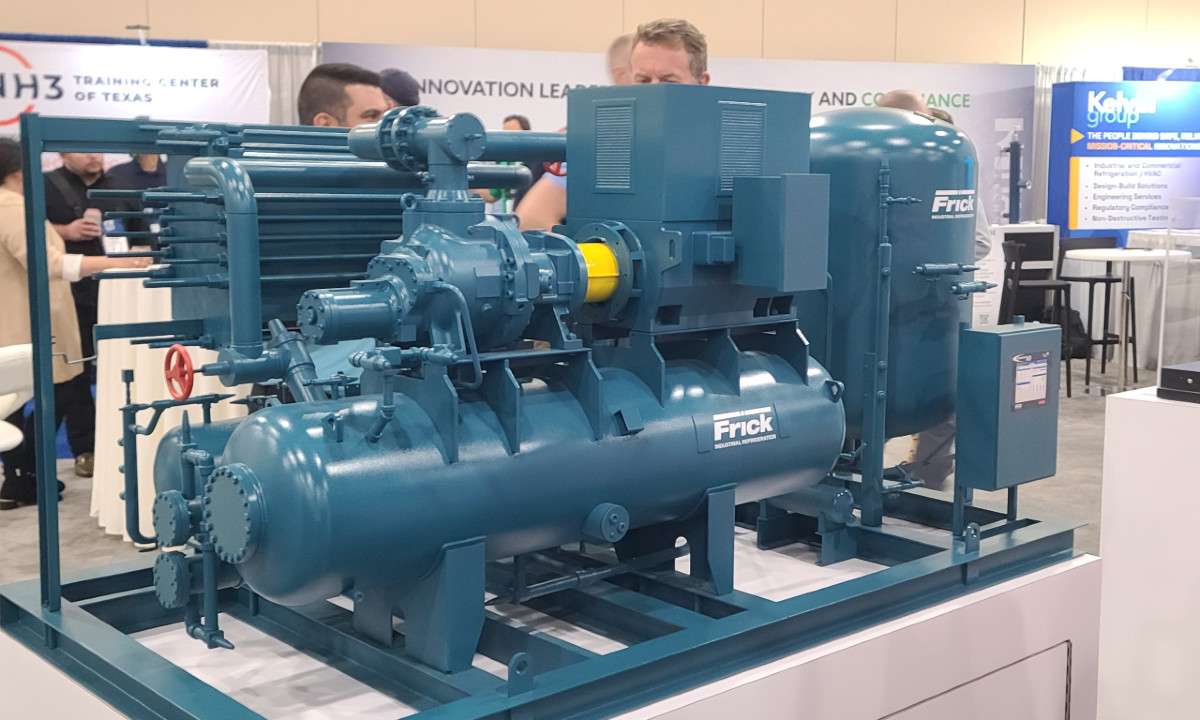
SmartPAC specifications: On a single base, the SmartPAC contains a rotary screw compressor, heat exchanger, pressure vessel and a unit controller.
- In the heat pump cycle, saturated ammonia, with a temperature typically between 65 and 95°F (18.3 and 35°C), leaves the refrigeration system’s condenser to enter a pressure vessel, with the vapor funneled to the compressor. After compression, the ammonia condenses in the heat exchanger, heating the water. Liquid ammonia discharges back into the refrigeration system receiver.
- According to Frick, water flows into the heat exchanger at roughly 60°F (15.5°C) and leaves at temperatures up to 190°F. Forry indicated it produces water at several outlet temperatures based on processor needs, including 140, 160 and 180°F (60, 71 and 82.2°C).
- Frick offers five heat pump model sizes, with heating capacities ranging from 613 to 5,763kW (174 to 1,639TR).
Market prospects: Forry indicated that he floated the concept of a third-stage compressor for ammonia systems using waste heat in 2009. However, he said, it took social and regulatory pressure to make it a reality.
- The dairy and cheese industry was the first to show interest in the unit, Forry told NaturalRefrigerants.com. “It works great for the high temperatures required for protein processing and facility cleanup,” he remarked.
- Forry said the package has been used in “a number” of installations in North America, both in new construction and retrofits, by adding it to existing ammonia refrigeration systems.
Other industrial heat pumps: Several European manufacturers are in various stages of bringing large-scale natural refrigerant heat pumps to the North American region.
- Tequs, a Norwegian designer of CO2 (R744) heat pumps and chillers for industrial and commercial applications, announced at Chillventa 2024 that it plans to expand the availability of its heat pumps to the U.S. market.
- Last May, Europe-based Carrier Commercial Refrigeration, part of the Carrier Global Corporation, made its CO2 compressor racks and heat pumps for refrigeration systems available in North America, focusing on the industrial market.
Quotable: “Companies with mandates to get rid of boilers are interested in this technology,” Forry said. “Instead of throwing away the refrigeration heat, they want to reapply it to save energy and carbon emissions.”
“Instead of throwing away the refrigeration heat, [we] reapply it to save energy and carbon emissions.”
Nevin Forry, Senior Product Manager at Frick