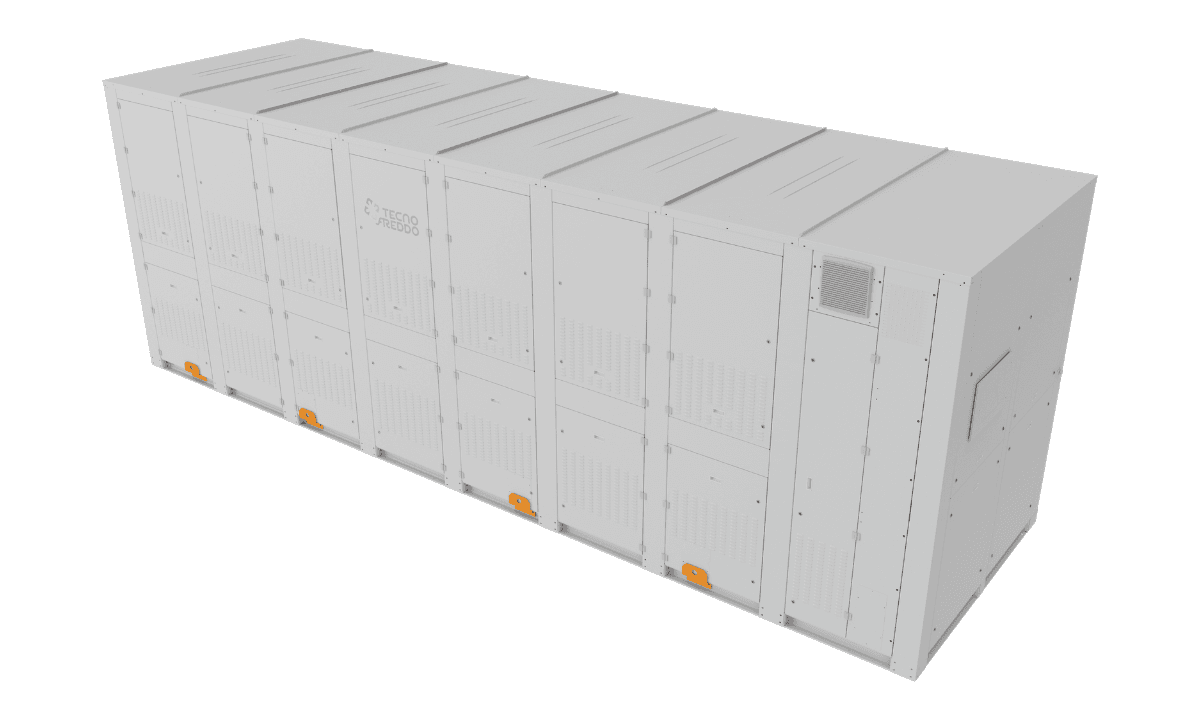
Refrigeration systems manufacturer Zero Zone has launched the Genesys CO2 Edge Compact, a new transcritical CO2 (R744) condensing unit for the North American market.
The new CO2 condensing unit, which was first shown at IIAR 2024, is available in four models, each with an optional adiabatic gas cooler. The capacity range for the lineup is 3 to 12TR (10.5 to 42.2kW).
“We had a prototype here two years and it’s gone through an extensive testing process at our facility in Ramsey, Minnesota, to make it more robust and serviceable,” John Collins, Director of Industrial Sales at Zero Zone, told NaturalRefrigerants.com. “The cabinet is larger than the prototype’s, for example. We’ve also optimized the controls and interface.”
The units have an operating range of 10 to 30°F (50 to −1°C) and can operate in ambient temperatures of −20 to 105°F (−28 to 40°C). The components are rated at 130bar (1,885psi) on the high side and 90bar (1,305psi) on the low side, and the condensing unit has an active oil management system.
Zero Zone’s new CO2 condensing unit is equipped with a Copeland scroll compressor, which the company released to the North American market in December 2025. The compressor features dynamic vapor injection, which Copeland says enhances system efficiency and performance by allowing for high-pressure vapor, such as refrigerant gas, to be “digested through the compression cycle,” eliminating the need for parallel compression. Copeland’s transcritical CO2 scroll compressor won the 2026 AHR Expo Innovation Award in the refrigeration category.
Hitting the market
Collins said Zero Zone has already taken a dozen orders for the CO2 Edge Compact and that he expects 2027 to be a “significant year in terms of volume.” The condensing unit is a fit for both end users in commercial and industrial refrigeration, with Collins noting that there is particular interest from the pharmaceutical industry.
“This is very attractive to pharma users that have to replace condensing units for their walk-in cold rooms that use synthetic refrigerants,” Collins said. “They want something that’s a long-term solution. There’s a realization that the current batch of refrigerants that may be low-GWP have their own problems in terms of thermodynamic properties.”
Collins said that while CO2 was previously seen as high cost, condensing units using A2L refrigerants are requiring larger coils and compressors that, along with the safety features required to address their mild flammability, is driving cost parity. Stricter f-gas regulations are also driving the shift to CO2, he added.
While the CO2 Edge Compact fills a slot in Zero Zone’s lineup for a smaller unit, demand is still driven by larger racks. “A lot of our volume is the larger capacity systems, 50 to 300 or even 400 tons [175kW/1MW/1.4MW] of capacity,” Collins said.
Zero Zone announced the expansion of its Minnesota production facility in October 2025, with the project adding 57,000ft2 (5,295m2) to its factory and increasing production by 30%. A good portion of that new production will be dedicated to CO2 refrigeration systems, which Collins said makes up more than 50% of its production.
“What we’ve seen in the last three to five years is a significant increase in the rate of CO2 installations,” Collins said. “We don’t see that slowing down. CO2 isn’t going anywhere.”
“What we’ve seen in the last three to five years is a significant increase in the rate of CO2 installations. We don’t see that slowing down. CO2 isn’t going anywhere.”
John Collins
Director of Industrial Sales at Zero Zone