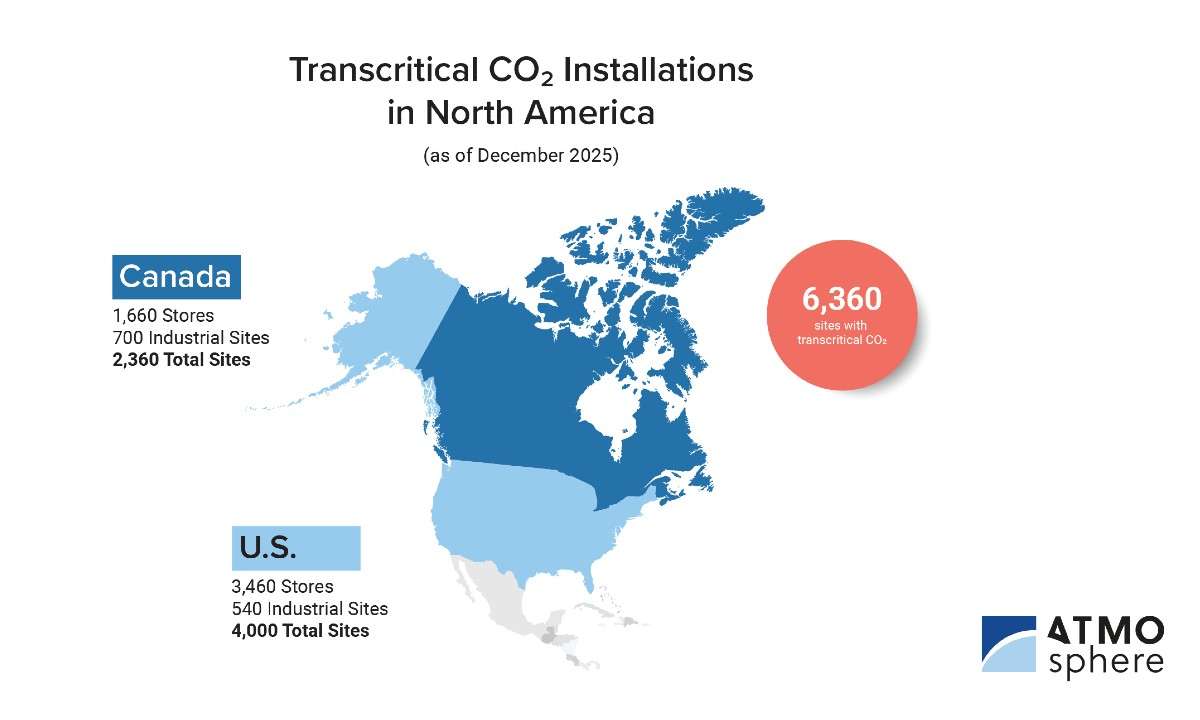
There were 6,360 food retail stores and industrial sites in the United States and Canada using transcritical CO2 (R744) refrigeration systems in 2025, a 28% increase from 2024, according to a new ATMOsphere report titled “Refrigeration: Commercial and Industrial Refrigeration with Natural Refrigerants.”
ATMOsphere, the publisher of NaturalRefrigerants.com, estimates that the North American market added 1,390 transcritical CO2 systems from 2024 to 2025. This includes 820 total sites in the U.S., underscoring continued adoption even as the U.S. Environmental Protection Agency (EPA) delayed low-GWP refrigerant requirements for new equipment from 2026‒2027 to 2032. Around 5.1 million self-contained hydrocarbon refrigerated cabinets – primarily propane (R290) models – are installed in food retail stores. The report also reveals that an estimated 1,480 sites in North America are using low-charge ammonia (R717) systems.
Several factors are driving the uptake of natural refrigerant solutions, including state-level policies in the U.S. and corporate sustainability targets. The report also examines emerging trends that could impact the industry, such as financial incentives for replacing HFC systems with natural alternatives and the increasing global concerns surrounding PFAS (per- and polyfluoroalkyl substances).
The full report can be downloaded for free here.
Commercial refrigeration
In 2025 the U.S. and Canada had an estimated 85,110 supermarkets and grocery stores, of which 5,120 (6% of total stores) used transcritical CO2 refrigeration systems, up from 5.8% in 2024. Major companies, such as ALDI US, Costco and Kroger, have selected CO2 as the primary refrigerant for new stores. Other retailers, including Loblaws and Target are also making extensive use of the technology.
As a leading adopter of natural refrigerants among North American food retailers, ALDI US has “nearly 800 stores using natural refrigeration systems,” representing about 32% of its portfolio, according to its 2024 sustainability report. In addition to CO2, the company is investing in R290 solutions, with 30 new stores using propane-based display cases and walk-ins for medium-temperature (MT) and low-temperature (LT) refrigeration, including nine “hybrid” stores with R290 cases and R448A walk-ins.
When factoring in the region’s 161,975 convenience stores, the CO2 market penetration across North America’s 246,705 retail food outlets falls to 2%, up slightly from 1.8% in 2024. By comparison, roughly 22% of convenience stores in Japan use transcritical CO2 condensing units. Still, recent developments point to growing momentum: In May 2025 Vitalis started manufacturing TEKO-branded CO2 condensing units at its facility in Kelowna, British Columbia, and Danfoss expanded its CO2 condensing unit offering in February 2025 to support both MT and LT applications.
In 2025 new builds made up 87% of commercial transcritical CO2 rack installations in North America, versus 13% for retrofits, according to ATMOsphere survey data. When it comes to the cooling capacity of the units sold, 46% of respondents said their units were under 100kW (28.4TR), while 51% said they were between 100 and 300kW (28.4–85.3TR). The remaining 3% of systems were between 300 and 500kW (85.3–142.2TR).
A range of technological and organizational developments continues to support growth in the North American market. Carel adapted its MPXPRO case controller for the U.S. market, Copeland offers a collaborative CO2 lab and openly available CO2 papers, and Zero Zone announced a new service division.
Industrial refrigeration
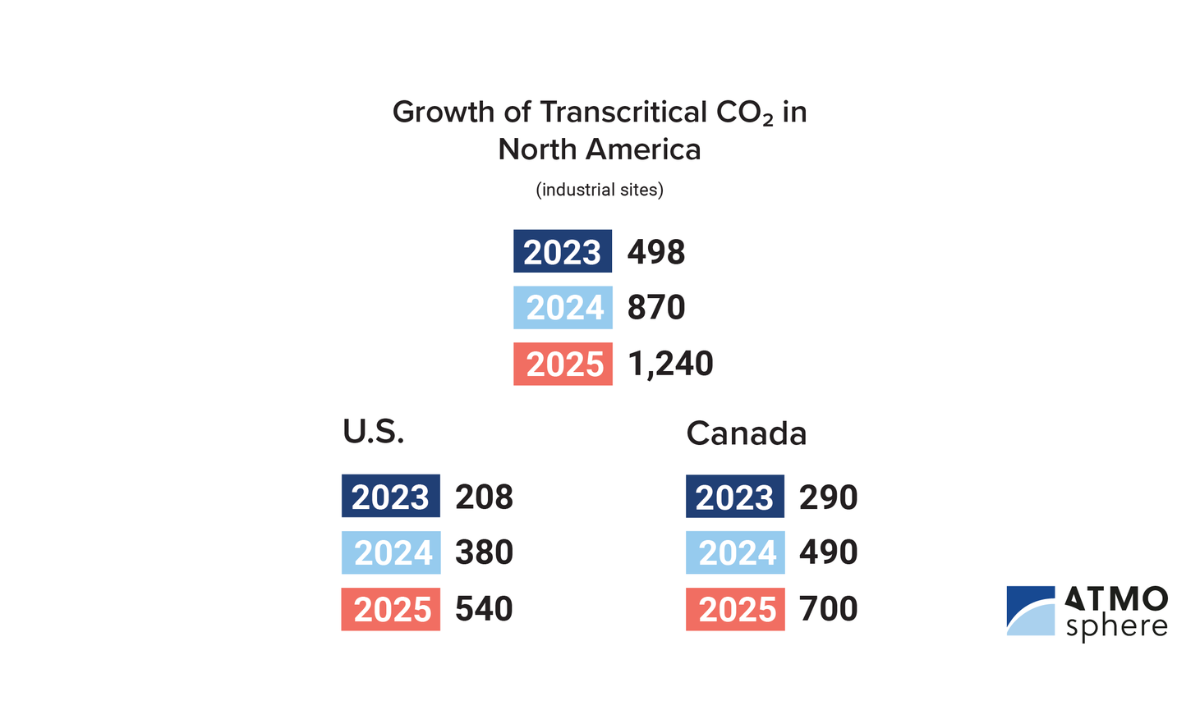
Approximately 1,240 industrial facilities in North America were using transcritical CO2 systems in 2025, reflecting a 42% year-over-year growth and a 2.5-fold increase since 2023, according to data collected by ATMOsphere. This expansion has been supported by Increased manufacturer backing, with Hillphoenix adding a new industrial CO2 rack and relative newcomer CO2 Refrigeration Systems launching a packaged skid.
In 2025 new builds made up 74% of industrial transcritical CO2 rack installations in North America, versus 26% for retrofits, according to ATMOsphere survey data. When it comes to the cooling capacity of the units sold, 69% of respondents said their units were between 100 and 500kW, while 27% said they were between 0.5 and 1MW (142.2–284.3TR). The remaining 4% of systems were under 100kW.
Approximately 1,480 industrial facilities have adopted low-charge ammonia systems, reflecting a year-over-year growth of 20% and a 1.4-fold increase since 2023. Centralized systems continue to dominate the market for low-charge ammonia systems with 1,260 installations compared to 220 with packaged ammonia units. However, packaged units see significantly faster adoption, growing 45% year-over-year compared to 17% for central systems.
Although CO2 has a higher growth rate, ammonia remains firmly entrenched in North America, with manufacturers finding ways to maximize its efficiency. Danfoss’s three-piece package NeoCharge ‒ comprising a controller, motorized control valve and sensor ‒ could save industrial refrigeration facilities up to $200,000 (€185,000) annually in energy costs.
Policies and politics
The political landscape shift in the U.S. in 2025 led to the EPA rolling back the implementation of the Technology Transition rule, one of three pillars of the AIM Act. The original rule bans HFCs in certain new equipment and sets a limit on the GWP of the HFCs in each subsector, with compliance dates ranging from 2025 to 2028. For many refrigeration uses, it sets a GWP limit of 150.
With a proposed rule issued on December 5, 2025, still under consideration, the EPA’s Office of Enforcement and Compliance Assurance said it will deprioritize enforcing the original stricter deadline. This effectively allows the industry to follow the proposed higher GWP limits while the rulemaking continues.
The new proposed rule, expected to be finalized in mid-2026, would do the following:
- Retail food: On January 1, 2027, change the GWP limit of 150 or 300 (depending on charge size and equipment configuration) to 1,400. Change the starting date for GWP limits of 150 or 300 from January 1, 2027, to January 1, 2032. The same applies to remote condensing units, except the original date was January 1, 2026, not 2027.
- Cold-storage warehouses: On January 1, 2026, change the GWP limit of 150 or 300 (depending on charge size and equipment configuration) to 700. Change the starting date for GWP limits of 150 or 300 from January 1, 2026, to January 1, 2032.
However, state-level regulations impose more stringent GWP limits, with California, New York and Washington leading the way. For example, New York employs a 20-year GWP value, with regulations setting a long-term goal of a GWP 20 no greater than 10 by January 1, 2034, effectively mandating the adoption of natural refrigerant solutions across most commercial refrigeration applications.
Another regulatory issue under development involves fluorinated refrigerants that break down into “forever chemicals” like TFA (trifluoroacetic acid), an ultrashort-chain PFAS. The Canadian government is collecting feedback on its proposal to regulate PFAS as a class, including HFOs and TFA. Maine has enacted a law that will ban PFAS refrigerants by 2040. Minnesota passed an aggressive PFAS law in 2023 and is determining whether PFAS refrigerants and other products are “essential” to avoid prohibition in 2032.