There were 5,120 supermarkets with transcritical CO2 (R744) refrigeration systems in North America (Canada and the United States) in 2025. While that’s just 6% of all supermarkets in North America, CO2 refrigeration has been growing rapidly in the sector, with installations jumping roughly 75% from 2023 to 2025.
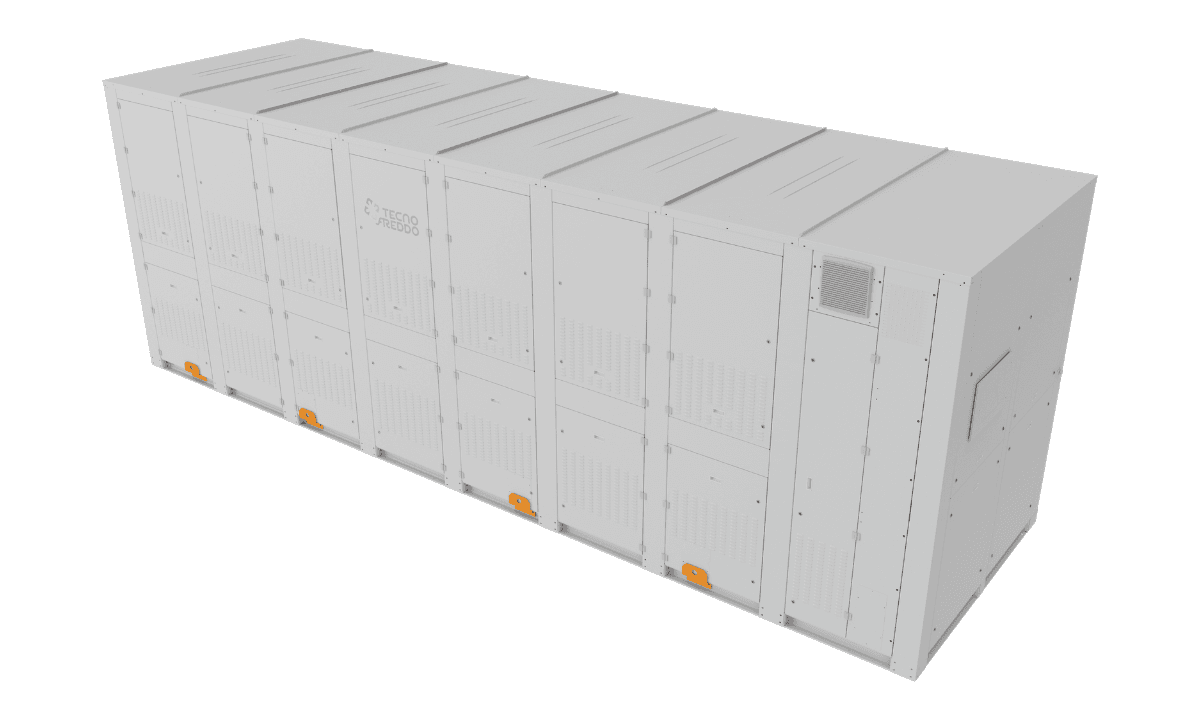
All of this growth has been driven almost entirely by racks, and the absence of CO2 condensing units (CDUs) is conspicuous given their widespread use in Europe and Japan. In 2025 there were approximately 18,000 food retail stores in Europe and 14,350 in Japan using CO2 CDUs. A further 580 industrial sites in Japan were also using the technology.
CO2 CDUs have yet to establish themselves in North America, but that appears to be changing. Several North American manufacturers have either added CO2 CDUs to their product lines or begun the UL certification process for overseas models:
- Zero Zone introduced a prototype of its CO2 CDU in 2024, with the production version launching in 2026.
- Heatcraft introduced a 15HP vertical condensing unit in 2026, the first of a new line of compact CO2 refrigeration units.
- Danfoss launched its first CO2 CDU in the U.S. for medium-temperature (MT) refrigeration applications in 2024 and expanded the line to include support for low-temperature applications in 2025.
- Hillphoenix introduced its first CO2 CDU in 2022.
- Kysor Warren Epta US obtained UL certification for its ECO2 remote CDU in 2022.
These manufacturers are meeting the demand for CO2 CDUs rather than trying to stoke it. Kysor Warren Epta US has sold 250 of its ECO2Mini CDUs since the beginning of 2026, according to Tom Wright, Vice President of Sales and Marketing.

“We anticipate sales to be equal to that for the second half of the year, with a strong demand for CO2 CDUs in the United States as CO2 replaces HFC gases,” Wright said.
Senthilkumar Shanmugam, Senior Product Manager at Hillphoenix, the North American leader in transcritical CO2 refrigeration systems, has also noticed the shift. “You can see the momentum in the market, with a number of major food retailers expanding their use of CO2, particularly in new-store development and broader natural refrigerant transition strategies,” he said.
NaturalRefrigerants.com recently spoke with Wright, Shanmugam and leaders at several other North American manufacturers about the developing market for CO2 CDUs.
All quotes have been edited for length and brevity.
Drivers and barriers
A growing familiarity with transcritical CO2 racks is serving as a driver for CO2 CDUs in North America. Aldi U.S., Target and Canadian grocer Loblaws have all committed to using natural refrigerants in new stores.
“CO2 rack systems are already widely used by several large supermarket chains,” said Ben Picker, Brand/Product Manager Lead at Heatcraft. “That makes CO2 CDUs more appealing than HFO systems for add-on or independent systems.”
In addition to new stores, CO2 CDUs can help retailers strategically transition to natural refrigerants “as expansions, remodels and new builds take place,” according to Wright. Condensing units are “an ideal choice” in small remodel projects, Shanmugam added.
“In those situations, a CO2 CDU gives the customer a relatively straightforward path to adopt CO2 in a focused, application-specific way,” Shanmugam said.
Justin Hoelscher, Product Manager of System Divisions at Zero Zone, echoed his colleague at Hillphoenix’s point. Hoelscher said uptake of CO2 CDUs is being driven by “customers who want a packaged unit to drop into an application.”

Along with simplifying the transition to natural refrigerants, CO2 CDUs can also help end users get ahead of issues with their aging refrigeration systems, according to DJ Frye, Sales Director at Danfoss. “Through load shifting, the units can mitigate service-related issues for ‘aged’ systems,” Frye said. “To boost existing capacity, CO2 CDUs can take over existing liquid subcooler loads, add subcooling capacity or both.”
Barriers to adoption include regulatory uncertainty, component costs, the limited number of qualified technicians and high-ambient conditions in parts of the country. Picker traced the issue back to early issues with CO2 refrigeration systems in North America.
“These systems had a tendency to lose charge during power outages or off-cycle maintenance,” Picker said. “Stronger components addressed these issues, but the supply chain has not caught up with demand. In many cases, a CO2 CDU can cost several times more than a comparable HFO/A2L unit.”
The U.S. Environmental Protection Agency’s (EPA) recent revision of the 2023 Technology Transitions Rule has breathed new life into the market for condensing units using f-gases. Previously, new condensing units in supermarkets had to use refrigerants with a GWP of 150 or 300 (depending on charge size and equipment configuration) starting January 2026. Under the new rule, new condensing units can use refrigerants with a GWP of 1,400, with the 150/300 GWP limits coming into force in January 2032. The 150/300 GWP limit for new refrigeration equipment in cold storage warehouses was also delayed until January 2032; new equipment can use refrigerants with a GWP of 700 until then.

Despite the U.S. EPA’s rule revision, Picker said many end users are sticking with their previous plans and committing to naturals.
“Many end users and facility operators have grown weary of the seemingly endless stream of refrigerant regulations and view current HFO alternatives as a temporary option,” Picker said. “They are looking for a long-term refrigerant strategy that provides regulatory certainty and supports sustainability goals.”
Taking on propane
The fact that CO2 CDUs are a good fit for convenience stores and small-format grocery stores without the space or need for a rack makes them potential competitors with self-contained propane (R290) cabinets. That comparison makes more sense on paper than in reality, though, per Picker.
“The cost differences between CO2 and R290 systems will keep these from truly competing anytime soon,” he said. “Alternatively, if regulations were to change to allow R290 in remote condensing units, R290 would likely become the preferred option.”

Shanmugam agreed, noting, “R290 will continue to be very effective in smaller, self-contained formats.” He added that CO2 CDUs are “well-positioned in applications where remote installation, larger load requirements and whole-building energy considerations matter more.”
Frye highlighted the capacity range where CO2 CDUs become cost competitive and market conditions favor their adoption. “From 10–15HP and higher, CO2 CDUs tend to be a very competitive applied-cost option,” Frye said, with that range equating to cooling capacities of roughly 7–17TR (25–60kW) depending on outlet temperatures.
CO2 CDUs in industrial refrigeration
In 2025 there were 1,240 industrial sites in North America using CO2 refrigeration systems. While ammonia (R717) has traditionally dominated this space, CO2 is carving out a niche based in smaller installations located closer to urban areas.
“We see relevant interest from smaller cold storage operators where ESG expectations from customers are becoming more visible,” Shanmugam said. “CO2 CDUs are being used in applications tied to cold storage, food processing and distribution environments, especially for walk-in coolers and freezers and other targeted loads where a packaged remote solution makes sense.”

These “targeted loads” can also be in facilities with existing ammonia refrigeration plants, noted Hoelscher. “While ammonia can be used for large volume spaces, CO2 CDUs are available for smaller process or storage rooms requiring more precise control of room conditions,” Hoelscher said. “These systems can be installed to work together to provide a complete solution.”
While it’s taken longer than in Europe and Japan, CO2 condensing units seem to have finally arrived in North America and are helping drive the shift to natural refrigerants in commercial and industrial refrigeration.