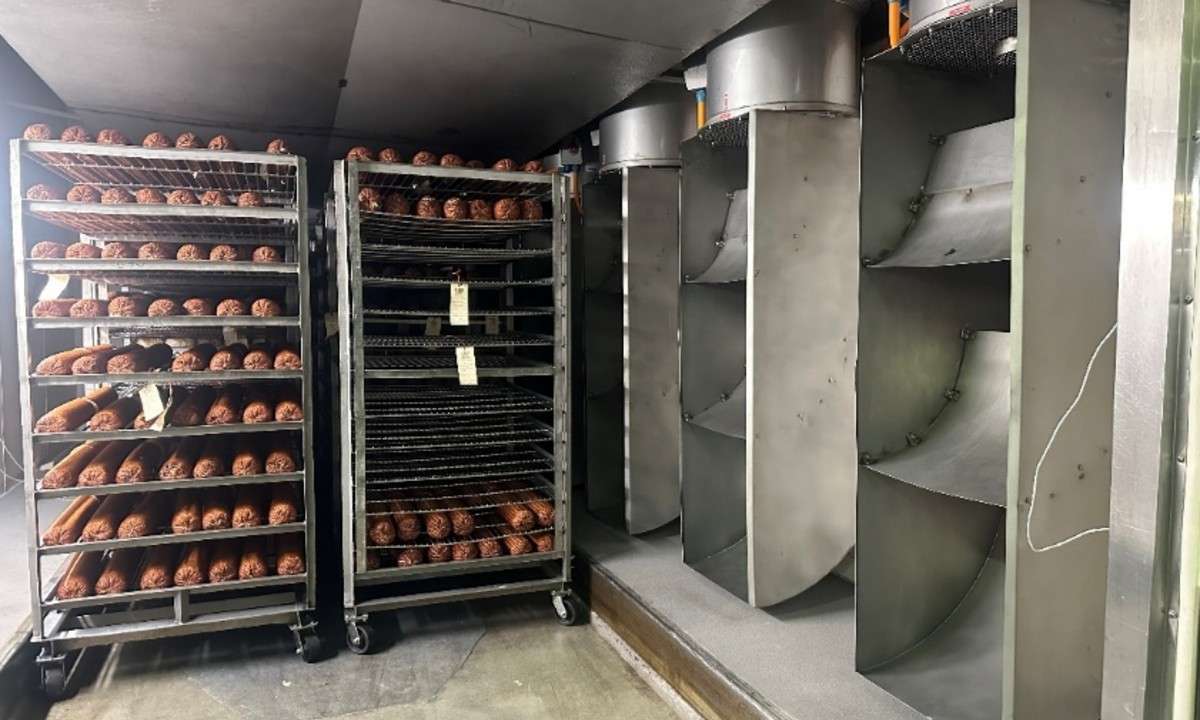
A test at the Waco, Texas, plant of food-processing giant Cargill showed that airflow diffusers directing the flow of air in a deli-meat cooling room toward turkey rolls were able to reduce the time it takes for the product temperature to reach 4°C (39°F) by two to three hours.
The study was conducted by Kushal Aurangabadkar, Engineering Manager at Cargill, and his team, in November of 2024 and described in a new internal Cargill paper provided to NaturalRefrigerants.com. Aurangabadkar, who will be discussing the study at the ATMOsphere America 2026 conference in New York in June, has been leading initiatives to improve thermal efficiency and operational throughput using ammonia (R717) refrigeration.
The study measured airflow patterns, cooling rates and heat-transfer efficiency in meat storage in two configurations, one with diffusers and one without, driven by an ammonia refrigeration system. “We looked at what we need to do to increase our efficiency and throughput at the plant,” said Aurangabadkar.
The differences in cooling behavior “can be attributed mainly to the presence or absence of diffusers and the resulting airflow pattern,” said the paper.
“We looked at what we need to do to increase our efficiency and throughput at the plant.”
Kushal Aurangabadkar, Engineering Manager at Cargill
The room in which the test took place measured 3.67 by 6.1m (12 by 20ft) and included an upper and lower rack of product, each with an upper and lower core; equipment included five 30cm (11.8in) fans, five internally designed and manufactured diffusers and an ammonia refrigeration coil supplied by an engine room with a capacity of 2,800TR (9,847kW) . The cost of upgrading the test room, including diffusers and new fan blades and motors, was $75,000 to $80,000 (€65,000 to €69,000), he said.
The Waco plant in total comprises 14 cooling rooms served by two engine rooms using ammonia as a refrigerant.
Shorter cooling time
In a comparison of the cooling rate with and without diffusers, the use of diffusers shortened product cooling time to 4°C from 68–72°C (154–162°F) by two to three hours for both the fastest- and slowest-cooling product cores, according to the paper. The use of diffusers also improved temperature uniformity between racks and between upper and lower cores, reducing the hot–cold spread from 3–4°C to 1–2°C (5.4–7.2°F to 1.8–3.6°F) late in the cycle.
Without diffusers, cooling is “relatively slow,” and the product temperature of the warmer cores “could challenge compliance if acceptance is based on the warmest point,” the paper said.

Overall, it takes from 13.5 to 15 hours for all monitored cores to cool to 4°C without diffusers. By contrast, with diffusers all cores reach 4°C in about 11 to 12.25 hours.
Aurangabadkar noted that the standard design of the facility’s cold rooms is without diffusers. Indeed, most food processors that he has observed do not use diffusers, he said.
The test room still has its diffusers, and Cargill may to add them to other cold rooms, Aurangabadkar said. “Our experiment shows there is two hours of savings. We can compound this and get more throughput in the plant.” He plans to also examine the energy saved from the shorter cooling time.