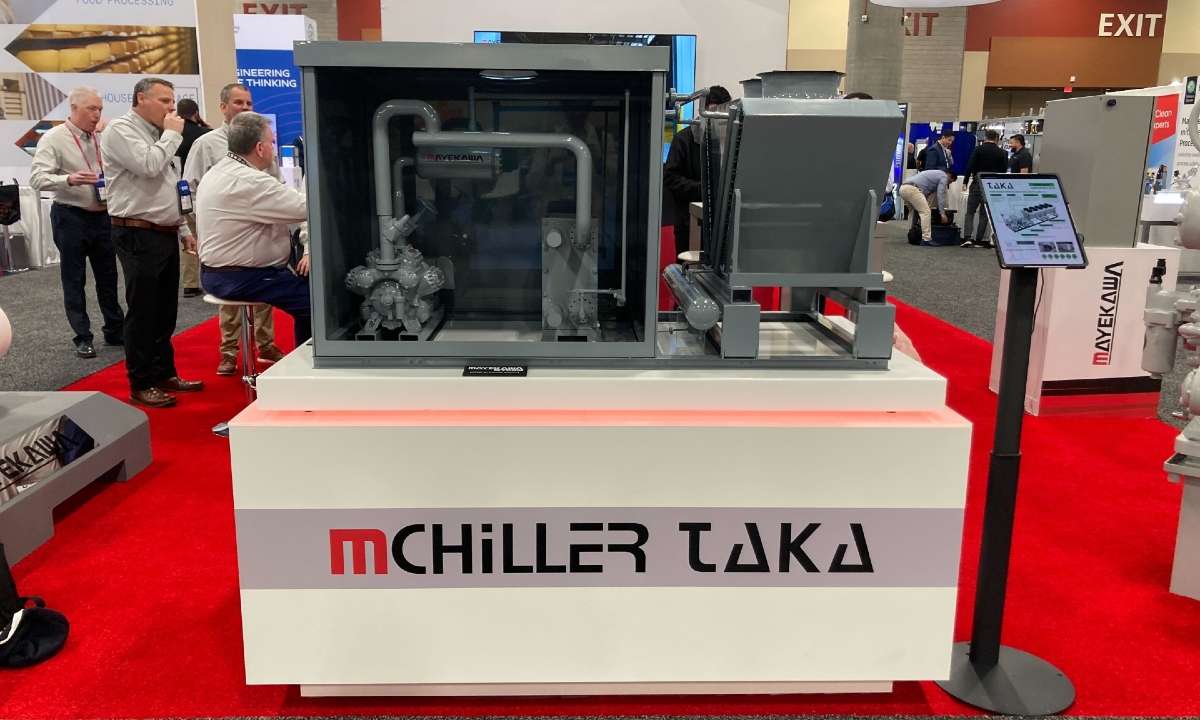
Japanese manufacturer Mayekawa has introduced its standard air-cooled ammonia (R717) chiller – the mCHILLER TAKA – to the U.S. market, showcasing a model of the unit at the International Institute of All-Natural Refrigeration (IIAR) Conference and Expo 2025.
According to Mayekawa, the low-charge ammonia chiller provides a “perfect alternative” to systems using synthetic refrigerants, offering a plug-and-play solution for industrial, semi-industrial and commercial applications, including sports complexes, data centers, process cooling and cold storage.
The chiller can deliver cooling capacities of 52–1,758kW (15–500TR) and supply temperatures of −12 to 23.8°C (10 to 75°F).
The mCHILLER TAKA has been available in the U.S. since mid-2024, a representative of the company told NaturalRefrigerants.com at IIAR 2025. Multiple units have been sold over the last six months, they added.
The unit was originally developed in Denmark and launched in Europe in 2022. The manufacturer has since updated various aspects of the technology to make it more relevant for the U.S. market, explained Allison Huck, Applications Engineer for Mayekawa USA, during a product demonstration at IIAR 2025.
Updates include reformatting of the PLC program language, converting units from metric to imperial and integrating locally-sourced components to reduce maintenance costs and system downtime, she noted. The manufacturer has also achieved UL certification and reconfigured system design to comply with U.S. codes and maintenance practices.
IIAR 2025 is currently taking place in Phoenix, Arizona, running March 2–5.
Standardized for simplicity
Mayekawa USA has been manufacturing custom-built chillers in its U.S. factories for several decades, Huck noted, adding that the TAKA range of standardized chillers was brought to the market to offer a streamlined solution.
“We were looking for a more simplistic offering for contractors that would reduce lead time and lower initial costs,” she said. “This is because the engineering is already done and proven.”
The mCHILLER TAKA is available in nine models, offering flexibility to meet diverse end-user requirements. Customers can select from three compressor options: the K-series reciprocating compressor for smaller capacities, the M-series reciprocating compressor for larger capacities or the V-series screw compressor. The chiller can also be equipped with three heat exchanger options: a direct expansion (DX) plate and frame, a flooded plate and frame or a flooded plate and shell unit.
The chiller can be further customized with the choice of either an air-cooled or adiabatic condenser from Mayekawa’s B series.
With a low operating charge of 116–310g/kW, the mCHILLER TAKA prioritizes safety with integrated ventilation, leak-detection alarms and remote monitoring. Designed for ease of maintenance, the unit features convenient access to electrical panels and components, along with straightforward power and glycol/water loop connections. Its modular design simplifies shipping, reducing costs and logistical challenges for larger systems, noted Huck.
The rise of ammonia in the U.S.
The TAKA unit is part of Mayekawa’s mCHILLER series, which also includes a water-cooled model, the FUGU. Introduced to the U.S. market in 2023, the FUGU can cover capacities of 299–1,582kW (85–450TR) for industrial and semi-industrial applications.
At IIAR 2025, Mayekawa also showcased its R717-based Plus+HEAT heat pump, a selection of its compressors – many of which are compatible with ammonia – and its ammonia-CO2 (R744) based cooling system, the NewTon.
The company’s expansion of its ammonia portfolio in the U.S. aligns with the market’s rising demand for R717 technologies. According to Natural Refrigerants: State of the Industry 2024, an annual report from ATMOsphere, publisher of NaturalRefrigerants.com, the number of industrial sites using low-charge ammonia systems in the U.S. grew by roughly 40% between 2021 and 2024, reaching an estimated 842 installations nationwide.
Mayekawa has said that it is focused on producing technologies that use natural refrigerants, including hydrocarbons, air (R729) and water (R718), in addition to ammonia and CO2.
“These refrigerants are sustainable and future proof, supporting a multitude of applications over a wide range of temperatures, from freezing [applications] to hot water supply,” said Alexander Lape, Regional Sales Manager – Central Region for Mayekawa USA, at IIAR 2025.
Founded in 1924, the Japanese manufacturer opened its first U.S. office in California in 1967. In 2022, Mayekawa USA opened a new facility in Katy, Texas, which is now the company’s North American headquarters.
“[Natural] refrigerants are sustainable and future proof, supporting a multitude of applications over a wide range of temperatures, from freezing [applications] to hot water supply.”
Alexander Lape, Regional Sales Manager – Central Region for Mayekawa USA