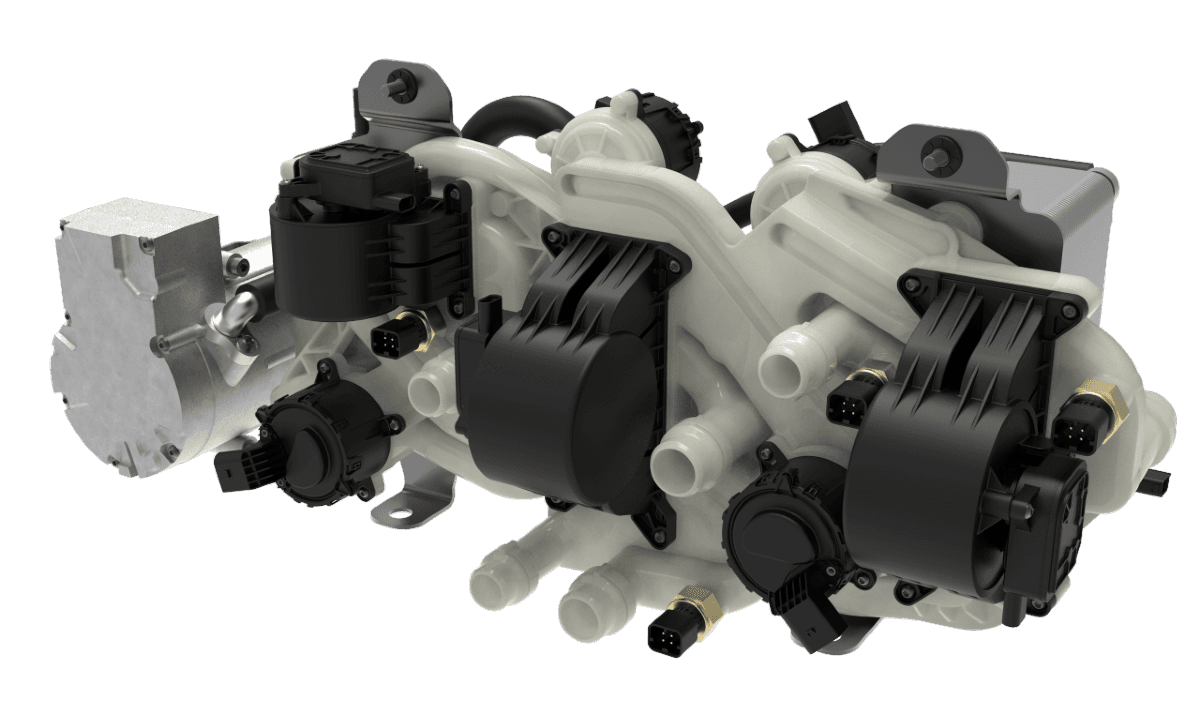
Cooling efficiency should be prioritized over heating efficiency by manufacturers of CO2 (R744) heat pumps for electric buses in the U.S. to maximize range, according to Alexander Schmig, Lead Engineer of Refrigerants and System Technologies at Trane Technologies USA.
Using simulated modeling, Schmig evaluated the annual energy consumption of CO2 heat pumps in electric buses across 18 cities, ranging from Puerto Rico to Alaska. In only two cities ‒ Fairbanks, Alaska, and Duluth, Minnesota ‒ did the CO2 heat pump require more energy to heat than cool the cabin.
Schmig presented his findings in a presentation at the 16th Gustav Lorentzen Conference, which was held at the University of Maryland from August 11‒14. During the presentation, he highlighted his findings from Minneapolis, Minnesota.
“Over a year, Minneapolis experiences an ambient temperature of 24°C [72.2°F] 20% of the time, and the energy consumed by the heat pump to cool the bus at that temperature accounts for 25% of the annual usage of the unit,” Schmig said. “At 2°C [35.6°F] ‒ experienced 18% of the year ‒ the heat pump only consumes 10% of the annual energy to heat the bus.”
“Since efficiency is the most important factor for the driving range for an electric vehicle, if you are going to produce only one product for all climate zones, based on our analysis, you should favor cooling efficiency over heating efficiency,” Schmig said.
In addition to Schmig, two other presenters also focused on efficiency in mobile air-conditioning (MAC) using natural refrigerants.
Double or single expansion: Pavel Houdek, Senior Refrigeration Engineer at Trane Technologies Czech Republic, compared the COPs of a double expansion system controlling discharge pressure and superheat in a CO2 heat pump to a single one in an electric city bus to determine if the more complex system is worth the cost. In the model, he optimized the gas cooler pressure, superheat and refrigerant charge for a variable speed compressor and found the following:
- The two systems operate similarly over a wide range of conditions. However, the double expansion system has no range restriction, whereas the single caps at an ambient temperature of 35°C (95°F).
- “The additional component regulating the compressor suction pressure may allow a wider operating range, but it carries a higher initial cost and increases the service complexity over the single expansion system,” said Houdek.
Long-distance buses: Jan Hellmuth, Research Associate Thermodynamics at Technische Universität (TU) Braunschweig, presented his research on propane (R290) and CO2 heat pumps with a focus on efficiency to support long-distance electric bus travel. His work specifically focused on systems providing cabin heating/cooling in ambient temperatures ranging from −20 to 40°C (−4 to 104°F) and battery cooling in temperatures above 25°C (77°F).
In his modeling, Hellmuth kept a steady state load case with 75kW driving power at 100km per hour (62mph) and compressor power ranging from 1.8‒16.8kW (0.5‒4.8TR) with 3kW (0.9TR) of battery cooling demand in the summer. He found:
- R744 provides superior COPs for heating and R290 for cooling.
- With R290, other safety features may be necessary, with the refrigerant requiring an additional secondary loop.
- With waste heat reclaim, the R744 system offers more flexibility but requires a more complex system.
- “We need further investigations into different regions and climate conditions to recommend the appropriate refrigerant for local use,” Hellmuth said, adding that solid-state batteries hold a promising development for electric buses.
On the market: At Busworld 2023, held in Brussels last fall, NaturalRefrigerants.com reported on several manufacturers with CO2 heat pumps for electric buses.
- A CO2 heat pump thermal management system for double-decker electric buses manufactured by German-based Konvekta was nominated for the Busworld 2023 Innovation Award.
- The Athenia ENVI CO2 heat pump produced by Thermo King, a brand of Trane Technologies, was also nominated for the Innovation Award.
- Last fall, German manufacturer Rheinmetall outlined details of its prototype R290 heat pump for electric vehicles at the ATMOsphere (ATMO) Europe Summit 2023. ATMOsphere is the publisher of NaturalRefrigerants.com. According to the manufacturer, the unit provides a 10kW (2.8TR) cooling capacity, 40% more than an equivalent-sized R1234yf compressor.
- Natural refrigerant mobile heat pumps will be the subject of discussion at the ATMOsphere MAC Summit 2024 × TU Berlin. The event, organized by ATMOsphere and the Technische Universität Berlin’s Department of Heat Transfer and Heat Conversion, will be held September 12–13 on-campus at TU Berlin.
Quotable: “Thermal management presents a key challenge for range targets of electric buses,” said Hellmuth. “Natural refrigerants remain the only option.”