The most energy-efficient warehouses operated by Mexican cold chain logistics company Frialsa are those using ammonia (R717) or ammonia/CO2 (R744) cascade systems, said Ricardo Garcia, Project Director at the company.
Of its 31 cold storage facilities (29 in Mexico and two in Peru), 22 use natural refrigerants: 13 with ammonia systems and nine with ammonia/CO2 cascade systems. The different temperatures required in each facility range from storing chocolate between 14 and 18°C (57.2‒64.4°F), ice cream at −28°C (−18.4°F) and quick freezing of palletized goods at temperatures as low as −40°C (−40°F).
“One of the great advantages we get with natural refrigerants is the quality of the cold,” Garcia said. “Quick freezing a batch of bakery products requires a large thermal load. With the ammonia/CO2 systems, we can freeze batches fast.”
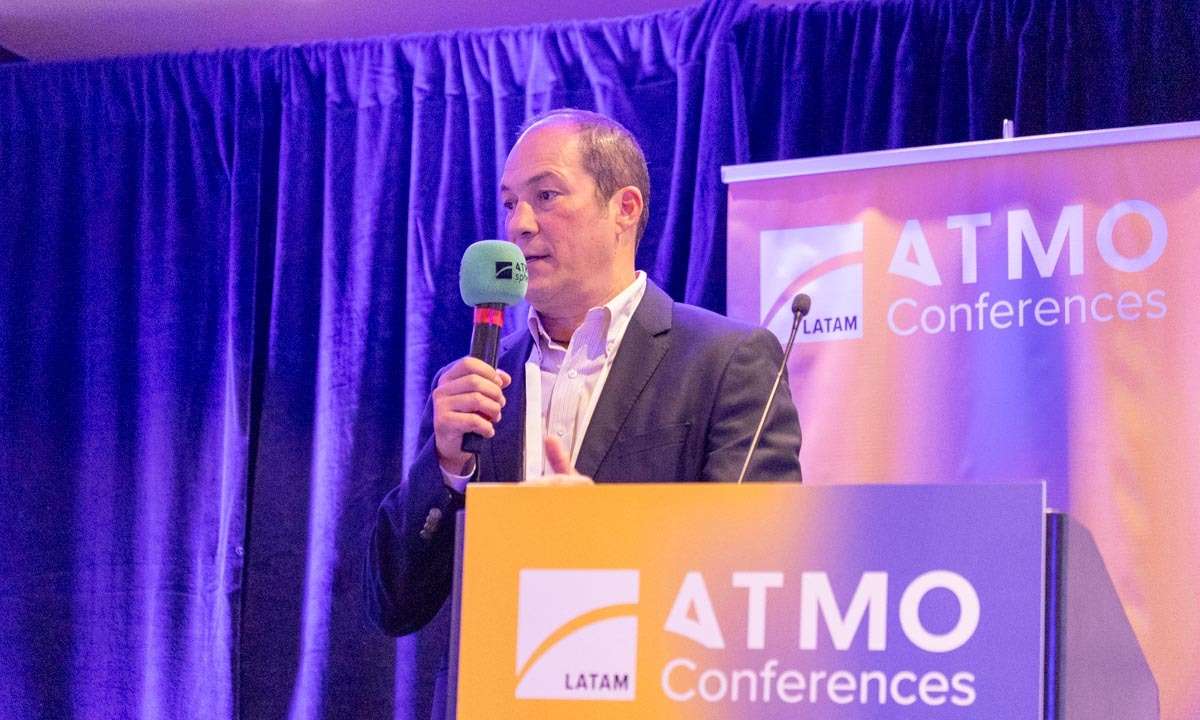
Garcia outlined Frialsa’s journey toward net zero, including its natural refrigeration systems, as part of a keynote address that kicked off ATMOsphere (ATMO) LATAM 2025. The event was held February 19‒20 in Mexico City and was organized by ATMOsphere, publisher of NaturalRefrigerants.com.
Frialsa, founded in 1983, first used natural refrigerants in its operations in 2010, with its largest facilities accommodating up to 40,000 pallets. In a presentation at ATMO LATAM 2023, Garcia reported that the company found an ammonia compressor used roughly 25% less energy than an R404a compressor.
In a 2017 interview with Accelerate ‒ published by shecco (now ATMOsphere), Garcia said that for large batch freezing, the ammonia/CO2 cascade system provides 15‒20% greater energy efficiency than ammonia alone, with savings depending upon the local electricity rates. “The lower the temperature, the greater the energy savings,” he remarked.
“With the ammonia/CO2 systems, we can freeze batches fast.”
Ricardo Garcia, Project Director at Frialsa
Considerations
According to Garcia, Frialsa’s first consideration when installing a new refrigeration system is security and safety, followed by efficiency and sustainability. Ammonia and CO2 support its efficiency and sustainability goals. However, the two refrigerants come with some disadvantages.
Obtaining a government-required permit for ammonia with its toxicity or CO2 with its high working pressure can be problematic, he explained, with authorities not understanding the complexities of the systems nor the built-in safety measures. Getting approval for natural refrigerant systems in industrial parks is especially difficult.
High water consumption is another issue for these systems in arid regions. “If we want to cool a large industrial system with only air, the condensers become very large and consume too much energy,” he said. The company has configured a system combining air and evaporative condensing using collected rainwater or treated wastewater from the company’s reverse osmosis plant in Monterrey, Mexico. “In high ambient temperatures, we use water and air. When the temperature goes down, we only condense with air,” he said.
Another issue pointed out by Garcia is the availability of qualified personnel to install, maintain and service equipment. “Properly installed systems with no leaks reduce installation costs, and consistently trained staff keeps the system operating efficiently and safely,” he said.
At this time, Friasla does not use transcritical CO2 systems in its operations. “Transcritical CO2 easily maintains storage temperature, but in our climate, it’s not efficient enough to meet our [fast] cooling needs,” Garcia said.
Frialsa obtains 50% of its power from renewable resources, including solar panels installed on 26 of its facilities and the acquisition of energy from a wind farm in Oaxaca, Mexico. “We hope the government will increase the allowable solar panel limit per roof, which right now is maximized at 500kW alternating current,” Garcia said. “We want to power our facilities with 100% clean energy.”