Australian HVAC&R contractor MB Group has installed more than 50 CO2 (R744) systems across the country as of May 2025, according to Director Christopher Paulson.
The systems – including transcritical booster racks, chillers and heat pumps – have been deployed in a range of facilities, from supermarkets and refrigerated warehouses to breweries and food-processing sites, highlighting the technology’s versatility, he noted. MB Group’s first CO2 project was in 2018, when it installed a transcritical integrated HVAC&R system at a Ritchies IGA supermarket in Beechworth.
“There’s a bright future in natural refrigerants, and it’s a very interesting segment of the market to be involved with,” he said. “If you are a contractor and you’re willing to learn, there’s a phenomenal amount of opportunity in the space.”
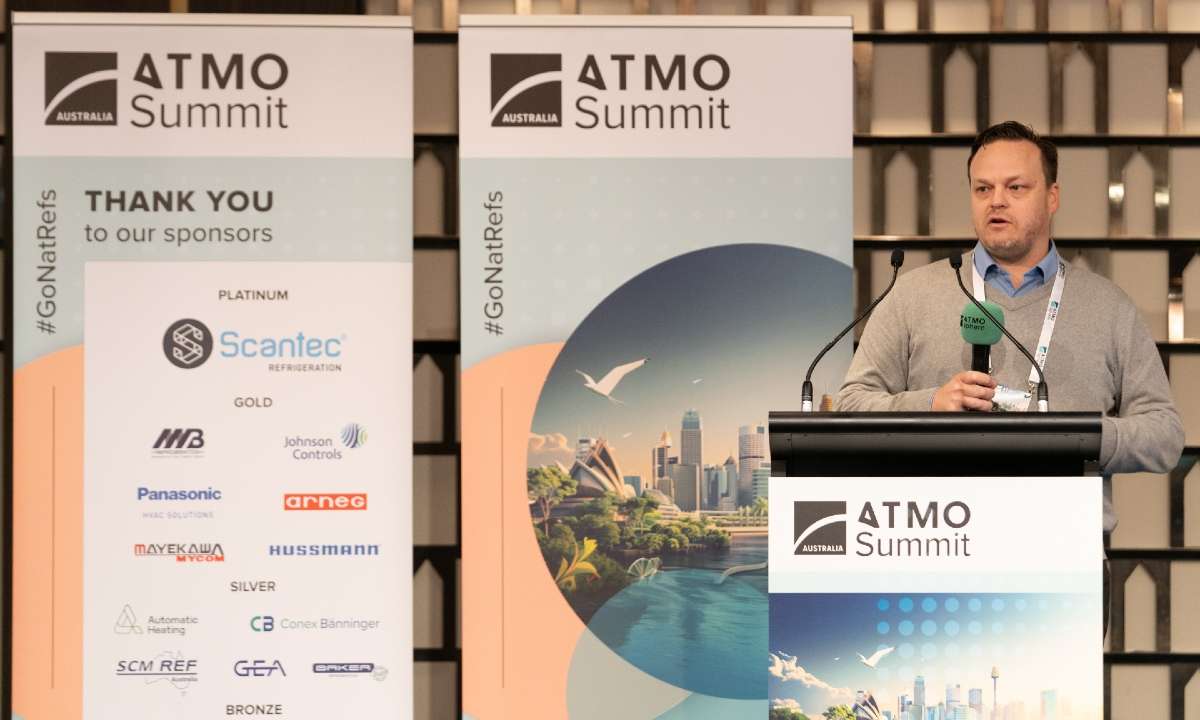
Paulson shared details of these installations and highlighted areas of emerging opportunities for CO2 systems in Australia during a presentation at the ATMO Australia Summit 2025. The event, which was held May 12–13 in Sydney, was organized by ATMOsphere, publisher of NaturalRefrigerants.com.
“There’s a bright future in natural refrigerants, and it’s a very interesting segment of the market to be involved with.”
Christopher Paulson, Director of MB Group
Emerging opportunities
Although CO2 and other natural refrigerants are gaining traction in Australia, adoption still lags behind other markets like Europe and Japan.
There are several applications that could benefit from CO2 HVAC&R systems, noting that the refrigerant “definitely has a place in the market,” Paulson said.
CO2 is proving to be a cost-effective and efficient technology for the industrial refrigeration sector, including cold storage. It can offer lower capital and operational expenditure than many existing alternatives, he explained. It can also supply various temperatures with a small footprint and is non-toxic and non-flammable.
There’s increasing interest in using CO2 systems for hot-water applications up to 100°C (212°F). According to Paulson, R744 is particularly well-suited for single-pass high-lift heating, such as lifting municipal water from 18°C (64°F) to 90°C (194°F) for washdown and cleaning in food and dairy facilities.
“Anywhere you’ve got a hot water requirement under 100°C, CO2 becomes a very compelling offer,” Paulson said. “It’s hard to beat CO2 for that application.”
Interest is also growing in natural refrigerants for data-center applications, with MB Group currently working with one of Australia’s largest telecommunications providers to trial CO2 and propane (R290) chillers. The company is pursuing ISO accreditation to support work in this sector.
“They’re specifically asking for naturals on this,” he said. “They’re not looking at anything else, and we’re not offering anything else.”
While CO2 air-conditioning is viable – especially where it can be integrated into supermarket refrigeration systems – Paulson noted that R290 may be a better fit in certain standalone applications.
“Anywhere you’ve got a hot water requirement under 100°C, CO2 becomes a very compelling offer. It’s hard to beat CO2 for that application.”
Christopher Paulson, Director of MB Group
Overcoming challenges
Despite its potential, CO2 adoption still faces hurdles in Australia, such as a lack of awareness among industrial end users or prohibitive upfront costs for systems with a capacity of less than 50kW (14.2TR). Paulson noted that the cost of CO2 technologies will likely come down as more manufacturers introduce more products to the market.
For heating applications requiring temperatures above 100°C, CO2 is not yet suitable, limiting its use in processes like drying or steam generation.
For propane, inconsistent regulations across Australian states pose a challenge to broader deployment.
“It would be nice to see some type of harmonized regulatory environment so that we can address projects consistently across the country,” he said.
Domestic manufacturing
Founded in 2007 as JLM Refrigeration, the company originally operated as a contractor, installing systems manufactured by other companies. However, in 2021, following disruption to the global supply chain during the COVID-19 pandemic, the company – now called MB Group – began to design and manufacture in house.
“It became easier, more economical and more predictable for us to purchase components and begin to do design and fabrication ourselves, as opposed to relying on overseas suppliers with very long lead times,” Paulson noted. “You wouldn’t think there would be a CAPEX advantage manufacturing [in Australia], but there is.”
The majority of the 50 CO2 systems MB Group has installed have been designed and manufactured at the company’s Bayswater facility. While the company also works with propane, it does not yet manufacture these products in house. Instead, it opts to import systems from European manufacturers.
MB Group has also recently expanded into servitization, offering full service contracting across the lifespan of an asset, including maintenance and performance guarantees.
“There is a strong and growing interest in this offering,” Paulson said.