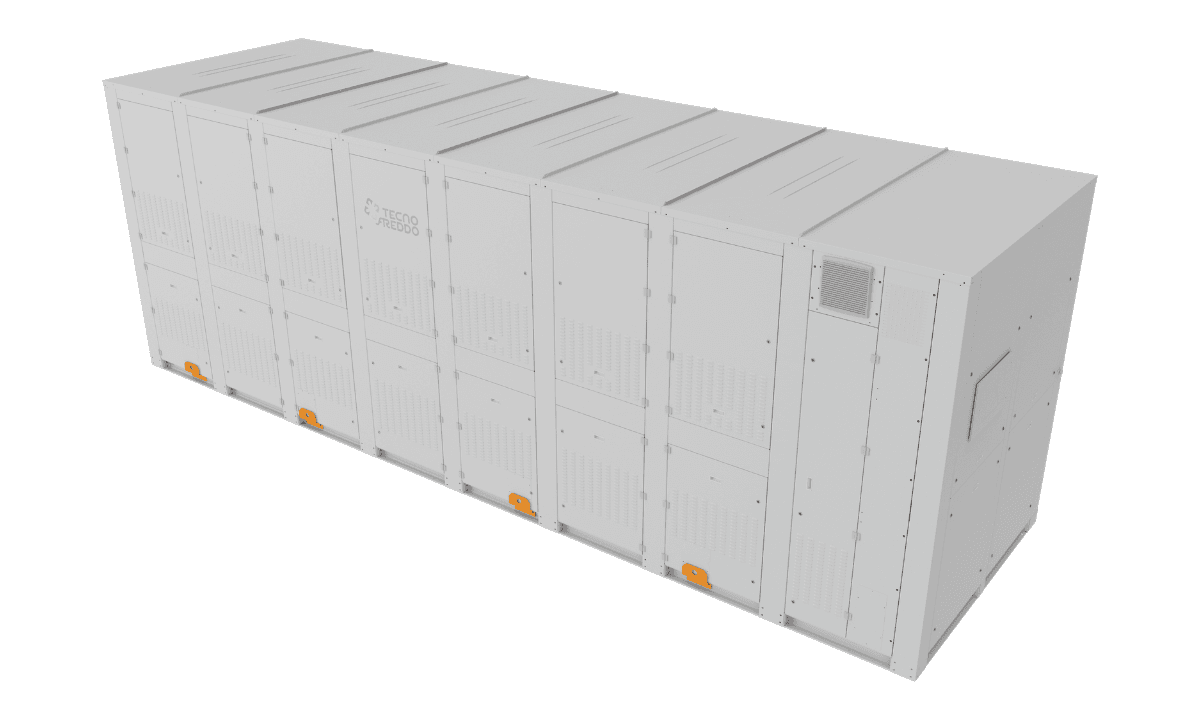
Working with Californian Hanabi Lager Company, Pro Refrigeration is testing the viability of a CO2 (R744) chiller for small breweries and determining its potential return on investment (ROI) by comparing it with an R454C chiller operating at RD Winery.
Pro Refrigeration installed a roughly 20.8TR (73TR) CO2 system, powered by two 25HP Dorin compressors, at Hanabi’s facility in Napa Valley. The system, commissioned in May, produces ice water at 32°F (0°C) and maintains a glycol reservoir between 18 and 25°F (−8 and −4°C), with heat recovery supplying water at up to 180°F for brewery processing and sanitation. The trial, originally scheduled to conclude in late October, will now extend into January 2027 to accommodate the brewery’s production schedule and allow additional time for data collection.
“Because we have both cooling and heating needs, we were really interested in working with Pro and their CO2 system to take the waste heat – which, with other chillers, is typically just released into the atmosphere – and use it to make hot water,” said Nick Gislason, Owner and Founder of Hanabi Lager. “Otherwise we would have to use fossil fuels to produce hot water.”
Pro Refrigeration developed its first CO2 chiller for process cooling and hot water generation in 2021 with support from South African consulting firm Future Green Now. After testing the unit in a California dairy farm, the company launched its 100HP ProGreen CO2 chiller, with a cooling capacity of up to 1,829,000BTUH (152.5TR/536kW).
Equipment development: The brewery presents an opportunity for Pro Refrigeration to develop new CO2 equipment, including a smaller-capacity unit tailored to the brewing industry.
- Unlike dairies, with repeatable load profiles, breweries experience highly variable, rapidly changing heating and cooling loads, creating challenges for flow control and system standby times.
- The new unit features a Thermaline gasketed plate heat exchanger, allowing the brewery to circulate descaling chemicals through it for sanitary cleaning without disassembling it. Pro Refrigeration now offers the sanitary heat exchanger as a standard upgrade across all its chiller lines.
- Pro Refrigeration has also incorporated a new pad design with a wet mesh surface to precool ambient air entering the adiabatic gas cooler.
The performance: Based on just under a week of live operating data for the CO2 chiller, Pro Refrigeration reported a COP of 3.65 in mid-August, with an average ambient temperature of 70°F (21°C).
- The system produced a total cooling output of 250,000BTUH (20.8TR/73kW), supporting simultaneous cooling of nine tanks, each holding a 7bbl (217gal/819L) batch of beer, from 50 to 43°F (10 to 6°C), according to Sergio Romero, Refrigeration Engineer at Pro Refrigeration.
- Without switching the system into heat mode, it had 327,000BTUH (27.3TR/96kW) of available heat-recovery capacity, with the potential to heat 474gal (1,794L) of water per hour from 71 to 154°F (22 to 68°C). This is based on the gas cooler operating with an inlet temperature of 163°F (73°C) and an outlet temperature of 77°F (25°C).
- With the system’s potential heating capacity, Gislason plans to replace the 60bbl (1,860gal/7,040L) tanks with 200bbl (6,200gal/23,500L) tanks, according to Jim Weatherwax, Regional Sales Manager at Pro Refrigeration. Doing so will “create enough hot water for the whole facility,” Weatherwax added.
Comparison notes: Hanabi Lager and RD Winery operate in the same communal space shared by more than a dozen beer, cider and wine producers. The CO2 system was installed two weeks after the R454C chiller.
- The CO2 system costs roughly $100,000 (€85,800) more than the R454C unit.
- However, the R454C chiller does not provide hot water. The synthetic system does not operate at a high enough temperature for effective waste heat recovery, according to Pro Refrigeration Co-Founder and CEO Jim VanderGiessen Jr.
- In the coming months, the trial will directly compare the electricity consumption of the two systems when cooling the same tank of water. “How different is the efficiency of a CO2 chiller compared to a synthetic one in terms of kilowatt of cooling per kilowatt of electricity?” It is a question Gislason regularly gets and wants to answer with hard data.
Quotable: “The performance shows a clear story from the kilowatt usage,” Gislason said. “Our ambient losses are relatively small with respect to the production needs. That gives me confidence that the system is not unnecessarily burning a lot of electricity.”
“The performance shows a clear story from the kilowatt usage. Our ambient losses are relatively small with respect to the production needs. Nick Gislason, Owner and Founder of Hanabi Lager