Roof-mounted heat rejection panels, produced by California-based Skycool Systems, provide pre-cooling for CO2 (R744) refrigeration systems to cut transcritical operation during high ambient temperature conditions, said company Co-Founder and CTO Eli Goldstein.
According to Goldstein, an optical film on the panel ‒ developed by Stanford University and vetted by the U.S. Department of Energy ‒ reflects solar energy and emits heat in the form of infrared light back into space. A closed water/glycol loop connects the panels to the refrigeration system via a heat exchanger.
“Passive cooling with the panels can improve system efficiency by 15‒20% compared to mechanical subcooling,” Goldstein said. “With CO2 systems, the panels reduce the hours spent in transcritical operation by 50‒100%, depending on the conditions.”
Goldstein detailed the technology and its performance data at the 2024 Food Industry Association (FMI) Energy and Store Development Conference, held September 23‒26 in Baltimore, Maryland.
“Passive cooling with the panels can improve system efficiency by 15‒20% compared to mechanical subcooling.”
Eli Goldstein, Co-Founder and CTO Skycool Systems
Target studies
Working with the U.S.-based retailer Target, Skycool collected performance data at two Texas hypermarkets equipped with CO2 refrigeration systems using adiabatic gas coolers to compare the time spent in transcritical operation with and without the panels.
At the new La Cantera store in the suburbs of San Antonio, the temperature reached 102°F (38.9°C) on two separate days in 2023. The seasonal afternoon humidity in that area averages 50%. Without the panels on August 25, the CO2 system operated transcritical for five hours. On September 8, it never went into transcritical operation, with the panels reducing peak discharge pressures.
“When the panel array was off, the system energy use peaked at 76kWh,” Goldstein said. “With the array on, it peaked at 69kWh.”
Goldstein also compared two days in 2023 when the temperature reached 102°F at the recently CO2-retrofitted Katy store in the suburbs of Houston, where the afternoon seasonal humidity averages 60%. Without the panels on August 13, the system operated transcritical for 13.5 hours. With the panels on September 7, it operated transcritical for 10 hours, a 26% reduction.
“The ability for the panels to reduce transcritical operation varies depending on the conditions and the refrigeration controls,” Goldstein said, adding that the plotted data over a year for the Katy store indicates the panels cut transcritical operations by over 50% at ambient temperatures above 90°F (32.2°C).
Panel array logistics
Goldstein shared data collected by a third party in an observation study conducted in Death Valley, California, comparing the ambient air temperature and the surface temperature of the Skycool film to a reference box. The ambient temperature peaked around 115°F (46.1°C), with the surface of the reference box at 143°F (61.7°C) and the film at 105°F (40.6°C).
“The material is so reflective, it is cooler than the air temperature,” Goldstein remarked. “However, the technology doesn’t work well in environments with a lot of fog or rain like in Seattle, [Washington].”
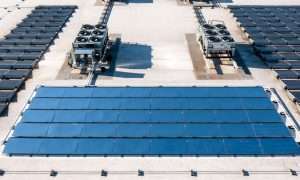
Each 3.7 × 7ft (1.1 × 2.1m) panel, modeled after a commercial solar panel, weighs roughly 30lbs (13.6kg). A small-scale water pump circulates the water/glycol loop from the array to the refrigeration system with a low mass flow rate of one liter per minute.
An array installation typically takes 3‒5 days without disrupting store operations. The only interruption in the refrigeration service comes with the installation of the brazed plate heat exchanger, which requires a minimal rack downtime of two hours.
According to Goldstein, systems require one to two panels per metric ton of refrigeration to provide sufficient subcooling. “On average, 1°F [0.6°C] of additional subcooling improves refrigeration efficiency by 0.5‒1%,” he said.
“A 600,000btu/hr [175kW/50TR] rack requires a heat rejection area of 1,500 to 3,000ft2 [140 to 280m2] or the equivalent of 50 to 100 panels,” Goldstein said. “The economic break-even point for the cost of the panel array compared to the extra compressor load from mechanical subcooling comes for systems requiring over 60 panels.”
A representative from Target indicated that the Skycool array fits well on a store’s roof between the existing solar panels and the HVAC system. The tilt of the panels provides self-cleaning in rainy conditions. In desert locations, the panel requires more regular maintenance, with cleaning requirements similar to those of solar panels.
According to Goldstein, the reflective film on the panels lasts for 10‒15 years, depending on the UV light concentration of the location. In Phoenix, Arizona, he said to expect 10 years; in Ohio, it is closer to 15. The plumbing of the water/glycol loop has a longer life expectancy. However, Goldstein said that since the film is basically a sticker, it is easy to replace the reflective panel.
Supporting transitioning to NatRefs
Goldstein noted that the Skycool panels also support synthetic refrigerant systems through pre-cooling or desuperheating to increase condenser capacity, especially for undersized or aged equipment.
In a Roseville, California, store with an R404a system, the panel array provided 40kW (11.4TR) of heat rejection to the condenser circuit to increase the condenser capacity by 35% and lowered discharge pressure by 35psi (2.4bar) on average on a day when the ambient temperature reached a high of 102°F.
Manufacturers exhibiting at the FMI conference told NaturalRefrigerants.com that CO2 refrigeration is gaining traction in the U.S. retail sector. This is driven in part by the U.S. Environmental Protection Agency’s final “Technology Transition” rule limiting the GWP in new refrigeration equipment to 150 with compliance dates ranging from 2025‒2028 and its recently released final rule for HFC management.
The Skycool panels support switching to natural refrigerant systems and give retailers the flexibility to schedule it in a way that makes economic sense, Goldstein indicated.
“You can easily switch a store using a synthetic to CO2 and keep the panels operating with the new system by putting in a new heat exchanger designed for the natural refrigerant,” Goldstein said. “
According to its website, Skycool Systems, founded in 2016, has reflective panel systems operating in grocery outlets, convenience stores and data centers.
“You can easily switch a store using a synthetic to CO2 and keep the panels operating with a new heat exchanger.”
Eli Goldstein, Co-Founder and CTO Skycool Systems