The market penetration of natural refrigerants in commercial and industrial applications across parts of Asia, including China, Japan, South Korea and Southeast Asia, is outlined in ATMOsphere’s new report “Refrigeration: Commercial and Industrial Refrigeration with Natural Refrigerants.”
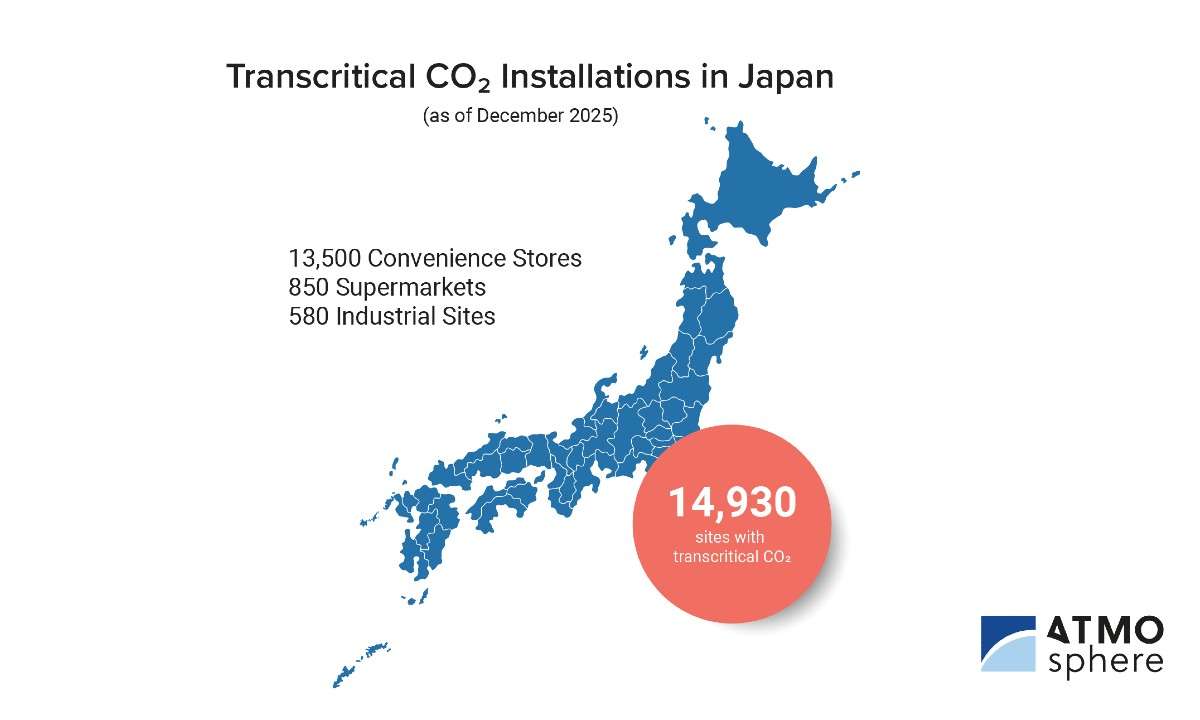
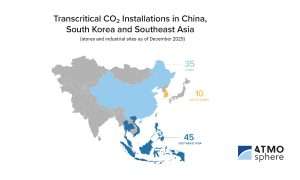
As of December 2025 there were 14,930 total transcritical CO2 (R744) installations in Japan: 13,500 convenience stores, 850 supermarkets and 580 industrial facilities. In China ATMOsphere estimates that there are 35 sites using CO2 refrigeration, 25 stores and 10 industrial facilities. Estimates for South Korea include four stores and six industrial sites, while Southeast Asia had an estimated 45 CO2 installations across stores and industrial applications. ATMOSphere is the publisher of NaturalRefrigerants.com.
Japan continues to lead the region in adopting CO2 refrigeration solutions, backed by government subsidies and domestic manufacturing. ATMOsphere estimates that the Japanese market added 2,680 transcritical CO2 systems between 2024 and 2025, reflecting a nearly 22% year-over-year growth and a 1.8-fold increase since 2023.
The full report can be downloaded for free here.
The Japanese market
Across convenience stores and supermarkets, Japan had an estimated 77,450 food retail outlets in 2025. Transcritical CO2 penetration in this segment reached 18%, up from 16% in 2024, with condensing units accounting for the majority of systems.
In 2025 roughly 13,500 of Japan’s 56,000 convenience stores ‒ around 24% ‒ used transcritical CO2 refrigeration, up from 20% in 2024. Leaders in the sector include Lawson, with 56% of its 14,600 stores using CO2 refrigeration, followed by Family Mart, with 9% of its 16,407 stores using CO2, and 7-Eleven, with 7% of its 21,883 stores featuring CO2 refrigeration systems.
Among the country’s 21,450 supermarkets, 850 used transcritical CO2 refrigeration, representing a 4% market penetration rate, up from 3.5% in 2024. AEON leads the sector in natural refrigerant adoption, with 21% of its 8,000 food retail and drugstores equipped with such systems.
There were an estimated 580 industrial sites (mostly cold storage facilities) using transcritical CO2 systems (mostly condensing units) in Japan’s industrial refrigeration sector, up 23% from the reported 470 in 2024. Transcritical CO2 continues to make inroads in industrial refrigeration, particularly in ammonia/CO2 secondary cooling systems.
The Japan Association of Refrigerated Warehouses (JARW), representing approximately 90% of the industry, conducts an annual survey of its members’ refrigerant use. For 2024, 52.1% of respondents reported using natural refrigerants, up slightly from 51.4% in 2023. A total of 36.4% of operators use ammonia/CO2 secondary systems, 7.6% used ammonia systems, and 7.8% used transcritical CO2.
Financial incentives and domestic manufacturing
Financial incentives continue to support Japan’s transition to natural refrigerants. In 2025 Japan’s Ministry of the Environment (MOE) allocated ¥7 billion (€38 million/$44 million) for natural refrigerant subsidies, covering up to one-third of installation costs for “large companies” and up to 50% for small businesses. In Tokyo food retailers, convenience stores and drug stores that are installing non-fluorocarbon refrigeration equipment are eligible for a Tokyo Metropolitan Government subsidy, which can be used in conjunction with the MOE grant.
Domestic manufacturers supporting the expansion of natural refrigerants in the market include Panasonic, Mayekawa and Nihon Netsugen Systems (NNS). In 2025 Panasonic introduced two new products: a 10HP side-flow CO2 condensing unit and EFRIO, a propane (R290) flat refrigerated showcase with glass doors. Mayekawa extended the operating range of its COPEL CO2 transcritical condensing unit to −50°C (−58°F), enabling applications for brine coolers. Regarding market growth, Katsuhiko Harada, President of NNS, projects the company’s CO2 sales will increase from 120 units sold annually to 150‒160 units in the coming years.
Emerging Asian markets
China’s large refrigeration manufacturing base and evolving policy framework create strong long-term potential for the uptake of CO2-based solutions. Transcritical CO₂ has been in the country’s food retail sector since 2015, although early adoption of CO2 as a refrigerant included cascade/secondary systems using HFCs and ammonia. International retailers, including Tesco and METRO, were the early drivers.
Key manufacturers in the region include Haier Carrier and the Bingshan Group, which is co-owned by Panasonic holdings. In January 2026 Haier Carrier announced the completion of China’s first automated production line for CO2 racks, which is estimated to increase its production capacity eightfold. Bingshan’s CO2 projects in China consist of two ice rinks, one Nestlé cold storage facility, six projects with retailer Sam’s Club, one Chaoshifa supermarket and outdoor condensing units at two Lawson convenience stores as of May 2024.
In South Korea an estimated four stores and six industrial sites are using transcritical CO2 refrigeration systems. Copeland is supporting the nascent sector through a partnership signed in August 2024 with the South Korean commercial manufacturer CRK as part of a “large-scale government project” to develop sustainable CO2 cold chain technologies in the country. Copeland will share with CRK its technical expertise, along with integrated CO2 compressors, controls and monitoring systems.
In the report, Southeast Asia is defined as Brunei, Cambodia, Indonesia, Laos, Malaysia, the Philippines, Singapore, Thailand and Vietnam. The majority of the region’s 45 CO2 installations, across both food retail and industrial applications, were in Malaysia and Indonesia.