In 2024, Europe had an estimated 300,000 food retail outlets, of which 30% used transcritical CO2 (R744) refrigeration systems, according to Natural Refrigerants: State of the Industry 2024, a new report from ATMOsphere, publisher of NaturalRefrigerants.com.
In total, 90,700 supermarkets, grocery stores and convenience stores used transcritical CO2 refrigeration systems, which includes racks and condensing units, up from 68,500 (22.9% of all stores) in 2023. The report classifies Europe as the continent up to the Turkish border, including Iceland and the European part of Russia.
In addition, it’s estimated that there are 17 million self-contained hydrocarbon refrigerated cabinets installed in food retail stores across Europe, the majority of which use propane (R290).
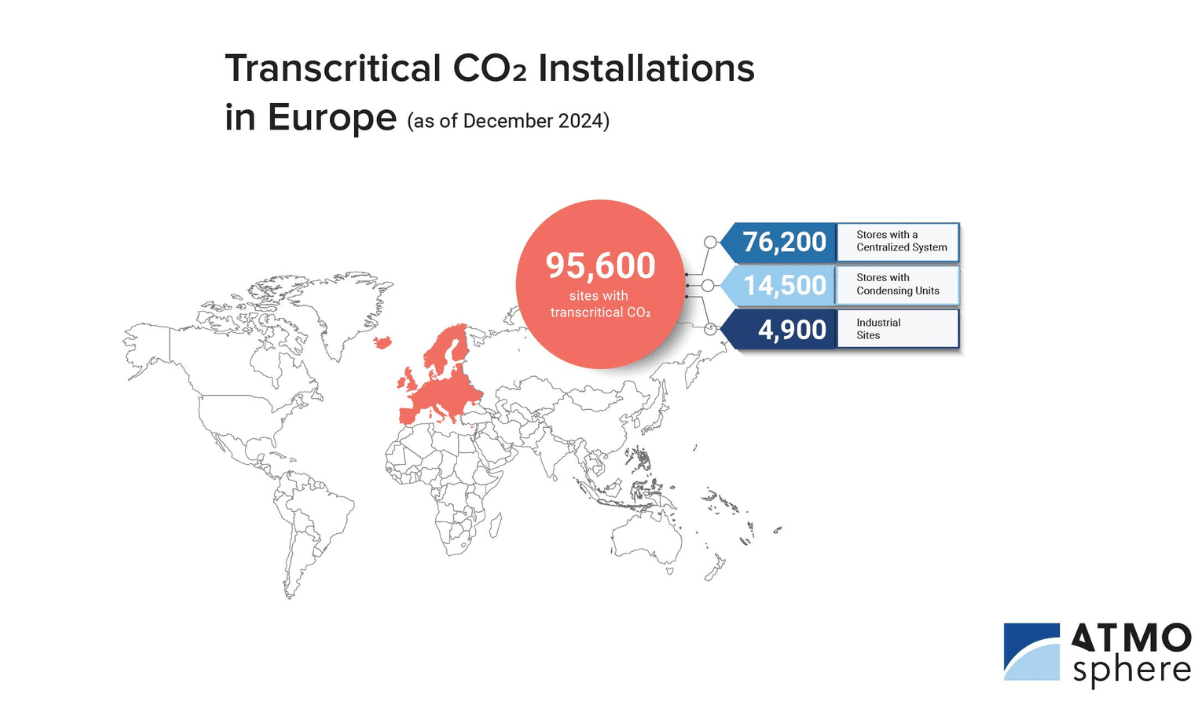
Along with commercial installations, the report also covered the industrial sector where there were 4,900 sites using transcritical CO2 systems, 3,600 with low-charge ammonia systems and 6,650 operating hydrocarbon-based chillers, the majority of which use propane.
The full report can be downloaded for free here.
Commercial refrigeration
The number of CO2 centralized systems (racks) in European retail supermarkets went from 60,000 in 2023 to 76,200 in 2024, a gain of 27%. Major retailers embracing this technology include Carrefour and ALDI Nord and ALDI Sud.
In its 2022 climate plan, Carrefour estimated that refrigerants accounted for 34% of its CO2e emissions. Its goal is to reduce refrigerant use emissions 50% by 2030 and 80% by 2040 in reference to its 2019 emissions. It will do this by replacing refrigeration systems using f-gases with ones using CO2.
In a presentation at the ATMOsphere (ATMO) Europe Summit 2024, held in November in Prague, Czech Republic, Jan Geeraerts, Head of Engineering at Carrefour Belgium, said 30% of the company’s franchised stores use CO2 systems and that the plan is to transition all locations to CO2 by 2030.
In 2023, ALDI Nord reported that all its freezers and 20% of its refrigeration units had already been upgraded to natural refrigerants, along with four of its seven distribution centers. In its 2022 Climate Action report, Aldi Sud said it would switch to natural refrigerants with a GWP of less than 4 – CO2 has a GWP of 1, and propane has a GWP of 3 – from 2024 to reduce its refrigerant emissions.
In 2024, there were 14,500 condensing units installed in European food retail stores, a jump of 71% from 8,500 units in 2023. Japanese HVAC&R manufacturer Panasonic, the leading supplier of CO2 OCUs in Japan, acquired Polish manufacturer Area Cooling in July 2024, giving it a condensing unit factory in Europe. Since bringing its 2HP CO2 OCU to Europe in 2017, Panasonic has sold 4,000 units, with supermarket demand accounting for more than 50% of its sales since 2023.
In Europe, new stores made up 54% of CO2 rack installations and 51% of CO2 OCU installations, with the remainder installed in retrofits or remodels of existing stores.
There were 17 million self-contained hydrocarbon cabinets installed in food retail stores in 2024. In 2022 Embraco, a subsidiary of Nidec Global Appliance, said that 70% of its total compressor sales for the residential and light commercial sectors used propane or isobutane (R600a). The company estimates that the self-contained case market will be nearly 100% hydrocarbons by 2030.
Industrial refrigeration
The number of industrial sites using transcritical CO2 refrigeration systems increased 48% from 2023 to 2024, from 3,300 to 4,900. The 2024 report notes that the rapid rise may be attributed to underestimates in previous years. However, it’s also likely that increased component manufacturer support is helping drive growth in the sector.
At Chillventa 2024, Italian manufacturer Dorin debuted an eight-cylinder CO2 compressor that can produce 500‒750HP. Also last fall, the BOCK HGX56 six-cylinder compressor, manufactured by Danish producer Danfoss, was released. The unit, offering 135kW (38TR) of heating capacity and 360kW (102TR) of cooling, won the 2025 AHR Expo Innovation Award in the refrigeration category.
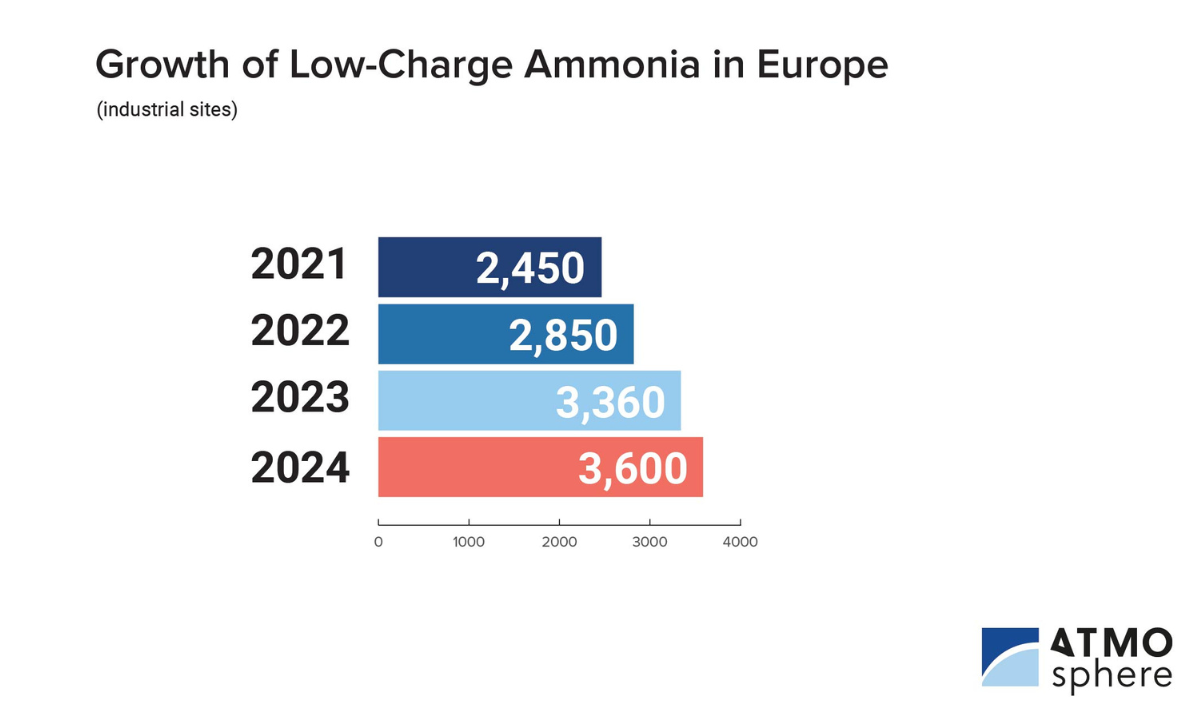
While low-charge ammonia systems didn’t post the same growth figures – 3,600 industrial sites in 2024, a 7% increase from 3,360 in 2024 – regulation and safety concerns continue to drive technological advancements. Danish sensor manufacturer HB Products working in partnership with U.S. controls manufacturer Hansen, debuted an evaporative control sensor in the spring of 2024 that they claimed could cut the ammonia refrigerant charge by 75%.
Major manufacturers of hydrocarbon equipment for the industrial market include the Italian companies Euroklimat and Enerblue. Since 2006, Euroklimat has installed more than 3,000 propane heat pumps and chillers in Europe, with its chillers ranging in capacity from 30‒1,000kW (8.5‒284TR). Enerblue, with 1,000 R290 heat pumps and chillers in operation since 2014, launched its new Silver line of R290 chillers with a cooling capacity of up to 768kW (218.3TR) at Chillventa 2024.
Regulations driving the market
Regulation remained the biggest driver of natural refrigerants in commercial and industrial refrigeration in Europe in 2024.
The revised EU F-gas Regulation, which became law in March 2024, mandates a complete phase out of f-gas refrigerants in new equipment by 2050, with bans on f-gases in stationary refrigeration equipment and chillers coming into effect starting in 2025.
In December 2024, the European Chemicals Agency (ECHA) announced that its committees for Risk Assessment and Socio-Economic Analysis would discuss the proposed restrictions of per- and polyfluoroalkyl substances (PFAS) in f-gas applications at its meeting in March 2025. In February 2023, the ECHA published a proposal from Denmark, Germany, the Netherlands, Norway and Sweden to restrict PFAS under the EU’s chemicals regulation REACH (Registration, Evaluation, Authorisation and Restriction of Chemicals).
The EU’s regulatory moves are being closely watched in the U.K., where several leading supermarket brands have elected to move to natural refrigerants in the absence of updated domestic regulations. The U.K. adopted the EU’s 2014 F-gas Regulation post-Brexit.
In October 2022, Tesco, the largest supermarket brand in the U.K., reported operating 1,000 transcritical CO2 stores in the country, accounting for one-third of its locations. It also operates stores in the Czech Republic, Hungary, Ireland and Slovakia and plans to be HFC-free chain-wide by 2035.
In its 2024 sustainability report, Sainsbury’s said it was replacing HFC systems with “natural refrigerant gas,” and in 2021, Morrisons said that it was switching to CO2 refrigeration.