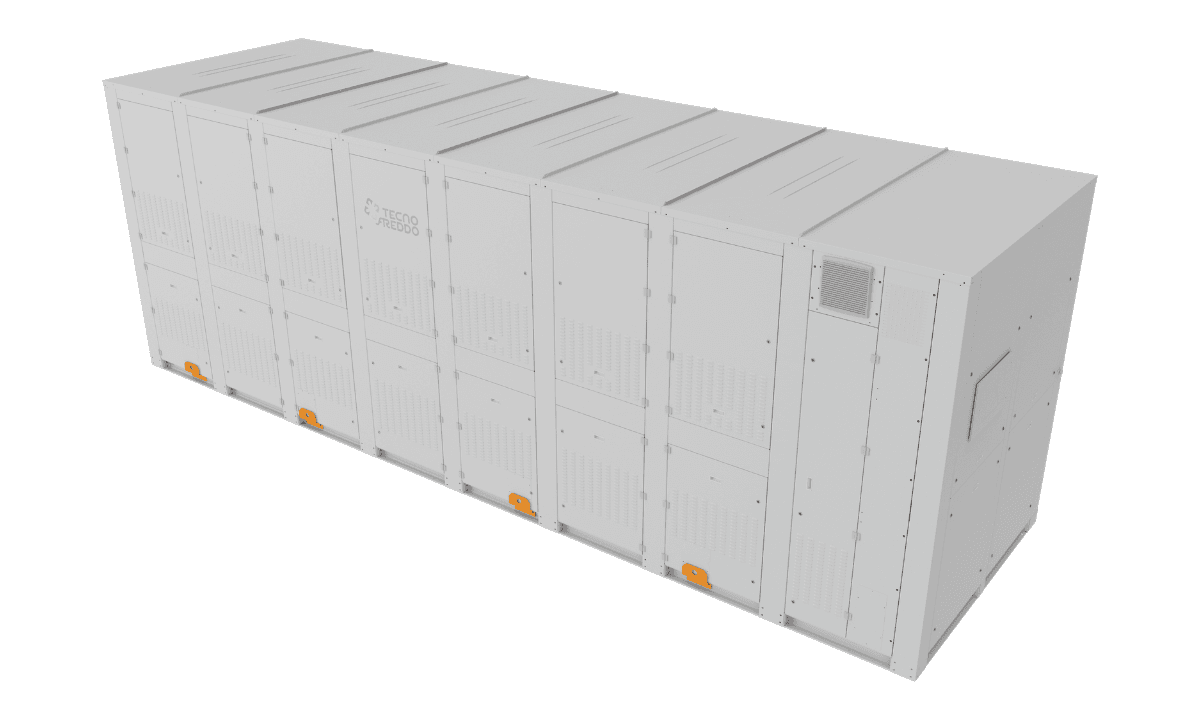
Canadian manufacturer Vitalis has supplied an 185kW (52.7TR) transcritical CO2 (R744) Roxsta G6 refrigeration compressor rack for installation at a Pennsylvania food processing plant.
The system, dedicated to low-temperature (LT) application, will blast-freeze steamed dumplings at an evaporating temperature of −42°C (−44°F) at the Bethlehem facility, Luke Redd, Head of Marketing at Vitalis, told NaturalRefrigerants.com.
“This project demonstrates the versatility of transcritical CO2 technology beyond traditional supermarket refrigeration,” Redd said. “It represents continued expansion into industrial food processing applications and reinforces the growing adoption of natural refrigerant solutions across the North American market.”
“This project demonstrates the versatility of transcritical CO2 technology beyond traditional supermarket refrigeration.”
Luke Redd, Head of Marketing at Vitalis
Expanding CO2 sales
In addition to manufacturing CO2 refrigeration compressor racks, the company also produces CO2 heat pumps and CO2 oil-management vessels. In May 2025 Vitalis doubled its production capacity by opening a new 25,000ft2 (2,323m2) manufacturing site in Kelowna, British Columbia.
“In the last year we doubled our revenue in general, but to a large degree from the racks,” Redd told NaturalRefrigerants.com at IIAR 2026, held March 15–18 in San Antonio, Texas. “[Our increased sales] came from demand, especially in California.”
In another recent U.S. application, Vitalis supplied a 570TR (2MW) CO2 refrigeration compressor rack for a North Carolina pharmaceutical cold storage facility, using eight Roxsta G6 units with gas coolers mounted on subframes. The installation included six 75TR (264kW) units serving medium-temperature coolers and two 60TR (211kW) units serving LT freezers, one of which incorporates heat reclaim.
In collaboration with its German-based parent company, Teko Refrigeration, Vitalis launched a new line of CO2 oil-management vessels in early 2026, available to other manufacturers. The lineup includes oil separators, oil reservoirs and liquid receivers featuring an AUthentic cartridge, a multi-layer polymer filter. Rated for design pressures up to 140bar (2,030psi), the vessels “eliminate the risk of fiber contamination in a CO2 refrigeration system,” according to Vitalis.
“If CO2 grows, the overall pie grows for us too ‒ and CO2 will only get a better reputation if people are getting good components,” Redd said.
Emerging market
Vitalis installed an air-source 1.5MW (426.5TR) CO2-based heat pump at the University of British Columbia (UBC)’s Okanagan Campus in Kelowna. The system supplies both district heating and cooling to campus buildings in ambient temperatures from −20 to 40°C (−4 to 104°F). After nine months of operation, the heat pump has reduced UBC Okanagan’s carbon emissions by 350 metric tons, Vitalis’s Program Manager Parham Eslami-Nejad told UBC News. “In a colder year, the system’s full annual potential reaches more than 800 [metric] tons,” he added.
Although CO2 heat pumps are widely used for district heating in Europe, such applications are just emerging in North America, driven by corporate sustainability targets, building decarbonization efforts and regulations phasing down high-GWP refrigerants. The UBC installation demonstrates the technology’s potential in the region, achieving an annual heating COP of up to 3.5 and an annual cooling COP of up to 3.6.
Company President James Seabrook said that the UBC project gives Vitalis a head start in the developing North American heat pump market. “It’s the foundational project of a whole new product line,” he said. “But we’ll have years of operating experience with it when the market emerges.”
Vitalis expects to more than triple in size within the next five years as CO2 adoption for heating and cooling accelerates in North America, according to UBC News.