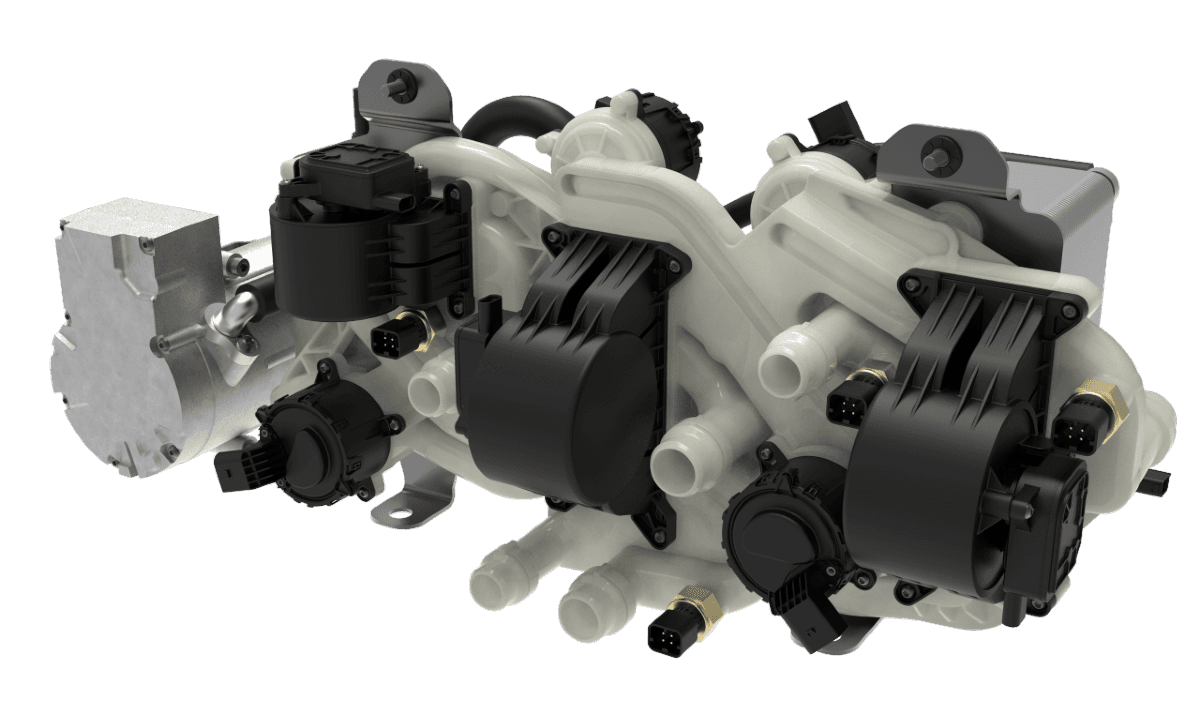
Valeo, a French manufacturer of heat pumps and other automotive components, has said it is “actively engaged” in the development of CO2 (R744)- and propane (R290)-based technologies to align with the proposed restrictions on per- and polyfluoroalkyl substances (PFAS) in the EU.
According to Pascale Herman, Global Product Marketing and New Value Spaces Director for Valeo’s Power Division, the manufacturer is currently working to improve the affordability of its existing R744 portfolio while also investing in R&D for R290 solutions.
“Many OEMS are considering natural refrigerants – both R744 and R290 – in their portfolio, which is also Valeo’s strategy,” Herman told NaturalRefrigerants.com in a recent interview. “We are working to provide the best solutions in terms of performance, affordability and safety.”
Currently, HFO 1234yf is the dominant refrigerant in thermal management systems, particularly for electric vehicles (EVs). However, the EU’s Universal Restriction Proposal, aimed at curbing the environmental and health impacts of PFAS, could lead to its ban.
In preparation for its possible prohibition, Valeo is committed to providing alternatives for the automotive industry.
“Valeo stands for limiting the environmental impact of its products and welcomes [the] European Commission initiative on PFAS,” explained Rody El Chammas, Valeo’s Heat Pump Module Director, in an interview with AutomotiveIQ. “According to our assessment, both R744 and R290 can meet the standard refrigerant R1234yf system performance, whether for cabin or battery cooling and heating.”
While R1234yf will remain in use until any PFAS ban takes effect, interest in CO2-based technologies is rapidly growing, he noted. Systems incorporating R744 are already in serial production and gaining traction among industry leaders, with Valeo’s roadmap also exploring R290 for future applications.
“Many OEMS are considering natural refrigerants – both R744 and R290 – in their portfolio. We are working to provide the best solutions in terms of performance, affordability and safety.”
Pascale Herman, Global Product Marketing and New Value Spaces Director, Power Division, Valeo
Advancing natural refrigerant solutions
Valeo first began working with natural refrigerants in 2016 when it supplied components for the R744-based air-conditioning system for the Mercedes S-Class, which Herman said was the first time a carmaker used natural refrigerants for HVAC.
The manufacturer has since partnered with the Volkswagen Group, supplying components for the R744 heat pump system offered on the automaker’s modular electric drive matrix (MEB) platform, which underpins several vehicles, including the Audi Q4 e-tron and Electric Ford Explorer.
“We continue to supply various components for the heat pump system on this platform, including the gas cooler, chiller and evaporator, all of which have been in serial production since 2019,” Herman said.
With several years’ experience in this space, Valeo now offers a range of R744-based components and systems for passenger cars, including its Smart Heat Pump Dual, Standard Heat Pump, heat pump heat exchanger and electrical compressor. The company is now focused on developing its R744 portfolio to make it more accessible.
“Previously, we were working on getting the best autonomy and efficiency [with CO2],” she explained. “Now, we are working on making our R744 technology affordable for all by simplifying systems to remove valves and pumps, for example.”
“We are working on making our R744 technology affordable for all by simplifying systems to remove valves and pumps, for example.”
Pascale Herman, Global Product Marketing and New Value Spaces Director, Power Division, Valeo
R744 vs. R290
According to Herman, R744 is currently the best solution in terms of efficiency, maturity and availability. However, with further development – particularly regarding safety – R290 could be a viable alternative.
“There are pros and cons for both R744 and R290,” she noted.
This opinion is reflected across the industry, with different automakers adopting different approaches based on their own studies. For example, the Ford Motor Company has identified propane heat pumps as a superior solution for electric vehicles, while Volkswagen sees CO2 heat pumps as beneficial for the operation of its EVs.
“We don’t expect a single refrigerant solution adopted by all OEMs and for [all] applications,” said El Chammas during his Automotive IQ interview.
This flexibility will allow Valeo and the broader automotive industry to design systems that balance performance, cost and environmental considerations, he added.
The shift from PFAS
The EU’s proposed PFAS restriction was first submitted to the European Chemicals Agency (ECHA) in early 2023 by national authorities from Denmark, Germany, the Netherlands, Norway and Sweden. The ECHA has announced that it expects its Risk Assessment Committee and Socio-Economic Analysis Committee to discuss the proposed restriction of PFAS in f-gas applications at its meeting in March 2025.
In the lead up to ECHA’s plenary session in March, the Coalition for PFAS-Free Cooling & Heating is set to host a three-part series of online events exploring the issues surrounding PFAS in the HVAC&R industry. The first event, featuring Professor Michael Kauffeld, is taking place Friday, February 14, at 1 pm CET and is open to all. ATMOsphere, publisher of NaturalRefrigerants.com, is a member of the Coalition.
While a decision on the ban is not expected until at least 2028, the proposed regulation has been affecting the automotive industry for many years, El Chammas explained, with a growing number of components and system manufacturers announcing PFAS-free solutions. For example, thyssenkrupp Dynamic Components, a division of German manufacturer thyssenkrupp Automotive Technology, recently launched a CO2 compressor designed for battery-powered EVs.
“There are a lot of ongoing projects to prepare the next generation of natural refrigerant-based solutions following the European Commission’s decision [on PFAS],” said Herman. “The industry is currently facing several challenges, but European carmakers are considering this matter very carefully because they want to be ready as soon as it becomes mandatory.”
According to Herman, because of these various challenges, very few carmakers are being proactive on PFAS, adding that the industry will follow policymaking.
“Globally, Europe will probably drive the shift and be the first to implement natural refrigerants by law,” she said. “Other regions, like Asia and the U.S., will then follow. I would say all markets, at a certain point of time, will shift.”
“Globally, Europe will probably drive the shift and be the first to implement natural refrigerants by law. Other regions, like Asia and the U.S., will then follow.”
Pascale Herman, Global Product Marketing and New Value Spaces Director, Power Division, Valeo