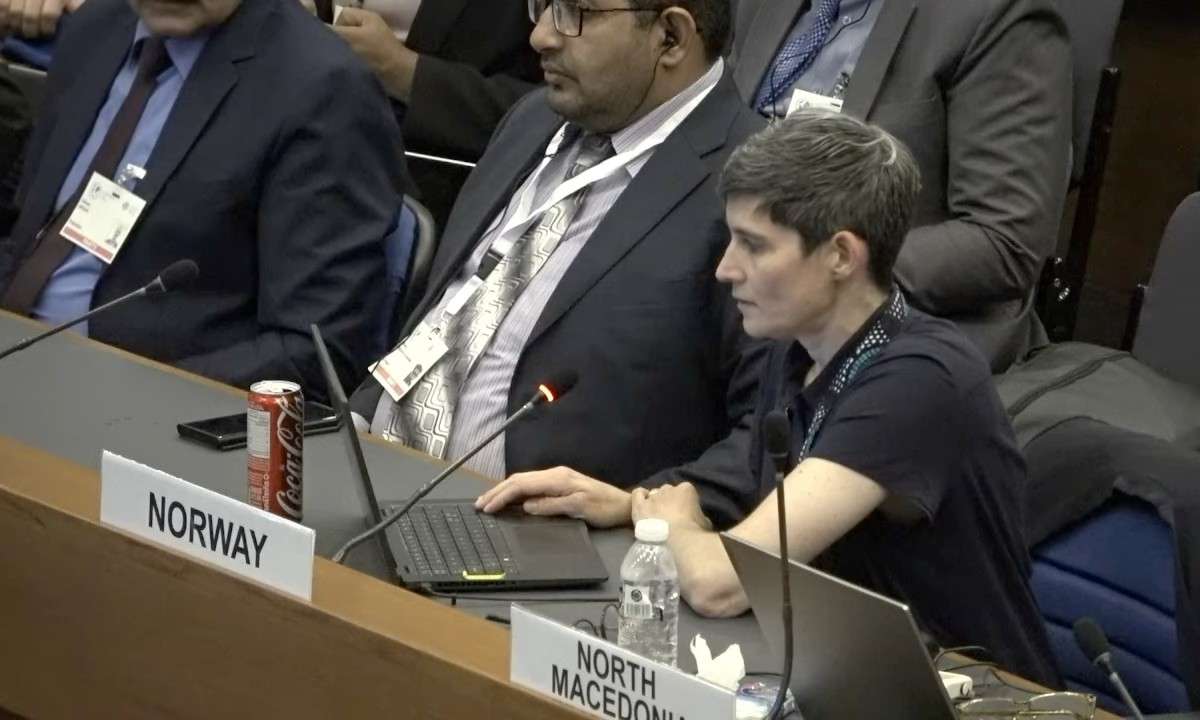
Delegates from the EU and Norway encouraged the application of the “precautionary principle” in regard to regulating HFOs and their atmospheric degradation product, trifluoroacetic acid (TFA), in a discussion on day two of the 47th Open-Ended Working Group (OEWG47) of the Parties to the Montreal Protocol, being held July 7–11 in Bangkok.
The delegates were addressing statements about TFA in a new Progress Report by the Technology and Economic Assessment Panel (TEAP), a section of the United Nations Environment Programme (UNEP). The TEAP report referenced the 2024 update to the 2022 Assessment Report of the Environmental Effects Assessment Panel (EEAP), which repeated the earlier report’s conclusion that the risk to humans from chronic exposures to TFA in surface waters remains “de minimis [of little importance] at current concentrations of TFA.”
However, Arno Kaschl, a Policy Officer for the European Commission working on CLIMA.A2 Climate Finance, Mainstreaming, Montreal Protocol, pointed out that water authorities have observed rising concentrations of persistent substances like TFA and expressed concern. “These substances are difficult to remove with conventional treatment methods and may pose long-term risks to water quality,” he added. “TFA, the main background product of many HFCs and HFOs, is a matter of concern.”
The most commonly used HFO, HFO-1234yf, upon release to the atmosphere, converts completely to TFA over a few weeks. The TFA is absorbed in rainfall and infiltrates surface and groundwater as well as soil on a global scale. As a PFAS (per- and polyfluoroalkyl substance), TFA does not break down in the environment.
Recent studies have detected TFA in drinking water, other beverages and foodstuffs in rising concentrations, and therefore “directly consumed by citizens,” said Kaschl. Furthermore, the European Chemicals Agency (ECHA) is considering a proposal from Germany to classify TFA as toxic to reproduction as well as persistent and mobile, he noted.
ECHA is also engaged in a consideration of a universal PFAS restriction proposal that would regulate certain f-gases and TFA as PFAS. “In the EU the precautionary principle is a basis for environmental legislation and requires us to act,” said Kaschl.
The EU defines the precautionary principle as “an approach to risk management, where, if it is possible that a given policy or action might cause harm to the public or the environment and if there is still no scientific agreement on the issue, the policy or action in question should not be carried out.”
Kaschl also refuted the assertion in the TEAP report that PFAS regulation would stymie the adoption of heat pumps or the phase out of HFCs. “There are today many suitable alternatives available for most refrigeration air conditioning sectors and natural refrigerants provide excellent energy efficiency in heat pumps, air-conditioning and refrigeration equipment,” he said.
The PFAS conversation begins around the 19:00 mark
Concern about increasing concentrations
The Norwegian Environment Agency’s Sandrine Benard, a Senior Adviser in the Climate Department’s Section for Climate Science, Air Quality and Local Climate Mitigation, also took issue with the “de minimis” description of TFA in the TEAP report. “Our concern is in the fact that TFA concentrations in the environment are expected to increase due to a growing use of substances that degrade into TFA,” she said.
Benard also referred to the 40th anniversary of the Vienna Convention for the Protection of the Ozone Layer, the forerunner of the Montreal Protocol. “Adopting a precautionary approach has been key to the success of the Vienna Convention, enabling parties to take early action and minimize further harm to the ozone layer. Considering the challenge ahead of us, we believe it is key that parties to the Montreal Protocol come together and embrace, once again, a precautionary approach, ensuring the best way of addressing emerging challenges, including PFAS.”
Benard noted that the TEAP report did not indicate the “level of certainty” with which it concluded that TFA posed little harm to human health. By contrast, in reports by the Intergovernmental Panel on Climate Change, she said, experts express “the degree of confidence with which their statement is made, reflecting agreement in the scientific literature and the evidence available.” She encouraged a “comprehensive and balanced assessment of the state of knowledge in order to better inform our upcoming discussions.”
Another delegate, Henry Wöhrnschimmel, Head of Section for Switzerland’s Federal Department of the Environment, Transport, Energy and Communications, said that new information, such as Germany’s linking TFA to reproductive toxicity, might lead the TEAP “to revisit [its] conclusion” about the harmlessness of TFA. He also cited a new study on TFA in precipitation and surface waters in Switzerland showing that TFA concentrations increased by a factor of four to six since the 1990s.
“Our concern is in the fact that TFA concentrations in the environment are expected to increase due to a growing use of substances that degrade into TFA.”
Sandrine Benard, the Norwegian Environment Agency
A delegate from the U.S. in the State Department, John Thompson, Deputy Assistant Secretary for Environment in the Bureau of Oceans and International Environmental and Scientific Affairs, disagreed with the other delegates on the use of the precautionary principle in regard to TFA. “We should be technology neutral,” he said, adding that “[we should not try] to worry people, create concerns based on one country’s or some countries’ application of precaution over the actual analysis of a risk that is done to assess this particular class of chemicals.”
Thompson urged the delegates not to turn “science work into a political discussion,” though the U.S. is currently dismissing the science of climate change for what environmentalists would call political reasons.
Other OEWG news
Earlier in the OEWG47, Martin Alex Bjørnholst, a Special Advisor to Denmark’s Ministry of Environment and Gender Equality, said the EU would like to discuss PFAS and natural refrigerants in a contact group during the conference.
ATMOsphere, publisher of NaturalRefrigerants.com, is holding a side event in Bangkok dedicated to PFAS and natural refrigerants on July 10. ATMOsphere just published a special report examining the rising threat of HFOs and TFA to human health and the environment.
The OEWG was established in the wake of the Montreal Protocol, with delegates from parties to the Protocol (signatory countries) meeting at least once a year to discuss the latest research, implementation issues and possible adjustments and amendments. The event is also open to members of industry, nongovernmental organizations and academics.