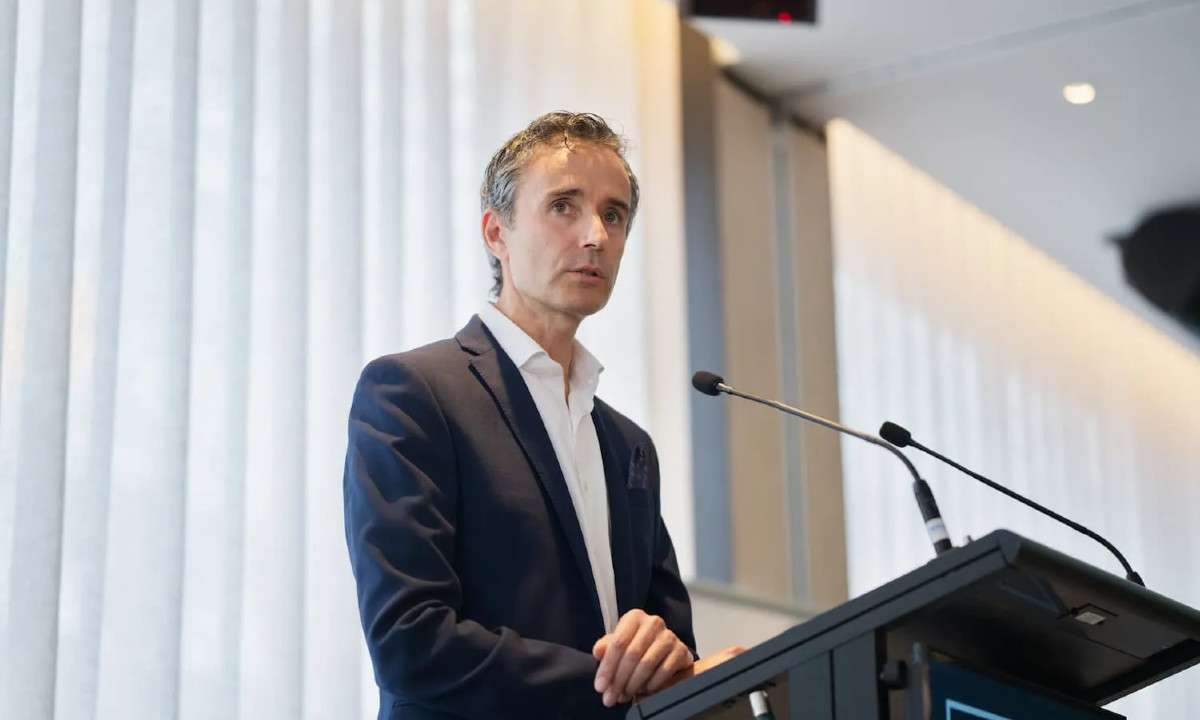
To enhance heat recovery, Australian retailer Woolworths has mounted an evaporator on the condenser deck of the CO2 (R744) refrigeration systems at two of its stores, according to the company’s National Sustainable Engineering Manager Dario Ferlin.
“By connecting an evaporator to the medium-temperature [MT] suction group, we are effectively turning the refrigeration system into a hybrid,” Ferlin said at Refcon 2025. “From a 100kW [28TR] MT [capacity] CO2 refrigeration system, we can recover almost 140kW [40TR] of heat for space heating.”
Ferlin outlined the heat reclaim theories and potential application challenges at Refcon 2025. The event, organized by the Air Conditioning & Mechanical Contractors’ Association of Australia, was held March 24 in Melbourne.
The theory: Heat recovery is a function of the heat content/enthalpy drop multiplied by the refrigerant’s mass flow rate. Increasing either one increases the heat recovery capacity. For comparison, Ferlin used a 100kW MT transcritical CO2 system operating in 15°C (59°F) ambient conditions with a passive heat recovery of 50kW (14TR) as the standard base.
- Increasing system operation to the 92bar (1,334psi) low-side design pressure increases the enthalpy drop, allowing the system to recover 86kW (24TR) of heat.
- Slowing down the gas cooler fans increases the mass flow downstream of the high-pressure expansion valve, allowing a heat recovery of almost 120kW (34TR).
- Adding a 20kW (5.7TR) nominal capacity evaporator on the condenser deck also increases the mass flow rate.
The challenges: Ferlin outlined things to consider when moving these theories into practice, including issues producing the proper outlet temperatures in low ambient conditions, designing the heat recovery heat exchanger based on the target temperature, the impact of refrigerated cabinets on the overall load and system design variations from equipment produced by different manufacturers.
- He invited participants to try some of these methods and come back and report at a future Refcon.
CO2 experience: Woolworths started using CO2 refrigeration in 2006 when it installed its first R134a/CO2 cascade system. It opened its first transcritical CO2 store in 2017.
- In April 2024, the chain celebrated opening its 100th transcritical CO2 store.
- As of December, Woolworth operates 125 of its 1,150 stores with transcritical CO2, according to Natural Refrigerants: State of the Industry 2024, a report from ATMOsphere, publisher of NaturalRefrigerants.com.
- More than half of the retailer’s transcritical CO2 stores operate with integrated heat reclaim systems, with 43 providing space heating and 22 space heating and cooling.
Quotable: “Finding the right heat recovery solution becomes site-specific,” Ferlin said. “However, we know the solution in all circumstances is to deliver stores with 100% natural refrigeration.”
“From a 100kW [28TR] MT [capacity] CO2 refrigeration system, we can recover almost 140kW [40TR] of heat for space heating.”
Dario Ferlin, National Sustainable Engineering Manager at Woolworths