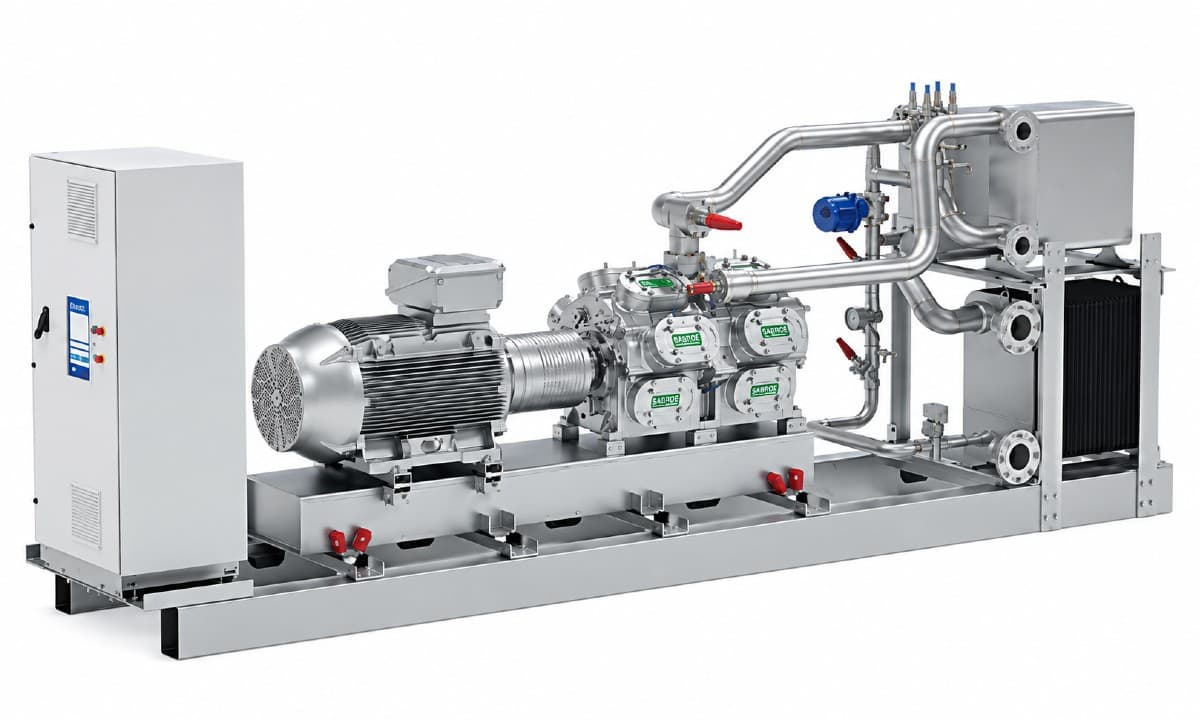
A single CO2 heat pump from Flow Environmental Systems replaced 27 rooftop HVAC units with a combined cooling capacity of nearly 197TR (693kW) at St. Paul Steamfitters/Pipefitters Union (Local 455)’s 100,000ft2 (9,290m2) training facility, according to Training Director Jeremy McConkey.
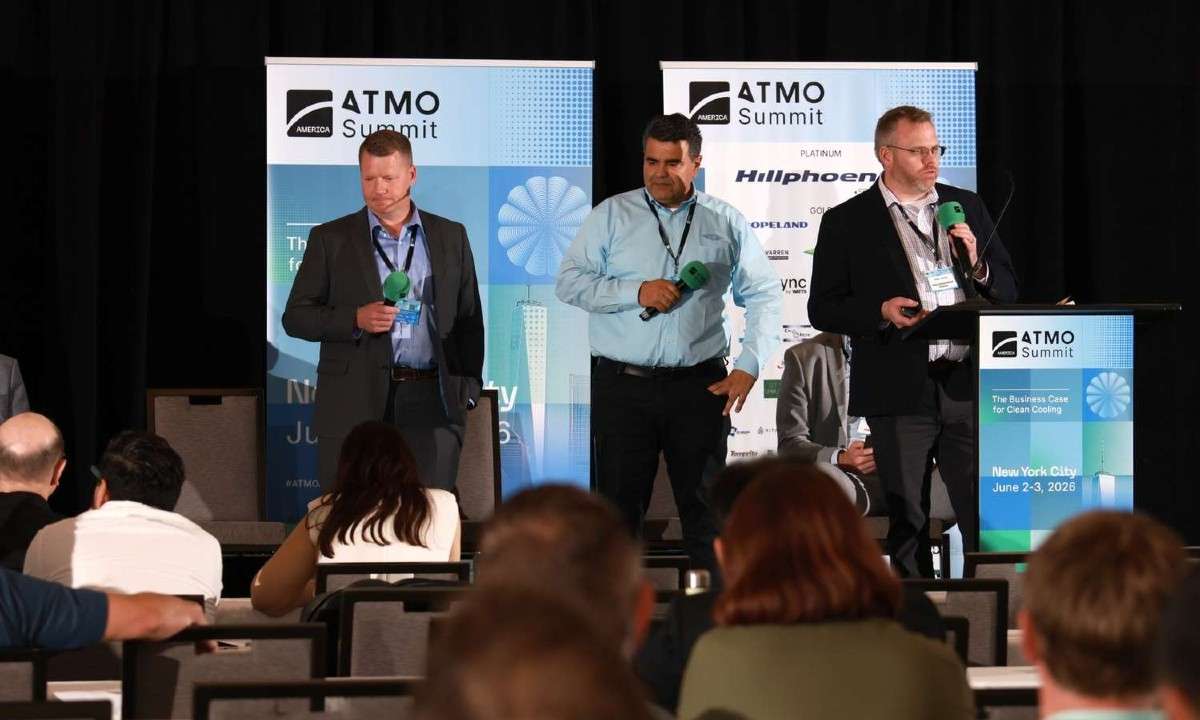
Since being commissioned in late January, Flow’s ANSWR CO2 heat pump, operating solely in air-source mode, delivered 130°F (54°C) hot water throughout the Minnesota winter for facility space heating, McConkey said during a presentation at ATMOsphere America Summit 2026. The event, organized by ATMOsphere, publisher of NaturalRefrigerants.com, took place June 2‒3 in Tarrytown, New York.
“The heat pump replaced our boilers and rooftop HVAC units,” McConkey said. “When we first ran it in January, it was −11°F [−24°C], and we had no problem with it heating our space or keeping up.”
Sean Jarvie, Flow’s CTO, and Alessandro Silva, Senior Application Engineer at Bitzer, joined McConkey during the presentation. Jarvie explained the unit’s ability to provide space heating, cooling and domestic hot water in a single integrated unit. Silva outlined validating the design using Bitzer’s new thermodynamic simulation tool, Fender.
In addition to providing heating and cooling, Flow’s heat pump serves as a versatile training tool for Local 455, with connections to both geothermal and outdoor-air heat sources via a hybrid changeover system. In late March Local 455 piped the unit into its existing geothermal system. The facility showcases the CO2 heat pump through a glass window, with a live display for engineers, building owners, policymakers, utility providers and the community to see the technology in action.
Additional details: Before the CO2 heat pump was installed, natural gas boilers provided space heating at the facility, and a natural gas water heater supplied domestic hot water. Space cooling was provided via a 52°F (11°C) geothermal aquifer exchange circulating 60°F (16°C) water through chilled beams.
- The training center has 350 apprentices and 238 signatory contractors.
- It contains 70,000ft2 (6,500m2) of lab space, including a supermarket-sized CO2 refrigeration rack, various heat pumps, HVAC and AI-based direct digital control.
- “If something new is coming to the market that we believe will work, we want to demonstrate it and train for it,” McConkey said, adding that a propane chiller is on his wish list once regulations allow larger A3 refrigerant charges.
Product specifications: Flow’s ANSWR unit supplies HVAC and hot water solutions for various markets, according to Jarvie, including multi-family dwellings, commercial applications and large industrial projects.
- Currently Flow builds 20 to 120TR (70 to 422kW) models, with Jarvie indicating that as the company continues to roll out products, capacities will go larger and smaller.
- The units operate in ambient conditions ranging from −40 to 120°F (−40 to 49°C) with heating output of up to 180°F (82°C) and cooling down to 0°F (−18°C).
- “Traditionally the return temperature is the issue [with CO₂],” Jarvie said. “However, we have tech – we have controls – that make it so we can manage returns up to 150‒170°F [66‒77°C].
Growing Adoption: To decarbonize hydronic space heating and domestic hot water, a major American tech company recently replaced legacy gas boilers in four buildings in the San Francisco Bay Area with Flow water-to-water CO2 heat pumps.
- Each of the occupied office buildings, equipped with existing variable air volume (VAV) distribution HVAC systems, houses its own data center on the first floor with a cooling load of roughly 1,000TR (3.5MW).
- The CO2 solution fits within the rooftop footprint of the existing boiler and domestic water heater. Using waste heat from data center cooling, it delivers 180°F (82°C) hydronic water and 140°F (60°C) domestic hot water.
- “By the time we started stacking up the reduced electrical cost from serving only one piece of equipment, the reduced roofing and the avoidance of changing out the VAV to deal with lower temperature water, the cost delta for the CO₂ solution was only 3% more than a conventional synthetic refrigerant system,” Brannon Wynn, Project Executive at MAI Construction, said in a different presentation at the ATMO summit.
Quotable: “The install was not as complicated as people thought,” McConkey said, adding that the refrigeration contractor installing the unit required some education on the mechanical side, but the project was otherwise a smooth process. “Most of the contractors that we work with could install this, and certainly our service techs can handle it.”
“Most of the contractors that we work with could install this, and certainly our service techs can handle it.”
Jeremy McConkey, Training Director at Local 455