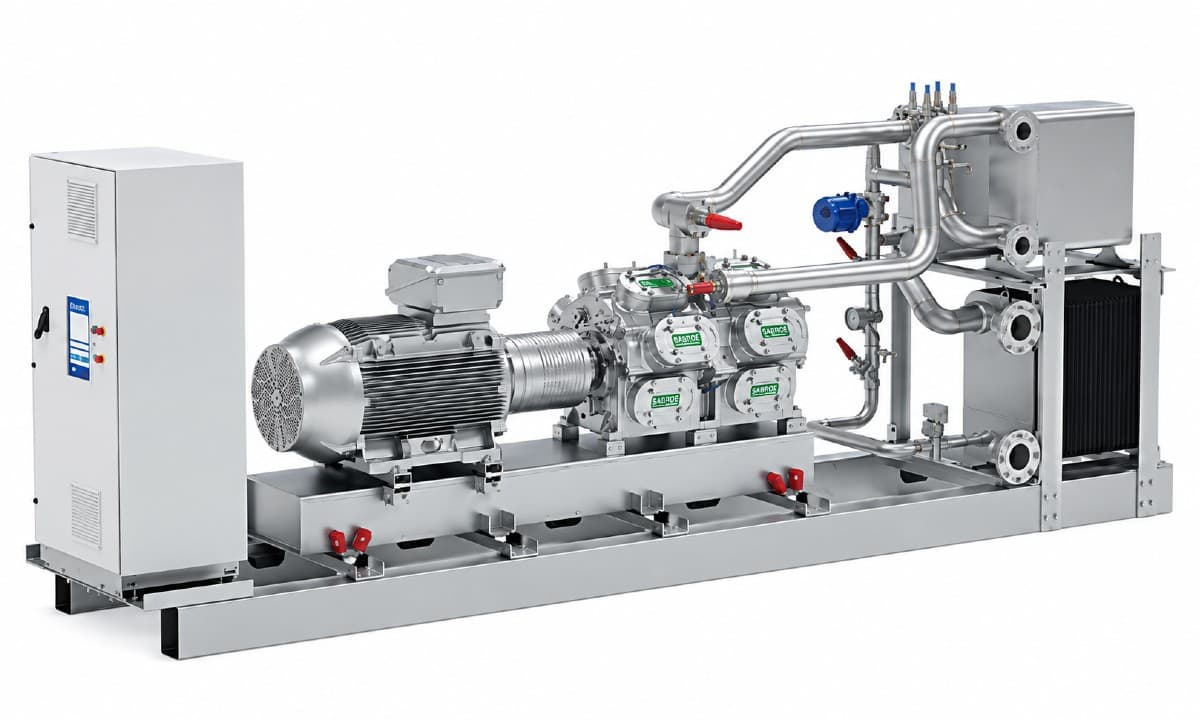
The Korean Institute of Machinery and Materials (KIMM) has demonstrated an ammonia-based adsorption heat pump capable of using waste heat as low as 40°C (104°F) for cooling, according to Young Kim, a principal researcher at the government-funded institution.
HVAC&R manufacturer Samjung Tech built a 10kW (2.8TR) prototype of KIMM’s chemical adsorption heat pump, which incorporates an electrochemical compressor developed through a collaboration between KIMM and Chung-Ang University professors Minseong Kim and Dongkyu Kim. The project was supported by the Korea Institute of Energy Technology Evaluation and Planning (KETEP) through the government’s Alchemist Project, an R&D program targeting high-risk, high-impact technologies.
“Unlike conventional adsorption cooling systems, which require heat sources above 70°C [158°F], the new system successfully demonstrated cooling operation using waste heat at just 40°C,” KIMM said, without specifying the prototype’s cooling-side configuration or output temperature. “The redesigned adsorption bed, the core of the heat pump, achieves a specific cooling power (SCP) of 346.5W/kg – more than twice [that] of comparable international technologies.”
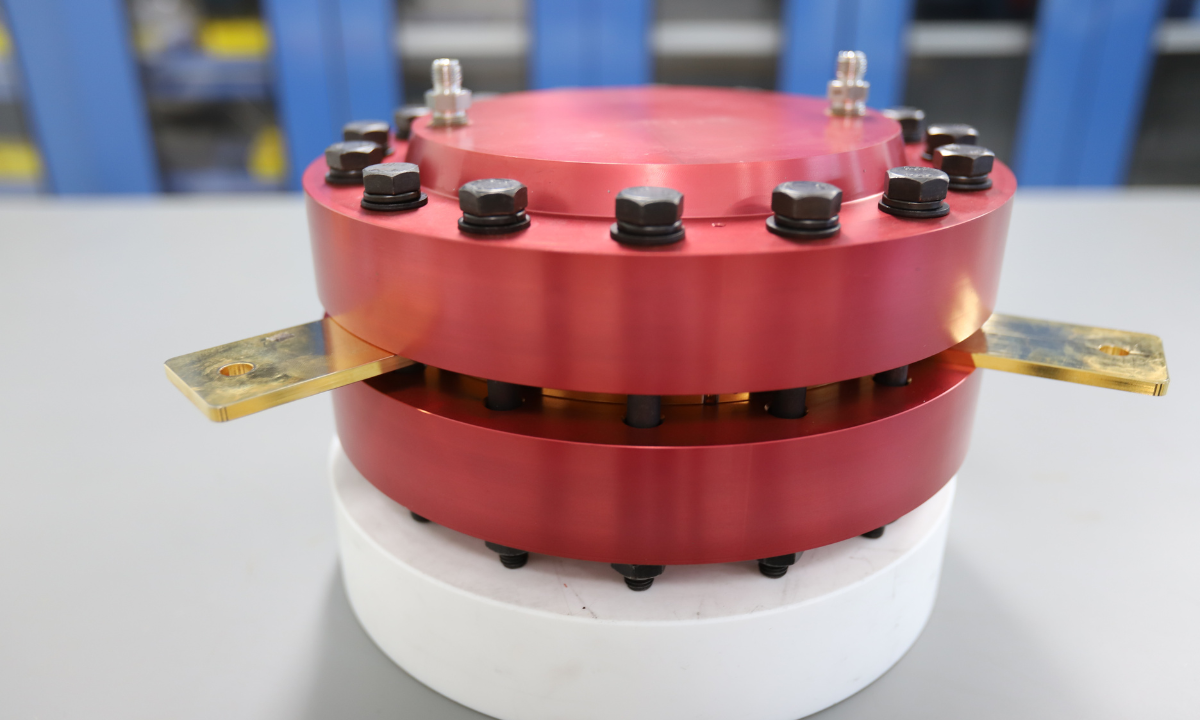
How it works: Instead of mechanical compression, the system uses a combination of low-temperature-driven sorption/desorption in KIMM’s ammonia chemical-adsorption bed and an electrochemical compressor to produce cooling.
- When heated, the adsorption bed releases ammonia vapor at elevated pressure. Electricity then drives the electrochemical compressor, which transports ammonia through an ion-conducting membrane, further increasing its pressure.
- In a condenser, the ammonia vapor releases heat and condenses into a liquid before passing through an expansion device, which reduces the pressure and temperature.
- As low-pressure ammonia evaporates in an evaporator, it absorbs heat, providing cooling. The refrigerant then completes the cycle by returning to the adsorption bed.
Additional information: KIMM has not specified the material used in the redesigned adsorption bed. Separately, under the same KETEP grant, Gyeongsang National University researchers Hiluf Fissaha and Duckjong Kim developed a salt-embedded covalent organic framework (COF) aerogel composite that demonstrated high ammonia adsorption capacity.
- The project has produced 74 Science Citation Index Expanded (SCIE)-indexed papers, 67 patent applications and 29 registered patents, according to KIMM.
- The institute will continue to conduct testing using the 10kW prototype in preparation for a follow-up field demonstration study, Young Kim said.
- Global regulatory developments are also encouraging waste-heat recovery. For example, the EU’s revised 2023 Energy Efficiency Directive requires member states to ensure that data centers with an installed IT power demand above 1MW access and enable waste heat recovery where technically or economically feasible.
Potential application: Conventional adsorption cooling systems typically require heat sources above 70°C (158°F), making KIMM’s reported 40°C capability potentially relevant to low-temperature data center waste heat.
- Global data center capacity is expected to nearly double from 103GW today to 200GW by 2030, according to ATMOsphere’s 2025 report “Clean Cooling for Data Centers.” ATMOsphere is the publisher of NaturalRefrigerant.com.
- Air-cooled data centers typically produce waste heat at around 25–35°C (77–95°F), while liquid-cooled data centers can produce waste heat at temperatures as high as 50°C (122°F).
- NVIDIA’s new Rubin AI server, for example, uses cold plates cooled by a water–glycol mixture. The fluid enters the cold plate at 45°C (113°F) and exits at 55°C (131°F), creating a waste-heat stream suitable for recovery.
Manufacturing connections: As technology develops for adsorption heat pumps to harness low-temperature waste heat, several companies are developing technologies that could support their wider adoption.
- While Samjung Tech’s current product lineup includes direct-fired, steam-driven and hot-water-driven absorption chillers, its R&D team developed the ammonia adsorption prototype for KIMM.
- Sweden-based Alfa Laval also offers absorption cooling equipment. However, its diverse range of heat exchangers could support low-temperature waste-heat recovery for adsorption cooling, with products engineered to integrate with different heat-reuse options, according to Anna Blomborg, Head of Data Centers at the company.
- Swedish manufacturer SWEP’s newly developed brazed plate heat exchangers could also support waste-heat recovery from data centers, where temperatures are rising from 30–33°C (86–91°F) for storage applications to 45–60°C (113–140°F) for AI workloads, according to Christer Frennfelt, Business Development Manager at the company.
“Unlike conventional adsorption cooling systems, which require heat sources above 70°C [158°F], the new system successfully demonstrated cooling operation using waste heat at just 40°C.”
KIMM