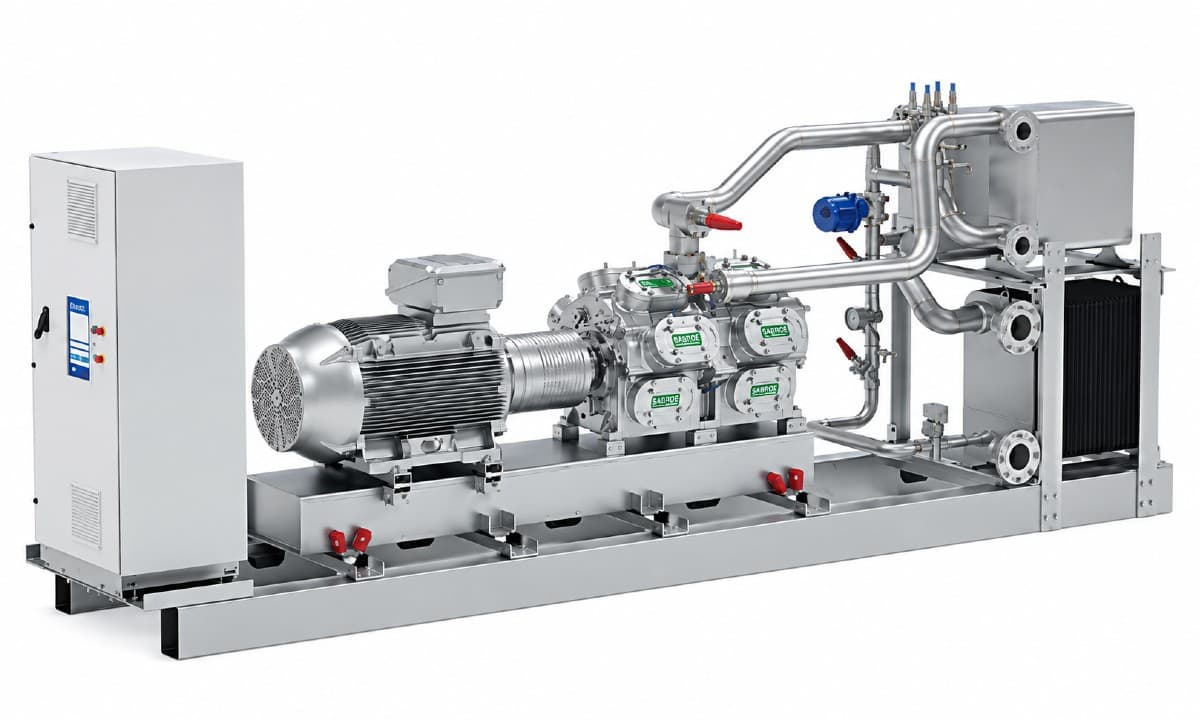

A group of companies that develops, manufactures and installs high-temperature CO2 (R744)-based heat pumps for a range of commercial applications was named runner-up in the New York’s Empire Technology Prize competition at a ceremony in New York City on September 19.
The companies – Flow Environmental Systems, Ambient Enterprises and Gil-Bar Industries – received $100,000 (€84,623) as the second-place winner. The CO2 heat pump is manufactured by Minnesota-based Flow Environmental Systems; New York City-based Gil-Bar, a business unit of Ambient, is a manufacturers’ rep that designs, installs and services building HVAC systems. The companies also collaborated with efficiency experts Ecosystem.
“It’s a great honor to be part of advancing the industry with high-temperature heat pumps, especially one using a natural refrigerant,” said Sean Jarvie, Chief Technology Officer for Flow Environmental Systems. Flow’s CO2 heat pump “can be the best technical and economical solution,” in addition to be being ultra-low GWP and PFAS-free, he added.
Flow’s CO2 heat pump is capable of heating water to 180°F (82°C) for space heating and can also provide domestic hot water and cooling and can use air or water as a heat source; it has a capacity range of 20 to 120TR (70.3 to 422kW) per module and operates down to -40°C (-40°F) with a 3.5 COP, said Jarvie.
“It’s a great honor to be part of advancing the industry with high-temperature heat pumps, especially one using a natural refrigerant.”
Sean Jarvie, Chief Technology Officer for Flow Environmental Systems
The hot-water heat pump is well suited for the many high-rise apartment buildings in New York City with baseboard radiators, said Nick Denson, Sales Engineer for Gil-Bar. The system is also applicable to office buildings, hospitals, industrial uses and district heating.
The grand prize winner of $1 million (€846,230) was Miller Proctor Nickolas, a manufacturer of steam and hot-water heat pumps that use R515B and HFO-1233zd refrigerants. In addition, Johnson Controls received honorable mention for high-temperature heat pumps that use HFO-1234ze and water. R515B has a 100-year GWP (4th IPCC) of 293; it consists of 91% HFO-1234ze and 9% HFC-227ea, both of which convert to trifluoracetic acid (TFA) in the atmosphere, the former at less than 10% and the latter at 100%. About 2% of HFO-1233zd converts to TFA.
Four other companies were finalists, including two that employ natural refrigerants: Clean Heat Technologies, which makes CO2-based steam heat pumps, and Enerin, which produces steam and hot-water heat pumps that use helium as a refrigerant.
The other two finalists were AtmosZero, which supplies steam heat pumps with HFO-1234ze and HFO-1233zd, and the combination of Hydronic Shell Technologies and Cycle Retrotech, which offer modular overclad window façades for retrofits of apartment buildings that facilitate the distribution of heating and cooling.
The Empire Technology Prize competition, announced in 2023, was designed to advance building technologies for low-carbon heating system retrofits and save energy and costs in tall commercial and multifamily buildings in New York State. It was funded with support from the New York State Energy Research and Development Authority (NYSERDA) and Wells Fargo and administered by The Clean Fight, with technical support from the Rocky Mountain Institute. The seven finalists were announced last year.
“New York State is investing in modern, energy-efficient solutions to help manage energy costs and reduce demand on the electric grid while putting New Yorkers’ health front and center,” said New York Governor Kathy Hochul. “Participants in this competition have the vision and dedication to advance new and innovative technologies that will help provide modern amenities in our aging building stock and improve the quality of life for residents across the state.”
Union Theological Seminary installation
The award announcement noted that Flow’s CO2 heat pump will be installed as a demonstration project at the Union Theological Seminary in Manhattan, enabling “the first carbon dioxide high-temperature hot-water heat pump deployment in New York.”
Multiple 20TR Flow modules will simultaneously supply hot water for space heating and domestic hot water, as well as chilled water and dehumidification for the Union Theological Seminary, including “precise temperatures for precious scriptures” in the building, said Lucas Taub, Project Development Engineer for Ecosystem. Flow said it expects to minimize retrofit costs while using the existing infrastructure.
As one of the seven original finalists, the group received $1.2 million (€1,015,476) from the prize administrators to support the demonstration project. They were also given an initial $250,000 (€211,558) award with the potential for up to an additional $750,000 (€634,673) as they achieved milestones in advancing their system.
In the past year, a number of commercial CO2 heat pumps designed to produce domestic hot water but not space heating have been introduced in the U.S. These CO2 heat pump water heaters are designed for domestic hot water but not space heating because of the high “delta T” or temperature differential required between the outlet and return water supply. Flow’s CO2 heat pump, which supplies both space and domestic hot water, is able to overcome that challenge through the manipulation of flash gas, said Jarvie, who dubbed this the system’s “secret sauce.”
Other deployments
In addition to its planned deployment at the Union Theological Seminary, Flow’s heat pump have been or are being installed in a wide range of applications in the U.S, noted Navaid Burney, Chief Financial Officer for Flow. These include water-source installations at a union hall in Minnesota and an airport in Fargo, North Dakota, and planned deployments at California tech companies.
Flow will soon complete an installation at Staus Family Creamery, a California company producing organic ice cream, yogurt and other dairy products. The heat pump will be used for hot-water pasteurization, cooling dairy products and freezing ice cream. In addition, a new CO2 energy storage unit, designed to cut the creamery’s energy costs, will be deployed; CO2 will be cooled during off-peak hours and used during peak hours, cutting peak electricity costs by 85%, said Burney.
In an interview last year, Jarvie touted the resilience and flexibility of Flow’s CO2 heat pump. “With an air interface, we can use an adiabatic cooler to support CO2 heat pump operation in scorching temperatures,” he said. “We can also handle low ambient temperatures that no other heat pump [on the market] today can touch.”