Bowing to industry pressure, the California State Legislature has decided to narrow the scope of PFAS (per- and polyfluoroalkyl substances)-focused Senate Bill 682 (SB 682), effectively excluding f-gases, according to PFAS scientist Anna Reade, who has worked with the legislature on the bill.
The bill had been designed to ban the sale and distribution of specific consumer products that contain intentionally added PFAS starting January 1, 2027. Then starting January 1, 2035, it would have more broadly prohibited the sale and distribution of any other product that contains intentionally added PFAS, including PFAS f-gases, unless it was determined that the use of PFAS in the product “is a currently unavoidable use, the prohibition is preempted by federal law, or the product is previously used.”
In effect, exemptions would only have been available for PFAS, including trifluoroacetic acid (TFA), found to meet “essential use” criteria. TFA is an atmospheric by-product of certain f-gases, notably HFO-1234yf, which undergoes 100% conversion to TFA in a few weeks. The bill also had called for further bans of f-gases in specific applications in 2040.
Instead, “the essential use portion of the bill was dropped this year, and we are proceeding with a straight ban of PFAS in cookware, cleaning products, juvenile products, food packaging, ski wax and dental floss starting January 1 of 2028,” wrote Reade, Senior Scientist and Director of PFAS Advocacy at the Natural Resources Defense Council (NRDC), in an email to NaturalRefrigerants.com on June 27.
The revised bill has passed the Senate and is working its way through the Assembly now, wrote Reade. “Even though the scope is narrower than what we initially hoped for, it is still a very good step forward to not have PFAS in these consumer products,” she added.
PFAS, which include more than 10,000 substances, are known as “forever chemicals” for their persistence and durability. The U.S. Environmental Protection Agency (EPA) established drinking water regulations for some PFAS last year and declared two long-chain PFAS, perfluorooctanoic acid (PFOA) and perfluorooctanesulfonic acid (PFOS), to be hazardous chemicals. PFOA and PFOS have been linked to a number of adverse health impacts, including certain cancers, reproductive issues, developmental problems and immune system effects.
ATMO America discussion
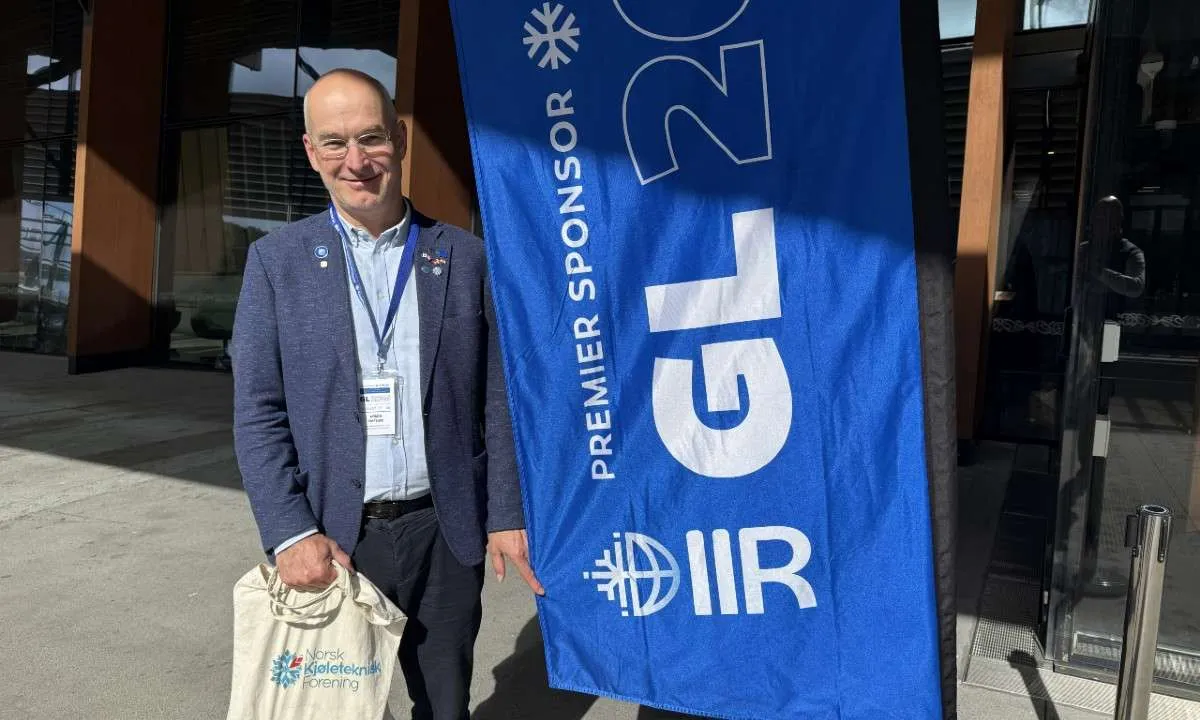
Reade had discussed SB 682 during a panel discussion on PFAS at the ATMOsphere (ATMO) America Summit 2025, held June 11 and 12 in Atlanta, Georgia. The conference was organized by ATMOsphere, publisher of NaturalRefrigerants.com. At the time, she was unable to speculate on the outcome of the legislation but noted, “I have never seen industry opposition quite like this in my career.”
However, Reade added that she was encouraged by the support for natural refrigerant alternatives to PFAS refrigerants evident at the ATMO America conference. It left her “a little bit surprised at the state of the refrigerants community and what is possible because that is not the picture being painted currently in California.”
She encouraged attendees “to get involved and round out that discussion” in the California legislature regarding the bill to ensure that it is “more accurate.”
Last year California’s legislature considered a bill, SB 903, that was similar to SB 682 but was not passed, in part because of costs. In 2022, California enacted PFAS regulations with a narrower scope, AB 1817 and AB 2771, which banned the sale and distribution of PFAS-containing textile articles and cosmetic products, respectively, beginning January 1, 2025.
SB 903 also faced considerable chemical industry opposition. To counter that, proponents of SB 682 obtained the support of the American Sustainable Business Network (ASBN) and the California Association of Sanitation Agencies.
California’s experience differs from what has been achieved in Maine and Minnesota. As part of its 2024 PFAS law, Maine plans to ban the sale of certain refrigerants, foams and aerosol propellants as well as cooling, heating, ventilation, air-conditioning and refrigeration equipment that contain “intentionally added PFAS” beginning in 2040. Following its 2023 PFAS law, Minnesota is engaged in rulemaking to establish a process to determine whether PFAS refrigerants and other products are “essential” to avoid prohibition in 2032. In April, Minnesota initiated a toxicity review of TFA.
TFA, which has been found in human blood, is considered a potentially harmful chemical and is linked to reproductive toxicity. There have been competing contentions about the potential toxicity of TFA made by the fluorochemical industry, which refers to a 2020 Assessment Report by the UN Environment Programme that says TFA is unlikely to cause adverse effects in terrestrial and aquatic organisms.
While the U.S. EPA has regulated long-chain PFOA and PFOS, it does not regard ultrashort-chain chemicals such as f-gases and TFA as PFAS, contrary to the policies of at least 24 U.S. states, including California, and the EU. These governments use the “at least one fully fluorinated carbon atom” definition that includes f-gases and TFA, and correlates to the OECD (Organisation for Economic Co-operation and Development) definition recently defended by a group of PFAS scientists.
The original bill
California State Senator Ben Allen (Democrat, Senate District 24) introduced the original SB 682 PFAS bill on February 21. Last month, it was approved by the Senate Committees on Health and Appropriations, and on June 9 was referred to the Assembly Committee on Environmental Safety and Toxic Materials. At ATMO America, Reade called the original bill “a science-based, common-sense approach to phasing out unnecessary uses of PFAS as a class.”
“We really want to reduce people’s exposures to PFAS as quickly as possible, but we can’t rely on cleanup,” said Reade at ATMO America. “We really do need to turn off the tap on PFAS pollution as much as possible.”
SB 682’s original 2035 prohibition would have covered most uses of f-gases such as HFO-1234yf and HFO-1234ze(E). Beginning January 1, 2040, it would have prohibited sales and distribution of certain PFAS refrigerant uses not covered in the 2035 bans: refrigeration below −50°C (−58°F), laboratory test and measurement equipment, and a refrigerated centrifuge. The 2040 ban would also cover fluorinated gases used for the maintenance and refilling of installed equipment for heating, venting and air-conditioning products.
Reade explained at ATMO America the three essential-use criteria that would have applied under the original SB 682. The first is that there’s no safer available alternatives to the PFAS. The next is that the function of the PFAS is actually necessary for the product to work. “We don’t actually need stain-resistant pants. We just need pants,” said Reade. Finally, the use of PFAS in the product is critical for the health, safety and functioning of society. If any of the three are false, the use of PFAS would be considered non-essential, she noted.
The reconfiguration of the bill “is definitely not what we wanted, but it seems the politics are not amenable to a more comprehensive approach at the moment.”
Anna Reade, Senior Scientist and Director of PFAS Advocacy, NRDC
The original SB 682 would have addressed PFAS as a class, rather than in the piecemeal fashion that has characterized many state and federal PFAS regulations to date. “Just from a logistical point of view, it’s actually impossible for us as scientists to study an individual chemical and regulate individual chemical one at a time in this class and get anywhere in a reasonable time frame, especially when doing it one at a time encourages regrettable substitutions,” said Reade.
Reade noted that in the U.S. there have been multiple efforts at the state level, some successful, to redefine PFAS to exclude f-gases from regulations, either by changing the definition of PFAS or through an outright exemption. “The easiest way to get out of the class-based approach is not be considered a PFAS at all,” she said, adding, “We really need to leave the definition of PFAS based in science.”
As the most populous U.S. state with more than 39 million residents, California has an outsized impact on the U.S. economy, and its environmental regulations are often viewed as a standard for other states to emulate. In 2020 California finalized ambitious HFC regulations that limit many new applications to a 100-year GWP of 150. It updated the regulations in 2022.
How harmful is TFA?
Reade, who has a PhD in developmental biology from the University of California, San Francisco, pointed out at ATMO America that there is “initial evidence for liver, immune, developmental, and reproductive effects for ultra-short chain PFAS like TFA and PFPrA (perfluoropropionic acid).”
In answer to a question about whether TFA can be harmful if, unlike long-chain PFAS, it has low bioaccumulation tendencies in human organs (though it is found to persist in the blood), she replied, “The problem is that there is a lot of TFA all around us all the time, and so we’re being chronically exposed. What we found out is, when you expose animals to long term chronic exposure, that we find the same health effects as the long-chain [PFAS]. So [the absence of] bioaccumulation is not actually a protective factor anymore.”
Reade acknowledged that the initial animal studies on TFA are no guarantee that it is toxic to humans; nonetheless, she said, they are concerning. “We’ve never really come across a PFAS that we have studied well that has been shown to be safe,” she said. “So the question is whether or not we decide that just because we don’t have enough studies that we should just ignore the problem. I think eventually, policy-wise, we’d like to get past waiting till there’s proof of harm in the population before we do something.”
This article was updated on June 28 to reflect new developments in SB 682.