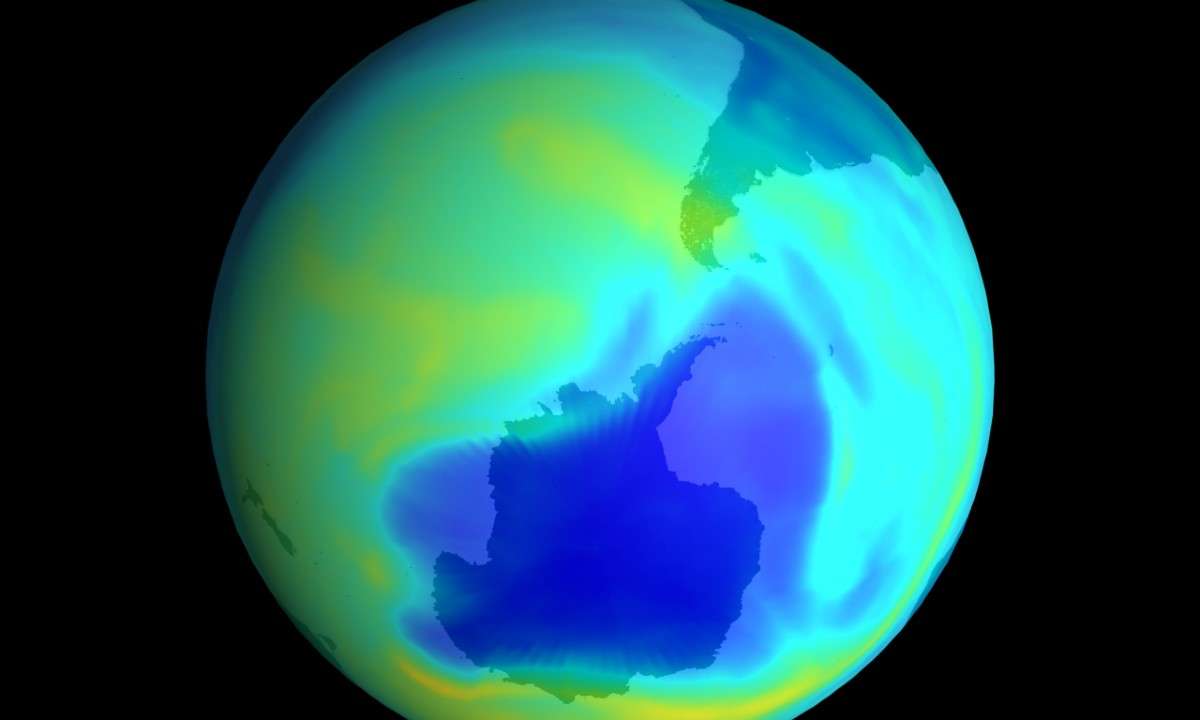
A global consortium of researchers has found that ozone-depleting substances (ODS) such as carbon tetrachloride (CCl4) and HCFC-22, used as feedstocks to produce HFOs, are leaking at rates much higher than previously believed, causing a delay in the repair of the ozone layer.
The researchers, led by Empa (Swiss Federal Laboratories for Materials Science and Technology), published their findings in a paper called “Continuing industrial emissions are delaying the recovery of the stratospheric ozone layer” in the April 16 issue of Nature Communications.
Without additional measures, elevated emissions of ODS (amounting to 3.6% of production per year, 4.3% for CCl4) could delay the recovery of the mid-latitude stratospheric ozone layer by 7 (6–11) years, until about 2073, the study said. This sharply differs from the assumption made by the Montreal Protocol on Substances that Deplete the Ozone Layer that emission rates of feedstocks were only 0.5% of the amount produced and that feedstock production would decline in the future.
Enacted in 1987, the Montreal Protocol prohibits the use of ODS as refrigerants and foams but excludes ODS used as feedstocks from the ban. That the healing of the ozone layer is a direct result of reducing ODS was confirmed last year by an MIT-led study.
The study proposed that losses from feedstock CCl4 explained the higher emissions, which were estimated to be 4.3% of production. In a recent analysis, this value was further split into 2% losses during the actual production and 2.3% from the use as feedstock.
The new findings are based on global atmospheric measurements from international networks such as the Advanced Global Atmospheric Gases Experiment (AGAGE), which includes the Empa research station at Jungfraujoch in Switzerland, according to a report in newswise.com.
The European Chemical Industry Council (Cefic) declined to comment on the Empa-led study.
Growth in feedstock usage
This higher emission factor was independently accompanied by a substantial increase in the use of CCl4 as a feedstock of 4–5% per year between 2014 and 2024, the study said, adding, “This development was mainly caused by a continuously increasing production of CCl4-dependent HFOs and HCFOs.” The current 4% annual increase in production in CCl4 is assumed to continue until 2034 and is expected to remain stable afterwards, the study said.
The Environmental Investigation Agency (EIA) reported last year that consumption of HFOs and HCFOs in the U.S. is projected to more than double by 2030, reaching approximately 106,000 metric tons – up from around 40,000 metric tons in 2021. Some HFOs, notably HFO-1234yf, break down when they leak into the atmosphere into trifluoracetic acid (TFA), an environmental pollutant that has infiltrated surface water and soil globally.
ODS feedstocks are also used in large quantities to produce non-ozone-depleting hydrofluorocarbons (HFCs), but HFCs are being phased-down under the 2016 Kigali Amendment to the Montreal Protocol because of their high GWPs.
However, ODS feedstock chemicals also have high GWP values (CCl4 has a 100-year GWP of about 2,200), meaning that they not only damage the ozone layer but also act as powerful greenhouse gases. If nothing changes, these additional climate-damaging emissions will reach around 300 million metric tons of CO2 equivalents per year by mid-century – comparable to the current annual CO2 emissions of a country like England or France, reported newswise.com, adding, “Reducing these emissions would therefore have a dual benefit.”
Other studies
The impact of CCl4 was highlighted in a recent study in the Proceedings of the National Academy of Sciences. It attributed ozone layer depletion that took place as early as 1957 — about 30 years before the ozone hole was discovered – not to CFC refrigerants, but to CCl4 used as solvents, the study said.
The EIA has reported extensively on CCl4 as a feedstock for HFO production. In a 2023 report, EIA cited data from the WMO (World Meteorological Organization), which estimated emissions of CCl4 in 2020 to be 34Gg/year from feedstock and other sources.
In a report released last year, the EIA stated that emissions of ODS like CCl4 “can be significant and there are numerous evidenced cases of feedstock and byproduct emissions being underreported.” Increasing demand for HFOs such as HFO-1234yf has already contributed to a growth in CCl4 production in recent years, the report added, and, if demand continues to increase, “this could result in sustained elevated atmospheric abundance of this damaging ODS.”
“This development was mainly caused by a continuously increasing production of CCl4-dependent HFOs and HCFOs.”
Empa-led research study