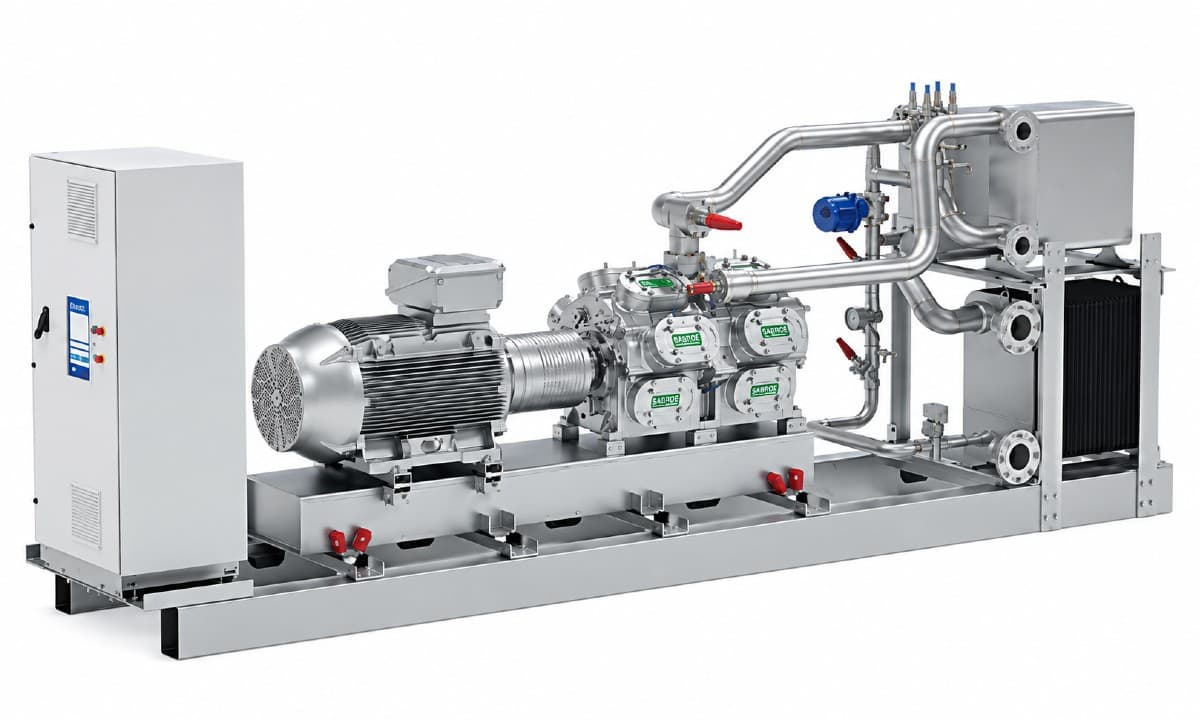
Two reversible CO2 (R744) heat pumps, designed and manufactured by Swiss OEM Biaggini Frigoriferi, will deliver 412kW (117.2TR) of heating capacity and decarbonize a historic railway station in Ticino, Switzerland, according to Project Manager Luca Rossi.
In addition to supplying water at 70°C (158°F) for space heating, the groundwater-sourced water-to-water units can simultaneously deliver 660kW (187.7TR) of cooling capacity at 7‒12°C (45‒54°F) for air-conditioning.
“The units replace two [fossil-fuel] burners and cut around 250 metric tons of CO2e emissions per year,” Rossi told NaturalRefrigerants.com. “In heating mode, they deliver high-temperature water, ensuring compatibility with existing systems.”
Commercial applications: Supermarket chain Migros Ticino, one of Swiss retailer Migros Group’s 10 regional cooperatives, has saved money and cut carbon emissions with Biaggini’s TotalGreEnergy CO2 systems. The design integrates refrigeration and HVAC functions, with recovered waste heat supporting space heating and domestic hot water within a single CO2-based installation.
- In the 2023 retrofit of an 800m2 (8,611ft2) store in Lugano, the retailer reduced store energy use by 35% compared to its previous HFC-based HVAC&R systems. The combined CO2 system cut CAPEX costs by roughly 25%, according to Rossi.
- Migros Ticino opted for an integrated CO2 system for a new 2024 build in Bellinzona, with a photovoltaic array powering the store. The TotalGreEnergy system provides 65kW (18.5TR) for medium-temperature refrigeration, 20kW (5.7TR) for low-temperature refrigeration, 80kW (22.7TR) for space heating, 90kW (25.6TR) for air-conditioning and 40kW (11.4TR) for hot water production.
- The design saves roughly 39 metric tons of CO2e per year, Rossi said.
Regulatory action: Switzerland’s Climate and Innovation Act establishes a legally binding greenhouse gas net-zero target for 2050 and provides a framework for emissions reductions across key sectors of the economy.
- Under its CO2 Act, the country aims to reduce its CO2e emissions by 50% by 2030 compared to its 1990 levels.
- The CO2 Act also operates funding programs, supported by revenues from auctioning emission allowances, to help Swiss industrial companies implement decarbonization measures involving financial or technical risks.
Quotable: “[The railway station] installation is a further step towards decarbonization in our region,” Rossi said.
“The units replace two [fossil-fuel] burners and cut around 250 metric tons of CO2e emissions per year.”
Luca Rossi, Project Manager at Biaggini Frigoriferi