German train operator Deutsche Bahn is expanding the use of propane (R290)-based HVAC in its fleet and says it expects that “all rail operators” in Europe will have 2,000 units in service by 2027, according to Peter Danzer, Project Leader.
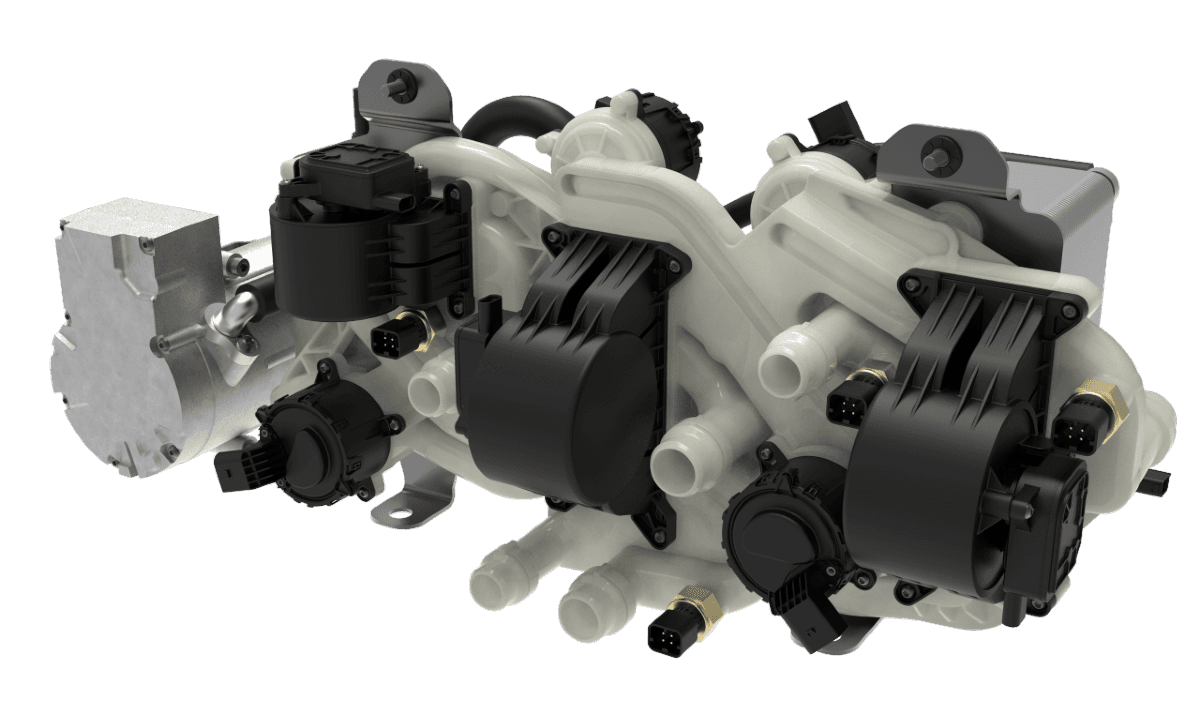
Deutsche Bahn currently has 16 R290 units ‒ manufactured by rail equipment supplier Faiveley Transport (Wabtec) ‒ installed in two of its new ICE 3neo passenger trains commissioned in June and July 2023. Each propane circuit contains less than 2kg (4.4lb) of propane.
“The attitude toward R290, deemed impossible [to use in rail HVAC] in the past due to flammability, has fundamentally changed,” said Danzer. “We’ve had no registered issues with the refrigerant in our trains and have added 48 propane HVAC units to our fleet [which includes Deutsche Bahn and all operators] since April and plan to add another 90 before the end of the year.”
Danzer detailed the German railway’s move toward R290 HVAC units in a presentation at the ATMOsphere (ATMO) MAC Summit 2024 × TU Berlin. The event, organized by ATMOsphere and Technische Universität Berlin’s Department of Heat Transfer and Heat Conversion, was held September 12–13 at the university’s campus in Berlin. ATMOsphere is the publisher of NaturalRefrigerants.com.
Transitioning to NatRefs
Deutsche Bahn’s first foray into natural refrigerant HVAC systems was in 2000 when it ordered 500 air (R729)-based units for its ICE 3 trains. In 2014, the company outlined a strategy to completely transition new passenger cars to natural refrigerants beginning in 2020.
“In 2018, we invited companies to test their natural refrigerant HVAC units with us,” Danzer said. “We considered air and CO2 [R744] solutions but not propane,” he added.
When Faiveley approached Deutsche Bahn about using a flammable natural refrigerant, Danzer said the company was open to it if the manufacturer could guarantee safety. “Faiveley convinced us they were on the right track,” he said.
“We participated in testing the R290 unit from mid-2020 to mid-2021 and then in railcars in 2022,” Danzer said. “We feel proud to be part of the pioneering work done by Faiveley to develop this safe unit.”
According to information available to Danzer, propane HVAC units currently operate or will soon operate in trains in Austria, Belgium, Finland, France, Germany, the Netherlands, Norway and Switzerland.
“With the current effort to transition from f-gases to natural refrigerants, propane, at the moment, is making a run in the railway HVAC sector,” Danzer said, adding that Italy and Germany also have cars operating with CO2 HVAC systems.
“Considering it normally takes six years in the train industry to make a transition like this, having 2,000 propane HVAC units in operation by 2027 is a good start to moving toward natural refrigerants,” Danzer said, adding that he estimates that roughly 200,000 HVAC units will be in operation in European railways by 2027.
Safety measures
As an A3 refrigerant heavier than air, installing propane HVAC units requires evaluating risks in normal operation, maintenance and accidental incidents, Danzer explained. “The risk assessment has led us to rethink the construction, workshop operation, maintenance and emergency procedures.”
“In the construction of the unit, Faiveley accounts for normal operation safety with a tight technical system,” Danzer said. “There is no explosion hazard while the circuit remains unopened.”
Ventilation in workshops, following local safety regulations and trained staff with flammable refrigerant competence certifications help address safety concerns for R290 HVAC maintenance, he said.
Failure of a component in the circuit or a railway accident could result in a propane leak. However, with the units mounted on the exterior of the rail car, generally on the roof, the cooling circuit is always in contact with the outside air, negating an explosion hazard, Danzer noted.
“If desired, gas leak detectors provide an additional assurance, but they are unnecessary when other actions guarantee a high level of safety,” he said.
“The way to natural refrigerants is paved,” said Danzer at the ATMOsphere (ATMO) Europe Summit 2023. “F-gases are a dead end; [they] are not the future. The industry must now follow the proven results of propane and CO2.”
A previous version of this article stated that Deutsche Bahn planned to have 2,000 HVAC units in service by 2027. That has been corrected to “all rail operators in Europe” to reflect that Deutsche Bahn alone will not be putting 2,000 R290 HVAC units into service by 2027.
“The attitude toward R290, deemed impossible [to use in rail HVAC] in the past due to flammability, has fundamentally changed.”
Peter Danzer, Project Leader at Deutsche Bahn