A diverse panel of HVAC experts, who are helping to chart a path for natural refrigerants like CO2 (R744) and propane (R290) to be used in HVAC applications in the U.S., described their approaches at the ATMOsphere (ATMO) America 2026, held June 2–3 in Tarrytown, New York. (ATMOsphere is the publisher of NaturalRefrigerants.com.)
Led by Aleisha Khan, Executive Director of REEF (Refrigerant Emissions Elimination Forum), the panel consisted of: Umesh Goswami, Principal Environmental Sustainability Manager for Roche; Michael May, President and CTO for êffecterra; Cory Palmer, Vice President of Engineering, DMG North; Jonathan Woolley, Owner, Emanant Systems & Co-Founder and CTO, Aris Hydronics; and Curtis Harrington, Director of Engineering, UC Davis Western Cooling Efficiency Center.
Roche, a global biotech giant based in Basel, Switzerland, plans to eliminate f-gases and ozone-depleting gases (what it calls halogenated hydrocarbons) from its facilities by 2030, a process that began in 1994. To that end, it has been employing a range of natural refrigerants.
CO2 heat pumps
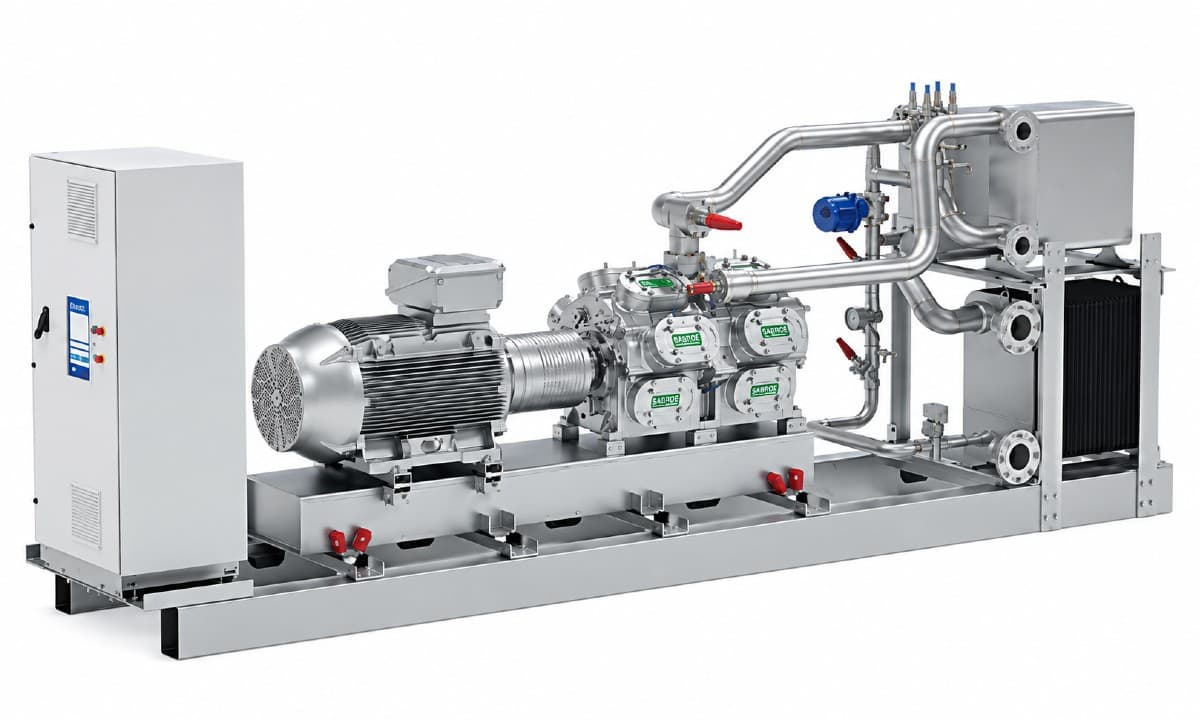
Êffecterra, a U.S. design and consulting firm, is developing a CO2 commercial/industrial chiller/heat pump that can deliver space heating, space cooling and domestic hot water production. It will offer 106TR (373kW) cooling to 120°F (49°C) ambient with a 5–6 COP at 101°F (38°C); and 125TR (440kW) heating to -25°F (-32°C) ambient, with a 3.3–4.5 COP at 10 to 30°F (-12 to -1°C). Targeted users include offices, hotels, hospitals, schools, gyms, restaurants and multi-mixed-use real estate.
May envisions the CO2 heat pump replacing a hydrocarbon-sourced boiler making hot water and an HFC chiller. “You can take both those pieces of equipment out and replace them with a single piece of equipment that uses less than 10 GWP gas.”
“CO2 as a refrigerant can deliver outstanding efficiency in these types of applications, and more importantly, it can actually provide multifunction benefits,” said May. He added that in the U.S. there is no widely used HVAC refrigerant that is less than 10 GWP and not a PFAS (per- and polyfluoroalkyl substance).

Êffecterra finished the design of the CO2 chiller/heat pump last year and is negotiating with the Oak Ridge National Lab and the U.S. Department of Energy (DOE) to finance a full-scale prototype in 2026. May expects units to be manufactured by Q1 2027 and ready for installation in Q3 2027.
In addition to replacing chillers and boiler in buildings, the U.S. HVAC industry needs a natural refrigerant-based rooftop solution, said May. “If you want to really change this market, we got to go after rooftops.”
Addressing concerns about the cost of CO2 HVAC applications, May advised “driving the message that the economic equation is there for natural refrigerants.” He added, “This room is deploying economic solutions every day with natural refrigerants, and it can be done.”
“CO2 as a refrigerant can deliver outstanding efficiency in these types of applications, and more importantly, it can actually provide multifunction benefits.”
Michael May, President and CTO, êffecterra
Last year DMG North, a California-based HVAC project management firm, opened its Decarbonization Training Center in San Jose focused on commercial buildings. The facility trains contractors, service companies, mechanical engineers, building owners and developers on heat pumps, in particular a transcritical CO2 heat pump, explained Palmer. Partner organizations include the California Energy Commission, California Air Resource Board, Flow Environmental Systems, Lawrence Berkeley National Lab and ProspectSV. DMG North also launched a website and event program called Mechtalk.com.
Palmer noted that in Northern California, CO2 heat pumps are being installed in commercial buildings for heating hot water, in some cases also domestic hot water, and providing chilled water in both new construction and retrofits. “If it’s a project revolving around decarbonization, it would be replacing an existing gas boiler with a heat pump, either air source or water source,” he said.
In some cases, the end user decides to completely remove the boiler; in other projects, they keep the boiler or downsize it “for peak days just when needed for capacity,” Palmer said. “The common denominator with these projects is it’s that you have an end user who’s keen on sustainability and also wanting to try this technology.”
R290 heat pumps
Aris Hydronics, a heat pump designer in the U.S. Pacific Northwest, is focused on bringing affordable and high-performance monobloc-style packaged air-to-water heat pump systems to residential applications and light commercial applications in the U.S. With installations starting in the Portland and Seattle markets, the units currently use R32, but Aris plans to ultimately employ propane, said Woolley.
“Our vision is to really help unfold the air-to-water market here in the United States,” said Woolley. He noted that while air-to-water heat pumps account for more than 50% of heat pump sales in Europe (where hydronic systems are more prevalent), their market share in the U.S. is practically zero. “So we only have room to grow.”
In 2024, the DOE selected Aris Hydronics as the winner of the $1 million Equitable and Affordable Solutions to Electrification (EAS-E) Home Electrification Prize for its Aris Home Comfort System for single and multifamily buildings.

Aris is running five R290 heat pump projects, including one at a low-income multi-family building in Northfield, Vermont, that serves as transitional housing for homeless veterans and one at an affordable housing location in Albany, New York.
The Northfield, Vermont, project, which has just begun installation, is funded by the DOE in a collaboration with Lawrence Berkeley National Labs and the VEIC. It will use three R290 air-to-water heat pumps, ductless fan coil units and dual-volume thermal energy storage (TES) modules to provide heating and cooling for 11 bedrooms and domestic hot water for five shared baths and a commercial kitchen.
The Albany, New York, project is being done with NYSERDA in collaboration with RMI and WinnCompanies, a manager of affordable housing. “That project is just getting underway, and we’ll be proceeding with design and installation over the next year or so,” said Woolley. It will include R290 air-to-water heat pumps for heating, cooling and domestic hot water.
“Our vision is to really help unfold the air-to-water market here in the United States.”
Jonathan Woolley, Co-Founder and CTO, Aris Hydronics
Current UL limitations on R290 charge size in HVAC systems in the U.S. (114g) discourage the use of R290 in air-to-water heat pumps, though efforts are underway to align with the global IEC standard adopted in Europe and elsewhere. Meanwhile for the Vermont project Aris Hydronics gained permission from local authorities with jurisdiction (AHJs) “up front, even while we were beginning to do design, so that hasn’t been a huge barrier,” said Wooley.
Another barrier to adoption of air-to-water heat pumps in the U.S. is that HVAC, especially for residential and mid-sized multifamily housing, is centered on central air distribution and duct work. “Hydronic systems are just really unfamiliar, and let’s be honest: They are actually a little bit complicated,” said Woolley. “From a systems perspective they have a lot of simplicity, but what we expect contractors to be able to do right now in the market is a really big lift.”
Aris Hydronics is addressing that problem by modularizing and streamlining its components as a vertically integrated HVAC solution provider. “We’re like a direct-to- consumer solution provider, like a one-stop shop,” said Wooley. “We provide everything from design specification of all the components and the integrated factory packaging of all of the main central pieces, so that when it’s out in the field, installers can focus on getting electrical to the right place and plugging it in, running hydronic pipes and taking time to insulate them properly without having to worry about all the details.”
The University of California (UC) Davis Western Cooling Efficiency Center is developing and testing R290 air-to-water heat pumps for residential applications, with funding from the California Energy Commission. With an R290 charge limit that exceeds the 114g limit, the heat pump uses a secondary loop to convey glycol into the living space.
To improve the performance of the secondary loop, UC Davis is designing a polymer-based heat exchanger that uses micro channels to improve the effectiveness of the heat exchanger relative to standard thin-tube hydronic heat exchangers, said Harrington. UC Davis is also incorporating phase change material (PCM) thermal energy storage in the secondary loop to allow load shifting for California’s grid.