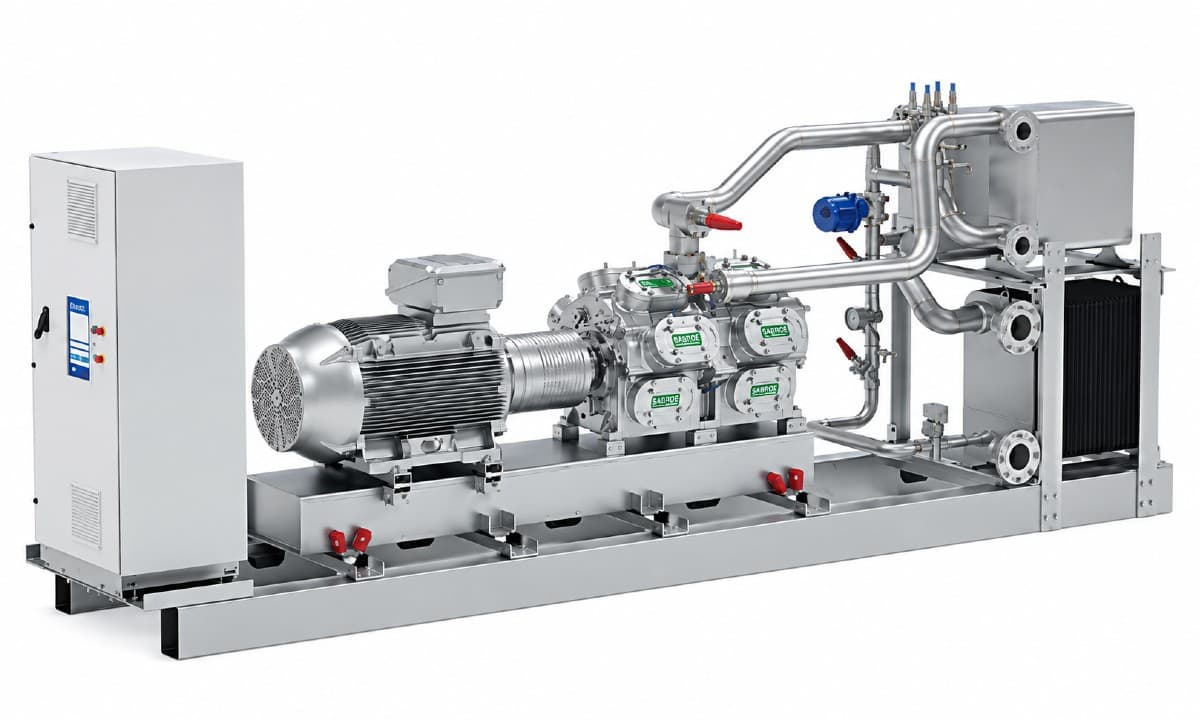
Multistack, a U.S.-based manufacturer of modular water chillers, has showcased its concept CO2 (R744)-based hot water heat pump at the 2025 AHR Expo.
Designed for large-scale commercial applications such as hospitals and multifamily buildings, the air-source ARP_CO2 heat pump promises a temperature lift of 55.6°C (100°F), delivering hot water temperatures of up to 65.6°C (150°F).
According to Brad Snodgrass, Multistack’s Special Projects Coordinator, the development of this CO2 heat pump aligns with growing industry efforts to reduce carbon footprints and electrify heating systems.
“Customers have said this is what they want,” he told NaturalRefrigerants.com in an interview at AHR.
While the heat pump’s launch date was not confirmed, it is unlikely that it would be commercially available in 2025, noted Snodgrass, citing limited market demand and a lack of R744-trained service technicians as the main barriers to the technology’s roll out.
“The biggest challenge we see is in the service industry,” he explained. “I can’t find a technician with a truck that has the necessary set of gauges. They exist, but not in our normal rep network – but that will come.”
Multistack hopes that developing the CO2 heat pump and showcasing the concept at fora like AHR will help stimulate market demand and encourage capacity building within the HVAC sector.
“There will be a lag, and it’ll be painful, but that’s how growth happens,” Snodgrass said. “We’ll get there.”
The AHR Expo took place February 10–12 in Orlando, Florida.
“The biggest challenge we see is in the service industry. I can’t find a technician with a truck that has the necessary set of gauges. They exist, but not in our normal rep network – but that will come.”
Brad Snodgrass, Special Projects Coordinator at Multistack
Collaboration on natural refrigerants
Snodgrass also attributed Multistack’s development of the ARP_CO2 heat pump to the company’s partnership with Ohio-based OEM Budzar Industries, which it acquired in 2018. Budzar offers a range of ammonia (R717)-, CO2– and hydrocarbon-based HVAC&R systems under its Budzar Green portfolio.
“Our partner Budzar Industries works with propane [R290], butane [R600a] and a bunch of different naturals,” he explained. “We have nice engineering resources and teammates there that get us thinking.”
Speaking to NaturalRefrigerants.com at AHR, Anthony LaRiccia, Sales and Service Support at Budzar, noted that the company is seeing particular interest in its hydrocarbon systems, which cover capacities of 2.6kW to 2.4MW (0.75–600TR).
Demand for these units are driven by consumers’ interest in “going green,” he said, particularly in the pharmaceutical and food industries. LaRiccia said that the main drive toward propane chillers is because of the sustainability of the refrigerant itself, adding that propane is also “way better” than synthetic alternatives like R404 in terms of efficiency.
However, the cost of propane systems is generally twice as high due to safety features needed to mitigate the risk of propane’s flammability. For example, pipe welding and including multiple refrigerant circuits in a system to minimize the amount of refrigerant per circuit.
At present, larger custom-built systems using propane require case-by-case approval from local authorities. However, the U.S.-based International Institute of All-Natural Refrigeration (IIAR) is currently developing a safety standard for large-scale closed-circuit hydrocarbon refrigeration systems that would allow for up to 1,100lbs (500kg) of hydrocarbon refrigerants onsite. Once approved, the standard will make the adoption of hydrocarbons much easier, according to Tony Lundell, Senior Director of Standards and Safety at IIAR.
As noted by LaRiccia, it is likely that each state will have its own regulations, highlighting the importance of tailor-made systems.
Currently, Budzar’s hydrocarbon-based chillers and heat pumps generate approximately $5 million (€4.77 million) in annual sales, said LaRicca, with each system costing around $1 million (€960,000). To date, customers include pharmaceutical companies IPS Pharma, Genentech and Merck and an egg farm. He said that sales are expected to increase over the coming years.
“It’ll catch on, but it might take five or 10 years,” he added.