A mix of Rivacold CO2 (R744) condensing units (CDUs) and propane (R290) monoblocs is supporting the sustainable retrofit of Brattleboro Food Co-op’s Vermont grocery store, according to Sam Major, General Manager at refrigeration contractor Turner Piping.
Major outlined the installation, which totals 32.1TR (113kW) of cooling capacity, for the space-constrained 14,000ft2 (1,301m2) store in an interview with NaturalRefrigerants.com. The piecemeal retrofit of the store, located in the city of Brattleboro, includes up to 13 roof-mounted CO2 CDUs serving the open and closed medium-temperature (MT) cases, along with R290 monoblocs cooling exterior walk-in coolers and freezers. A ground-level CDU with more than 10TR (35kW) of cooling capacity serves the store’s foodservice loads.
“The building is very unique, with the old refrigeration equipment stuffed into closets and operating with brazed-plate heat exchangers because there was no room for condensers,” Major said. “As we picked the store apart and tackled it one department at a time, we ended up using most of Rivacold’s natural refrigerant lines available in North America.”
With no dedicated mechanical room or back-of-house space, the store’s more than 50 refrigerated cases and eight walk-in coolers/freezers required a combination of refrigeration solutions, according to Major. The co-op occupies the ground floor of a multi-story building, with eight floors above the walk-ins and food-service area. In contrast a lower roof over the sales floor has limited weight-bearing capacity, ruling out a conventional CO2 rack.
The solution
The mixed refrigeration system provides 260,000BTU/h (76.3kW/21.7TR) of MT CO2 CDU capacity and 68,000BTU/h (19.9kW/5.7TR) of low-temperature (LT) CO2 CDU capacity. R290 monoblocs provide an additional 57,000BTU/h (16.7kW/4.7TR) of capacity for MT and LT walk-ins.
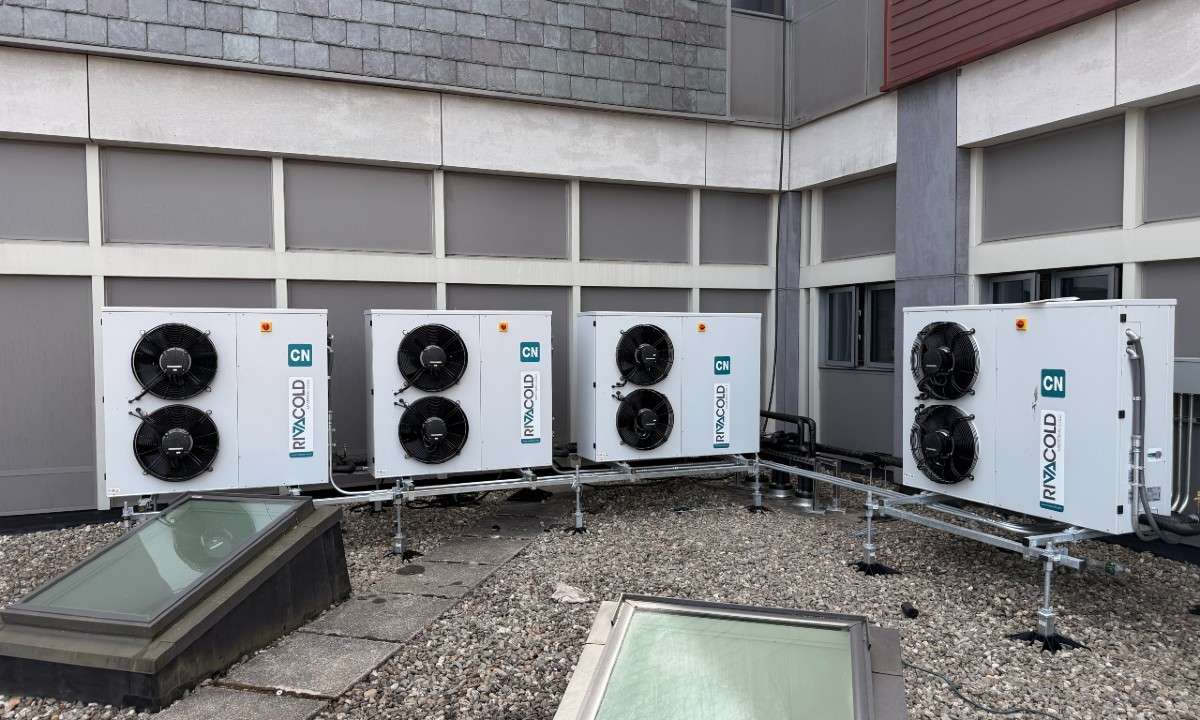
The CO2 equipment includes Rivacold’s CN line, with individual capacities ranging from 0.16‒2.2TR (0.56‒7.7kW), installed on I-beams or columns on the lower roof. A Rivacold MHX CO₂ CDU with two Dorin semi-hermetic compressors serves the food-service load.
Turner Piping kept the legacy system running while installing the new CO2 piping and CDUs, and it transferred the loads section by section. “The Rivacold CN CDUs have been very efficient,” Major said. “The large operating envelope with the use of the Toshiba rotary compressor allows for constant adaptability to load conditions, which is widely variable given the climate we have in Vermont. Early indications from the e-gauge on the building, comparing pre- and post-installation, point to double-digit percentage energy savings.”
For the exterior walk-ins, Turner Piping used Rivacold’s R290 BOLD line and the R290 BEST line for the small interior walk-ins. Every monobloc houses up to three refrigeration circuits, with each circuit charged with 140g of propane. Depending on the size of the cold room, the contractor installed up to four individual R290 monoblocs. The produce cooler, for example, uses two units with capacities ranging from 5,845 to 10,141 BTU/hr (1.7kW/0.49TR to 2.97kW/.85TR), providing a total MT capacity of 20,200BTU/h (5.92kW/1.68TR).
Balancing the grid
Beyond reducing energy consumption, the new refrigeration system is also being used to help manage the area’s electricity demand. As part of a pilot program, currently referred to as flexible load management, the Brattleboro co-op increases its use of abundant daytime solar power by pre-cooling its refrigeration systems, which allows it to float its refrigeration setpoints for up to three hours.
“For example, in preparation for a peak energy event, we drive normal ice cream storage setpoints from −10°F [−23°C] down to −20°F [−29°C], creating a thermal battery,” Major explained. He added that when the electrical demand is high from 6‒9 pm, the co-op receives demand-response compensation from its electric utility provider.
Collaborators on the flexible load management program include Turner Piping, energy-management company Dynamic Organics (DO) and the statewide energy-efficiency utility Efficiency Vermont. Turner and DO have implemented a strategic controls strategy, still under development, that adjusts refrigeration setpoints based on current and projected energy consumption, helping to smooth electricity demand during peak periods or other conditions identified by the energy aggregator.
Benefits/timing
In April 2025 Brattleboro Food Co-op was awarded $500,000 (€434,000) from the U.S. Department of Agriculture (USDA)’s Rural Energy for America Program (REAP) to replace its legacy R404A-based refrigeration system. The store’s annual leak rate at that time exceeded 300%, according to the co-op’s Administrator/Sustainability Coordinator, Sarah Brennan. In 2024 that amounted to 378lbs [171kg] of R404A emitted to the atmosphere, she added.
REAP requires the project to be completed by March 2027 for the Vermont co-op to receive the funding, with the total retrofit costing roughly $1.4 million (€1.2 million). However, Major expects the project to be completed in early October, with 85% of the retrofit already finished. Representatives from Rivacold’s U.S. and Italian teams plan to attend the upcoming grand opening.
“This project provides a huge platform for us, Rivacold, Dynamic Organics and Efficiency Vermont,” said Major. “It shows there are options beyond a traditional CO2 rack to transition stores to natural refrigerants while reducing environmental impact and saving energy.”
“Early indications from the e-gauge on the building, comparing pre- and post-installation, point to double-digit percentage energy savings.”
Sam Major, General Manager at Turner Piping