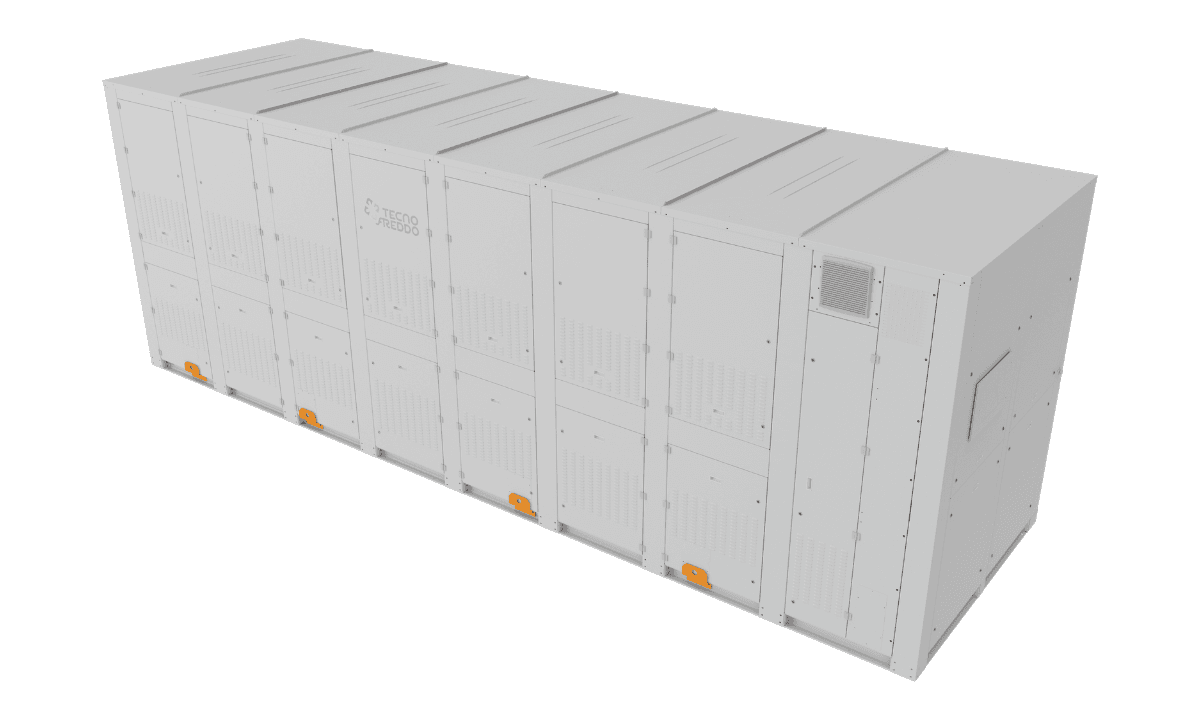
To determine the most efficient natural refrigerant solution for medium-temperature (MT) food retail applications, Arneg Oceania used simulated modeling to compare the energy efficiency of transcritical CO2 (R744) racks to propane (R290) glycol chillers.
The three modeled climate zones were of the Italian cities Padova (cold), Rome (temperate) and Catania (warm). Fabio Ferrara, Senior Refrigeration Engineer at Arneg Oceania, presented the simulation results in March at Refcon 2025, held in Melbourne, Australia. He highlighted the simulation’s applicability to the region, citing the need for “new refrigerant solutions” given the EU f-gas regulation’s export ban on refrigerated cabinets and racks with capacities greater than 40kW (11.4TR) and GWPs greater than 1,000.
The CO2 rack simulation did not account for additional CO2 energy-saving features other than flash gas bypass and parallel compression. The R290 chiller model accounts for the energy used by the pump to circulate the glycol.
“Although the modeling is rough, it highlights the COP advantage of direct CO2 racks in colder climates and that of the R290 chiller in warmer climates, especially for medium-sized or smaller stores,” Ferrara said.
CO2 rack versus R290 chiller: The modeling calculated the COP of 70kW (19.9TR) MT cooling capacity systems using Bitzer compressor software, according to Ferrara. The MT output for the glycol chiller was set at −12°C (10.4°F) to account for glycol temperature loss during circulation and the CO2 rack at −8°C (17.6°F).
- The COP was calculated at six different ambient temperature ranges, starting at less than 10°C (50°F) and going to greater than 30°C (86°F). The total energy consumption accounted for the requested cooling capacity from 52.5 to 70kW (14.9 to 19.9TR) based on the hours spent in the different ambient temperature ranges and the COP.
- The cold climate spends 651 hours a year operating at 70kW, the temperate 1,232 hours and the warm 1,432 hours.
- In the cold climate, the CO2 rack used 157,478kWh of energy annually, and the R290 glycol chiller used 164,737kWh. In the temperate zone, the CO2 rack used 173,153kWh and the R290 system 174,726kWh. In the warm climate, the CO2 rack used 184,349kWh and the R290 system 181,270kWh.
CO2/R290 versus synthetics: Ferrara showcased the advantages of natural refrigerants over synthetics using actual data and the simulated modeling of an R448A glycol chiller and an R1234ze glycol chiller in the three climate zones.
- Annual data from two roughly identical 66kW (18.8TR) total capacity grocery stores in Genova ‒ one using a CO2 rack and the other an R488A glycol chiller ‒ showed the two stores with comparable energy consumption from May to September when ambient temperatures climbed to 30°C. “However, from October to May, with ambient temperatures staying below 20°C [68°F], the CO2 rack has a definite advantage,” Ferrara said.
- In the modeling, the CO2 rack was more energy efficient than the R448A system in the cold and temperate zones by 3.5% and 0.1%, respectively. The R448 glycol chiller outperformed the R290 glycol chiller by less than 1% in all three zones.
- The CO2 rack and the R290 glycol chiller outperformed the R1234ze system in all zones by more than 4%.
Quotable: “Energy consumption based on the climate is not the only factor to consider when comparing CO2 and R290,” Ferrara said. “Other factors include the skill level of the technicians, the size of the store, modularity/flexibility and the potential integration with the AC, low-temperature refrigeration and hot water systems.”