The use of transcritical CO2 (R744) refrigeration systems and self-contained hydrocarbon display cases – mostly propane (R290) – continues to climb in Latin America, according to ATMOsphere’s 2025 report “Refrigeration: Commercial and Industrial Refrigeration with Natural Refrigerants.”
ATMOsphere is the publisher of NaturalRefrigerants.com. Latin America as defined in the report encompasses Mexico, Central and South America.
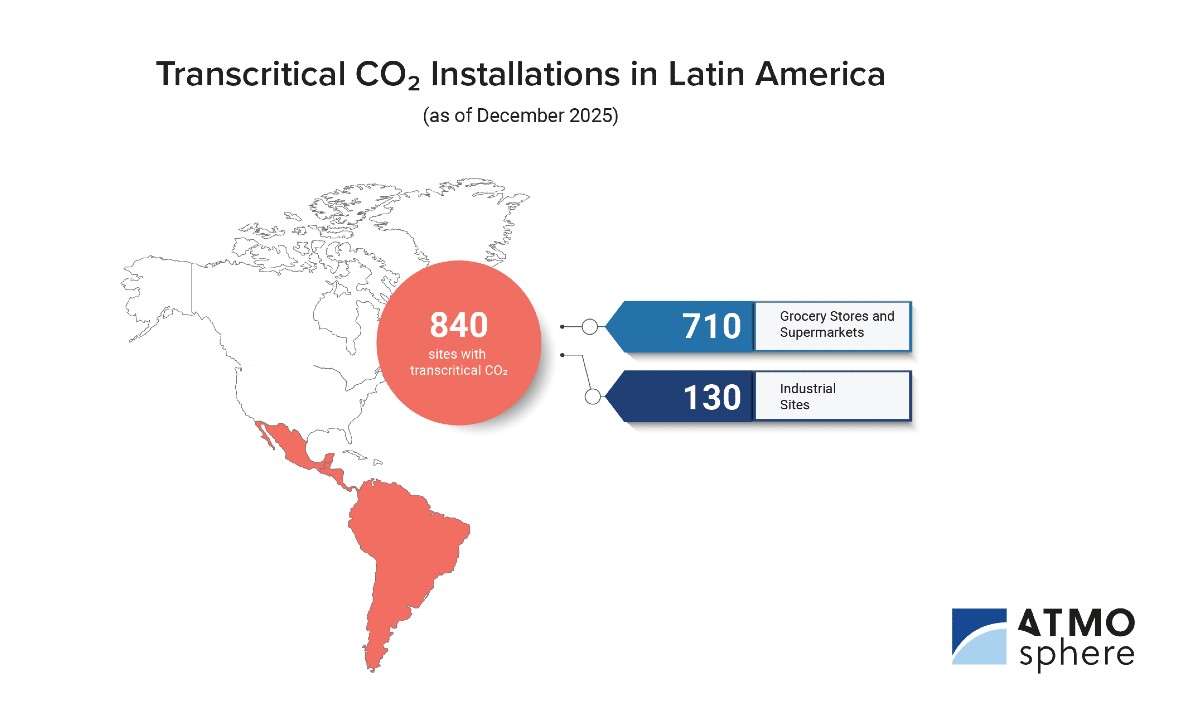
As of December 2025 an estimated 840 commercial and industrial sites in the region were using transcritical CO2 refrigeration, a 23.5% increase from the 680 sites estimated in December 2024. Of the 840 total systems, 710 were supermarkets and grocery stores, up from 580 in 2024, while 130 were industrial sites, up from 100 in 2024.
During the same time period, ATMOsphere estimates that installations of self-contained hydrocarbon cases grew 10%, from 8.5 million in 2024 to 9.4 million in 2025. The report also reveals that an estimated 65 industrial sites in Latin America were using low-charge ammonia (R717) in 2025, up from 60 sites in 2024.
Factors driving the uptake of natural refrigerants in Latin America include financial support from the Montreal Protocol Multilateral Fund, country-level policies and incentives, training initiatives and local manufacturing investments. In addition, the report examines the increasing use of propane chillers in the region.
Leading the way: While natural refrigerant adoption is growing across Latin America, several countries stand out, including Colombia, Mexico and Chile.
- The Colombian government offers incentives for purchasing refrigerant equipment with a GWP of less than 100. There were 150 transcritical CO2 systems installed in the country’s supermarkets and grocery stores as of December 2025, representing 21% of the total number in Latin America.
- Of the region’s 9.4 million self-contained hydrocarbon cases, 2.9 million, or roughly 31%, were in Mexico. With 29 warehouses in Mexico and two in Peru, cold-chain provider Frialsa reported that 22 of its 31 facilities use natural refrigerants – either ammonia or ammonia/CO2 cascade systems.
- Chile-based food retailer Cencosud has converted 22 stores to transcritical CO2, including 17 in Chile. It is using the refrigerant in all new stores, with plans to convert another 10 to 12 stores in 2026. Meanwhile the Chilean Ministry of the Environment’s Ozone Unit, with support from the Montreal Protocol’s Multilateral Fund, announced a pilot project for transcritical CO2 heat pumps in industrial refrigeration.
Supporting framework: Local manufacturing and training initiatives are helping lay the groundwork for increased adoption of natural refrigerant solutions.
- Mexican refrigeration manufacturer FB Industrial offers ammonia, CO2 and propane commercial and industrial solutions across Latin America. In 2023 German manufacturer TEKO Refrigeration formed TEKO Americas, a joint venture with Colombian manufacturer Weston, to supply CO2 refrigeration systems to the continent’s retail chains.
- Support for technicians is also expanding. Brazil opened a training laboratory equipped with a CO2/propane cascade system in 2025, while Ecuador opened hydrocarbon training centers in Quito and Guayaquil and held ammonia-training days. In Mexico a minimart featuring a propane chiller that subcools a CO2 system will be used to train technicians.
Emerging option: In addition to transcritical CO2 systems, propane chillers are also used in commercial and industrial sites for medium-temperature (MT) applications, both as a primary refrigerant and to subcool CO2 systems.
- In Ecuador several retrofit pilot projects feature R290 chillers, including a Manta fish processing center replacing its 30TR (106kW) R22 chiller and a Quito food bank swapping out its R507 chiller.
- Mexican contractor Sistemas de Refrigeración Totales (SRT) installed an R290 chiller at a Grupo Bimbo facility in Mexico City. The system uses a −8°C (17.6°F) glycol secondary loop to maintain a 30-metric-ton capacity storage room at 0°C (32°F).
- In March 2025 FB Industrial launched a line of indirect propane chillers for the Mexican market. It offers an 8‒85TR (28‒299kW) capacity range for high-temperature applications up to 50°F (10°C) and a 5‒50TR (17‒176kW) range for MT applications down to 10°F (−12.2°C).
Quotable: “Several Latin American countries are making significant progress in adopting natural refrigerants,” Luis Gerard, President of FB Industrial, told NaturalRefrigerants.com. “Their advancements are largely driven by government-led economic incentives that promote sustainable technologies. Colombia and Chile have developed ambitious climate strategies, while Costa Rica has built a strong knowledge base within its industry.”