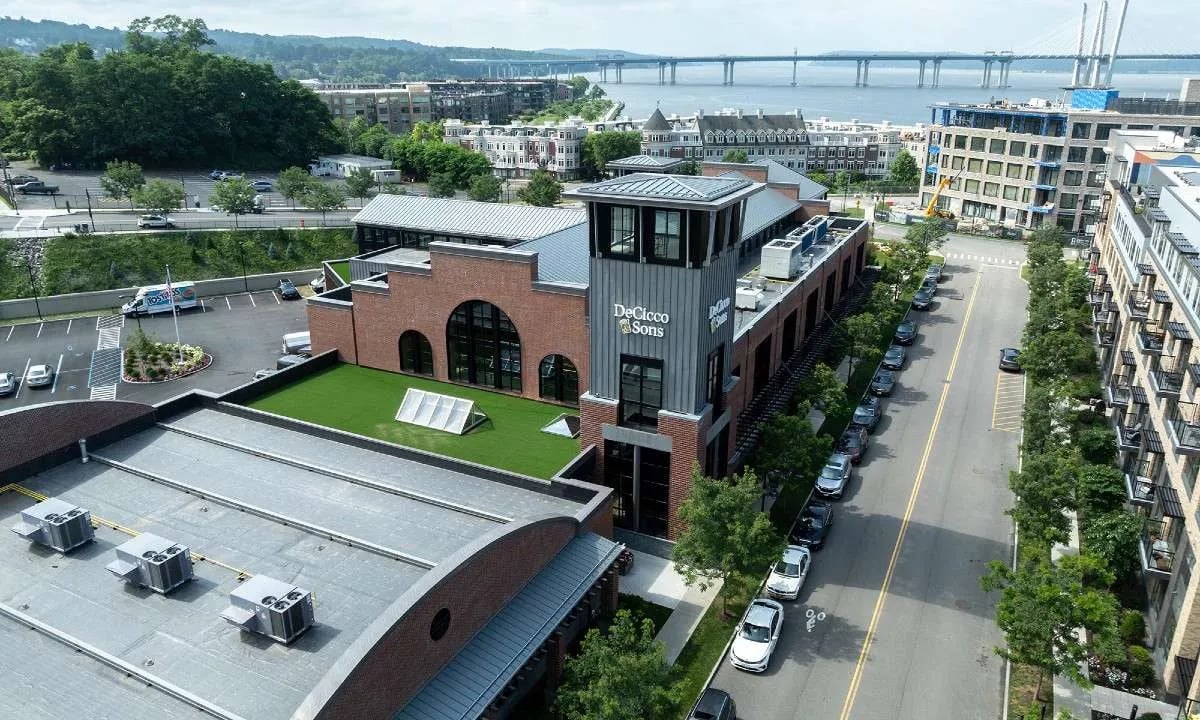
At DeCicco & Sons’ Sleepy Hollow store, Flō Energy Solutions’ HVAC unit, equipped with a CO2 (R744) direct expansion (DX) coil, is returning 60°F (16°C) refrigerant to the store’s transcritical CO2 rack even in summer, according to Niel Hayes, Senior Research and Development Engineer at Hillphoenix.
Hayes shared details about the configuration and the energy savings of the New York store in a presentation at ATMOsphere America Summit 2026. The event, organized by ATMOsphere, publisher of NaturalRefrigerants.com, took place June 2‒3 in Tarrytown, New York.
“We are seeing the same COPs at 70‒80°F [21‒27°C] ambient that we get at 60°F,” said Hayes. “From the data, we can project an energy savings of 40‒60MWh with the store running for an entire year with the adiabatic gas cooler and the HVAC units helping with subcooling.”
Varad Darji, Senior Product Manager at Hillphoenix, joined Hayes during the presentation to discuss the technology’s potential benefits for supporting CO2 operation in hot, humid climates. Peter Reist, Director of Product and Sales Strategy at Flō Energy Solutions, outlined the store’s boosted heat reclaim. John DeCicco Jr., President and CEO of DeCicco & Sons, also participated, covering the grocer’s natural refrigerant journey.
The configuration: In summer the standard order is reversed. Usually the refrigerant flows from the rack to the HVAC unit, then to the gas cooler and back to the rack. However, in the summer, the subcooling option routes hot CO2 to the gas cooler first, then the HVAC unit, before returning to the rack, according to Hayes.
- Depending on whether dry or adiabatic gas cooling is used, the gas cooler brings the CO2 within a couple of degrees of the dry- or wet-bulb temperature.
- In the HVAC unit, the refrigerant’s heat dehumidifies the air, further reducing the CO2’s temperature.
- “This is the first CO2 rack where we’ve established communications with an HVAC unit to help reject heat during the summer,” Hayes said, adding that subcooling lowers the flash-gas mass flow in the system, which reduces the energy required for refrigeration.
Moving forward: Based on the success of the DeCicco store, Hillphoenix plans to validate using heat reclaim to subcool CO2 refrigeration in additional pilot studies, starting with an installation in Florida, according to Darji.
- Hillphoenix expects boosted heat reclaim to deliver the greatest precooling savings in humid subtropical climates, such as Atlanta and Miami, followed by humid temperate climates, including New York City and St. Louis. Oceanic climates, such as Seattle, would experience the smallest savings.
- The HVAC-integrated design operates in parallel with other CO2 energy-saving technologies on the market, including parallel compressors and ejectors, Darji noted.
- Although the refrigeration and HVAC systems communicate with each other, they remain independent. “If one system goes down, it does not impact the other one,” Darji said.
Store heating: In the winter, Flō’s direct CO2 heat reclaim technology slightly raises the refrigeration system’s head pressure, pushing the refrigerant towards a supercritical state.
- The higher pressure allows Flō’s HVAC coil to capture almost all the system’s waste heat, compared to roughly one-third using standard heat reclaim, Reist explained.
- He added that for every kilowatt of energy used to raise the head pressure, the HVAC coil captures 5kW (1.4TR) of heat capacity that was already generated by the CO₂ refrigeration system.
- “Standard reclaim saves an enormous amount of natural gas,” Reist said. “Boosting reclaim reduces natural gas use by about another 52%, providing further support for decarbonizing stores.”
Quotable: “When we installed our first CO₂ store in 2014, we could only use heat reclaim to heat water,” said DeCicco. “Since then we’ve installed radiant heating systems, but I kept thinking there had to be a way to use DX. Then I met Peter at an ATMO America event, and now we’re cooling the rack with heat reclaim in the summer, and, in the winter, we’re heating the store.”
“I met Peter at an ATMO America event, and now we’re cooling the [CO2] rack with heat reclaim in the summer, and, in the winter, we’re heating the store.”
John DeCicco Jr., President and CEO of DeCicco & Sons