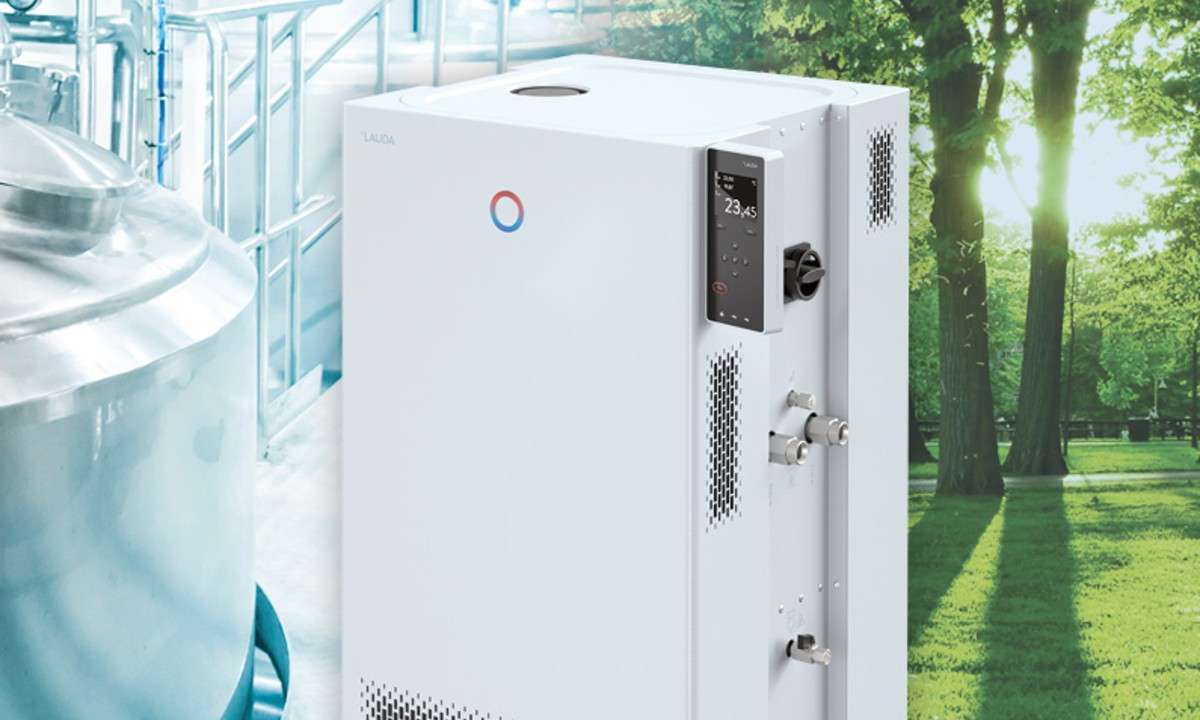
German temperature control equipment manufacturer Lauda has introduced its first CO2 (R744) refrigerant-based process thermostat, Integral IN 2040 XTW, for laboratory and industrial applications.
The new unit, with an integrated cooling system for dynamic temperature control of external circuits, delivers 20.8kW (5.9TR) of cooling capacity at an outflow temperature of 20°C (68°F). It offers a working-temperature range from −45 to 200°C (−49 to 392°F), while maintaining stability within 0.05K (0.05°C/0.9°F).
“Integral XT devices operate according to the flow principle with a cold oil blanket that enables the utilization of temperature-control media over a large temperature range,” Lauda said. “The electronically controlled, magnetically coupled pump can optimally set the flow rate both for the requirements of pressure–sensitive consumers and for applications with high hydraulic resistance.”
Additional details: “Thanks to its frequency-controlled compressor, the [unit] is extremely efficient, especially in partial-load operation,” Lauda said. “[It] consumes up to 50% less energy than comparable f-gas devices.”
- The device uses Lauda Variopump, which offers eight selectable output levels, with a maximum flow rate of 120L (31.7gal) per minute at a maximum discharge pressure of 6bar (87psi).
- The Integral IN 2040 XTW process thermostat comes in a 760 × 650 ×1605mm (29.9 × 25.6 × 63.2in) modular box, weighing 454kg (1,001lbs). It operates with a low noise level of 61dB(A).
How it works: A process thermostat uses an independent refrigeration cycle to maintain a constant temperature in a circulating laboratory or industrial fluid through a secondary loop.
- A water-cooled system in the new CO2 process thermostat rejects heat in the refrigeration cycle, according to Lauda.
- The manufacturer uses thermal oil as the tempering medium in operations requiring temperatures at or above 100°C (212°F) and ethanol for temperatures below 20°C.
Laboratory freezer: In 2024 Lauda launched a mobile ultra-low-temperature chest freezer using propane (R290) and ethane (R170) refrigerants.
- The Mobifreeze M 270 unit offers a user-adjustable temperature range from −86 to −50°C (−122.8 to −58°F), with 270L (71.3gal) of storage space for temperature-sensitive medicinal products.
- In ambient conditions ranging from 15 to 28°C (59 to 82.4°F), it keeps products within 3K (3°C/5.4°F) of the set temperature, with a four-hour battery life and wall-outlet rechargeability.
Quotable: “The switch to sustainable refrigerants not only fulfills current regulatory requirements, but it is also part of our commitment to environmentally friendly temperature-control technology,” said Marc Stricker, Managing Director at Lauda.
“Thanks to its frequency-controlled compressor, the [unit] is extremely efficient, especially in partial-load operation.”
Lauda