Auburn, Washington-based manufacturer Pro Refrigeration has obtained funding for an independent evaluation of two California installations of its PROGreen CO2 (R744) Hybrid Series chiller to directly compare the operating efficiency of the CO2-only part versus the R448A-based part, following its own tests showing “significant” energy savings from the CO2 side.
Funding comes from CalNEXT, an emerging electric-technologies program for California designed and implemented by Energy Solutions.
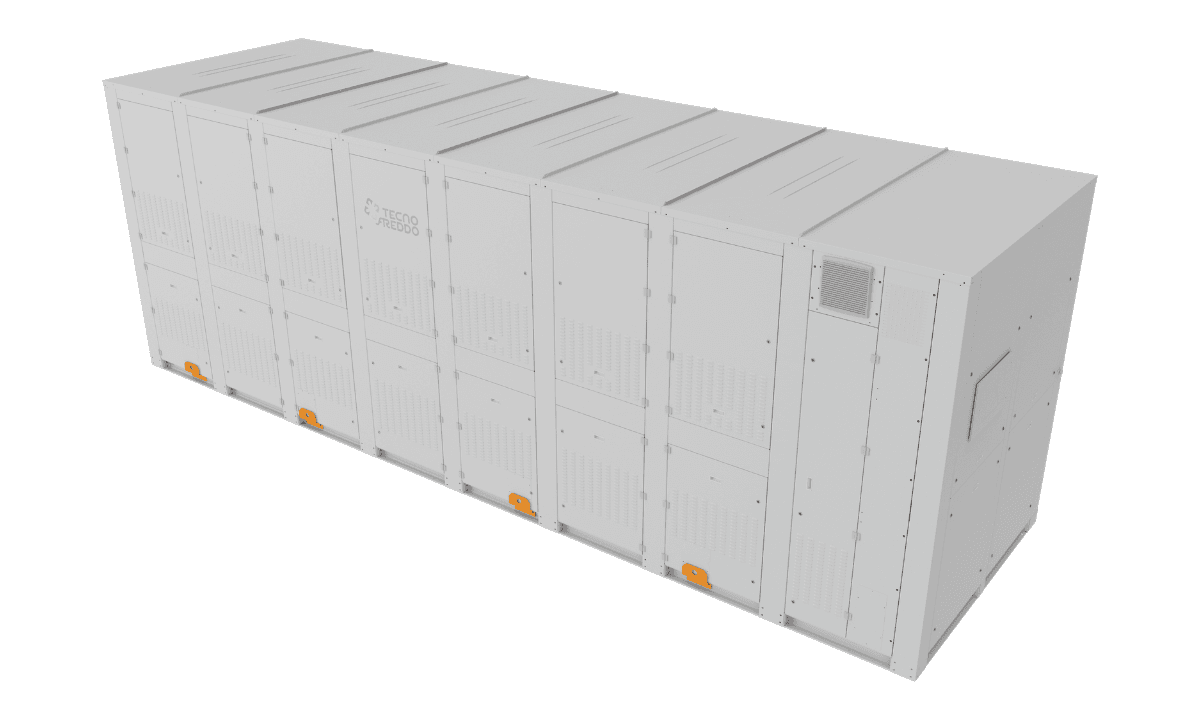
In 2021, Pro Refrigeration introduced its standard 100HP CO2-only PROGreen packaged chiller, equipped with Alfa Laval heat exchangers, targeting its traditional customer base of dairy farms, breweries and wineries. That was followed in 2022 with the two-part PROGreen Hybrid, which combines the CO2 Chiller with PRO’s R448A V Piston system, which serves as a backup to the CO2 system; each part has its own electrical power supplies and control centers, but the overall system operates on a single chassis with a shared 2,000gal (7,571L)-capacity chilled propylene glycol tank.
“The PROGreen R744 Hybrid Series offers dairy farms the advantages of a CO2‑based system, including heat recovery and reduced power consumption,” said Pro Refrigeration. “It heralds a new era for dairy farms, delivering unprecedented performance in milk cooling and water heating efficiency, cost-effectiveness and sustainability gains.”
The hybrid design has given Pro Refrigeration the opportunity to do long-term energy comparisons of the CO2 and R448A components. “We are logging kW usage individually on each refrigerant,” said Jim VanderGiessen, CEO and Co-Founder of Pro Refrigeration. “Based on our data we see significant kW savings on the R744 system versus the synthetic-based system.”
The first site that will undergo independent evaluation of its hybrid system is Costa View Farms in Madera, California, with a report on the results published in January 2025. “We look forward to sharing this report,” said VanderGiessen.
Pro Refrigeration developed the hybrid model because its customers wanted to see a hybrid option in addition to the CO2-only and R448A-only options, he said. (R449A is also available as an f-gas refrigerant.) Dairy farms typically oversize their chiller systems, requesting 100% redundancy to provide backup in the event of a system fault or alarm, the company noted.
Both parts of the hybrid system are kept active, with the CO2 part the primary system and the R448A part the backup. According to VanderGiessen, the R448A part is used less than 1% of the time: when there is a fault in the CO2 part, or there is an ambient temperature issue. “It is normal to see both sides running during high cooling loads and during high ambient,” he said.
Pro Refrigeration credited Swedish manufacturer Alfa Laval with helping in the chiller’s company’s transition to CO2-based units. “We were fortunate to have Alfa Laval as a key supply partner on our PROGreen team,” said VanderGiessen.
In particular, Alfa Laval helped Pro Refrigeration to deal with higher CO2 pressures, which called for adjustments in infrastructure and technician training, and to achieve “a threefold increase in the heat recovery, enabling the reuse of nearly all the waste heat,” said Damon Reed, Pro Refrigeration’s Chief Operating Officer.
The PROGreen CO2 chiller, both the stand-alone unit and the system in the hybrid chiller, incorporates Alfa Laval’s AXP and CBXP brazed heat exchangers for different functions, including heat recovery, sub-cooling and evaporation.
Robust heat recovery
Waste heat recovery has proven to be one of the most significant benefits of the PROGreen CO2 chiller. For example:
- William & John Jongsma Dairy in California slashed its annual propane usage by 75%, saving over 45gal (170L) per day, or about $4,500 (€4,114) a month based on an average price of $3 (€2.74) per gallon.
- Another California farm, South Creek Dairy, saved over $1,400 (€1,280) per month using PROGreen to generate hot water above 150°F (65.5°C) from waste heat, eliminating the need for their natural gas water heater.
Waste heat recovery from the CO2 system raises water temperatures from 70°F (21°C) to over 180°F (82°C), exceeding the limitations of f-gas-based systems, which typically heat water only to 125°F (52°C), said Pro Refrigeration. Both the hybrid system and the standard CO2 chiller system are equipped with the same heat-recovery capabilities.
VanderGiessen sees a role for propane (R290) in chillers as well as CO2. “Our business strategy hinges on shifting focus from synthetic-based refrigerants towards natural alternatives such as CO2 and propane. Both are needed to replace synthetics,” he said. “This paradigm shift is already underway in Europe, where diverse solutions are the norm. There is no one-refrigerant-fits-all solution.”
“Today, CO2 is emerging as the frontrunner for PRO customers who want to replace synthetic-based systems, especially those with high demand for hot water at drastically reduced or no cost,” he added. “The emergence of propane-based systems in the U.S. also signals a promising future.”
“Our business strategy hinges on shifting focus from synthetic-based refrigerants towards natural alternatives such as CO2 and propane.”
Jim VanderGiessen, CEO of Pro RefrigerationCalNEXT