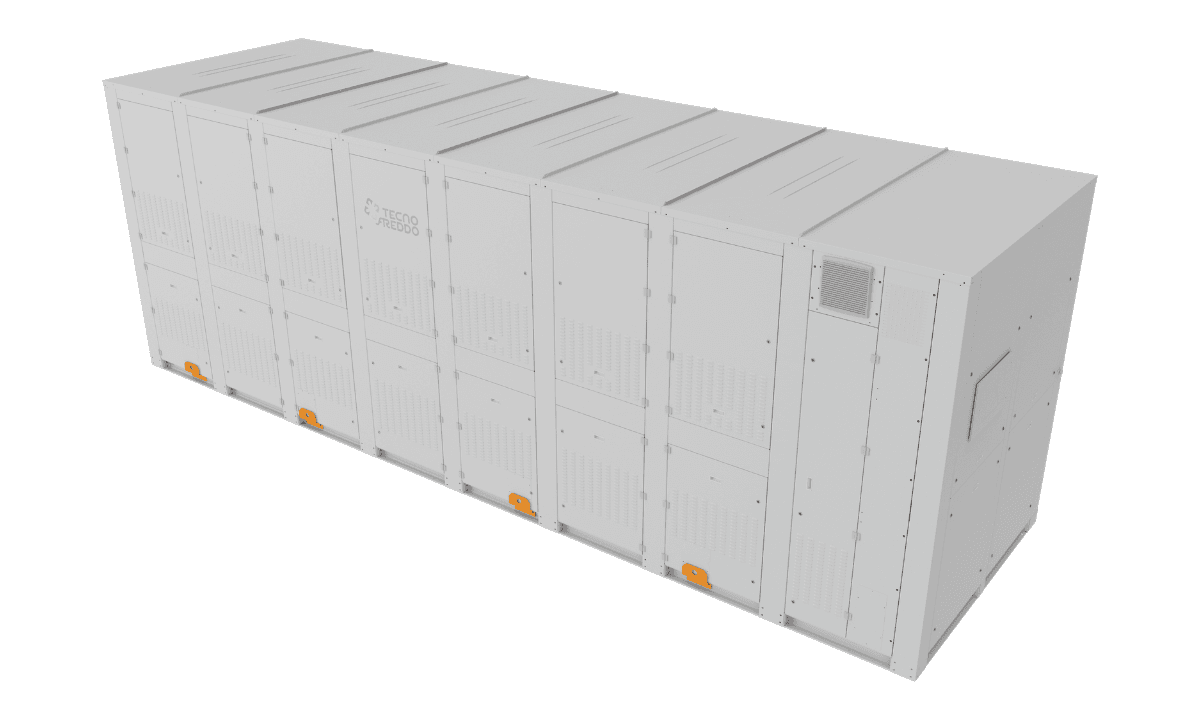
Wieland Provides ‒ part of the Wieland Group, a German supplier of copper and copper alloy products, including tubes for CO2 (R744) HVAC&R applications ‒ showcased an AI-assisted flooded evaporator compatible with industrial-sized natural refrigerant systems at AHR 2025.
The patent-pending unit uses AI to control the inlet valve based on the two-phase conditions of the refrigerant inside the evaporator shell. Franco Provenziani, CEO of Wieland Provides, told NaturalRefrigerants.com that the flooded evaporator, designed for industrial applications, has no capacity limits, with the company able to produce units handling from 50 to 5,000TR (175 to 17,584kW).
“When the AI detects a high liquid level, it controls refrigerant entrance into the evaporator by shutting the inlet valve and thus prevents liquid entrainment from entering the compressor,” said Provenziani.
The Wieland Group displayed the AI-assisted unit at AHR 2025, held in Orlando, Florida, from February 10–12. It also displayed a new dual-stage evaporator capable of handling large temperature differentials and propane (R290) heat exchangers new to the U.S. market.
AI-assisted: The flooded evaporator’s AI leverages the high heat transfer coefficient of the evaporator by mapping the operational behavior across the unit’s working range.
- Besides detecting liquid entrainment, the AI-assisted evaporator also recognizes oil foam, low/high/normal liquid levels and irregular refrigerant distribution.
- “This product is extremely new,” Provenziani said, adding that while the company has conducted testing, an AI-assisted evaporator has not yet been installed in an industrial application.
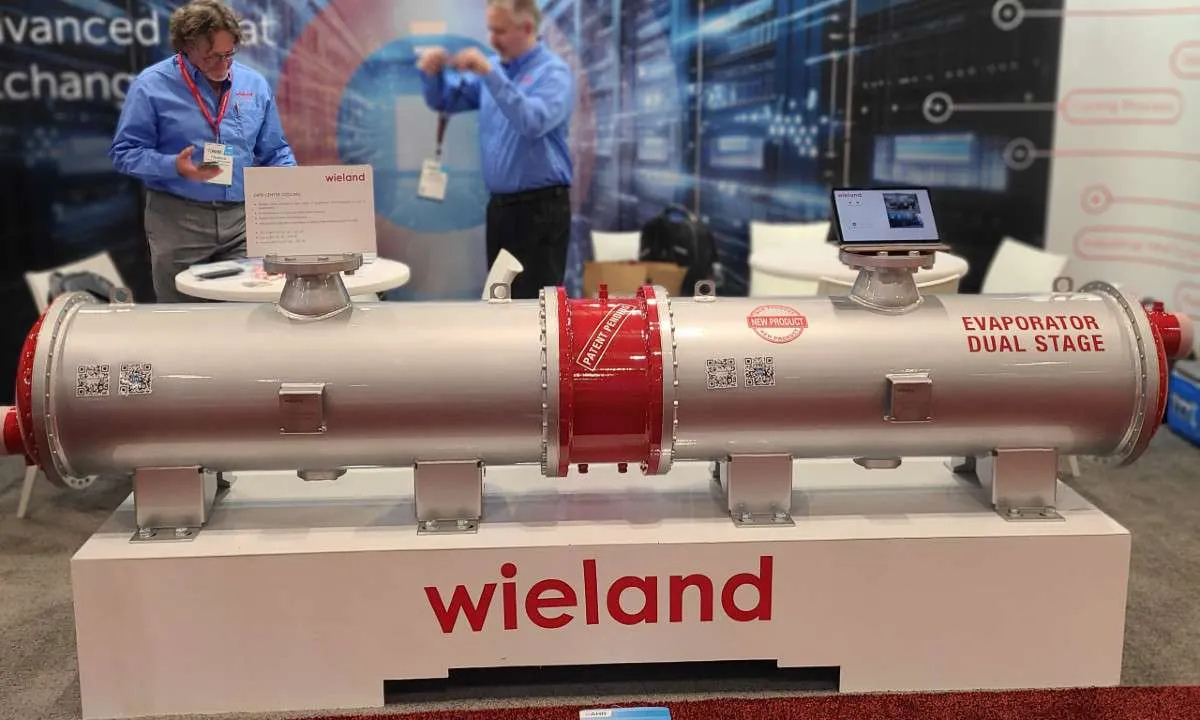
Data-center cooling: Italian-based thermal solutions manufacturer Onda, part of the Wieland Group, has launched a dual-stage evaporator. Managing Director at Wieland Onda, Alberto Bordignon, told NaturalRefrigerants.com that the patent-pending unit ‒ which combines two flooded evaporators ‒ is designed for applications with a large temperature difference between the inlet and the outlet, making it especially suitable for data-center cooling.
- A liquid distribution header connects the two evaporators to optimize the flow while reducing the piping.
- Although the unit on display at AHR 2025 was configured for use with synthetic refrigerants, Bordignon said that the concept is transferable to natural refrigerant systems, including CO2, with the appropriate evaporator tubing.
- “We’ve tested the design with a couple of our largest customers and have received our first order for the unit,” Bordignon said, though he could not disclose the center’s location.
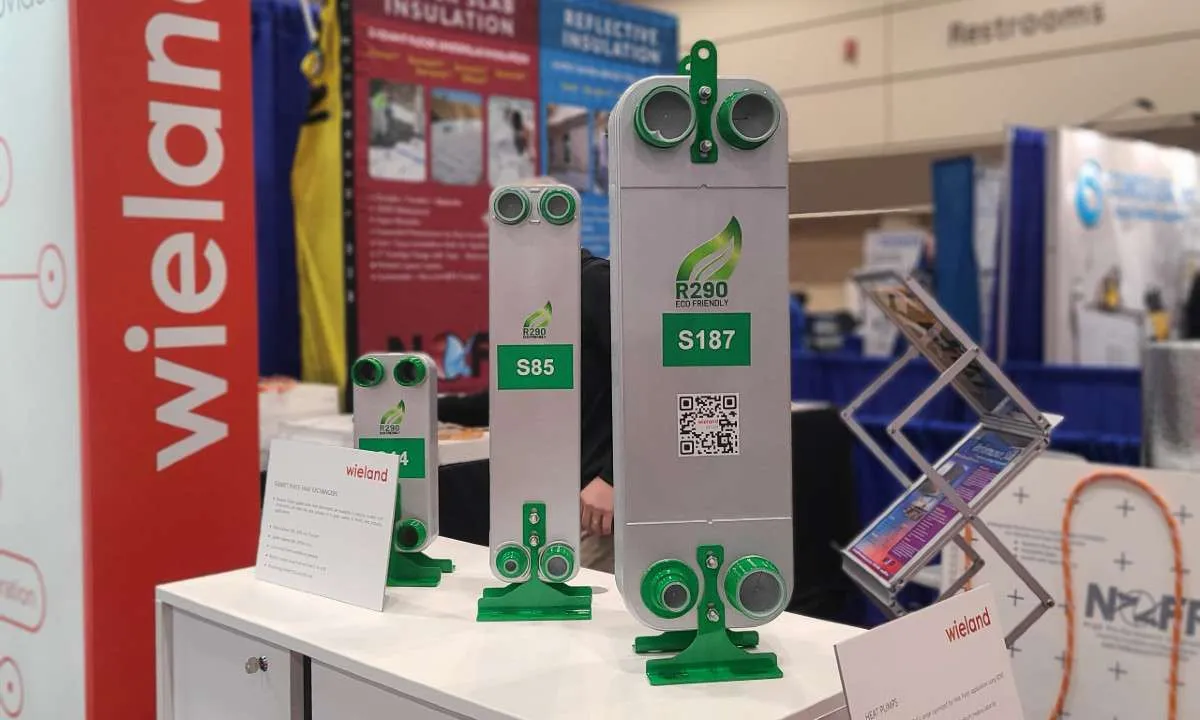
R290 product: Onda also displayed new propane gasket plate heat exchangers at the AHR Expo, with pressure ratings up to 250psi (17.2bar). “We’ve done a lot of testing in our facility in Italy to optimize the heat exchanger to make it suitable for very low volume propane,” Bordignon said, adding that the company brought the units to the expo to determine U.S. market interest.
- Federal and state entities are seeking to increase A3 charge limits for indirect systems with a hydronic loop. The ASHRAE standards committee does not expect to approve raising the A3 charge limit for indirect systems to 4.9kg ‒ like those commonly employed in Europe ‒ until 2025 or later, according to Committee Chair Jim VerShaw.
- To support ASHRAE’s efforts to raise the charge limit, the U.S. Department of Energy (DOE) awarded $2.5 million (€2.3 million) last fall to the Air-Conditioning, Heating and Refrigeration Institute in Arlington, Virginia, to conduct research and address the “performance and safety concerns” of implementing A3 air-to-water heat pumps in the U.S. market.
- In a report written to support the New York State Department of Environmental Conservation, industry experts ‒ including climate experts, manufacturers, consultants, building code experts and end users ‒ called for an investment in R290 hydronic heat pumps, stating that the technology presents an opportunity for “holistic decarbonization” by simultaneously tackling direct (refrigerant) and indirect (energy-related) GHG emissions.
Quotable: “Artificial intelligence already impacts our lives, and [we] believe there is a great potential for [its use] in the heat exchanger sector,” Wieland Provides said. “It can control the feed to the evaporator because it distinguishes the difference between the refrigerant’s two phases.”