A direct expansion (DX) ammonia (R717) refrigeration system – incorporating vapor sensors from HB Products and installed in a German cold storage facility – has demonstrated 23% higher energy efficiency than a pumped liquid overfeed system located at a similar site nearby.
The systems, operated by the same company, report energy use of 36kWh/m3/year and 47kWh/m3/year, respectively, according to a case study from HB Products, a Danish component manufacturer.
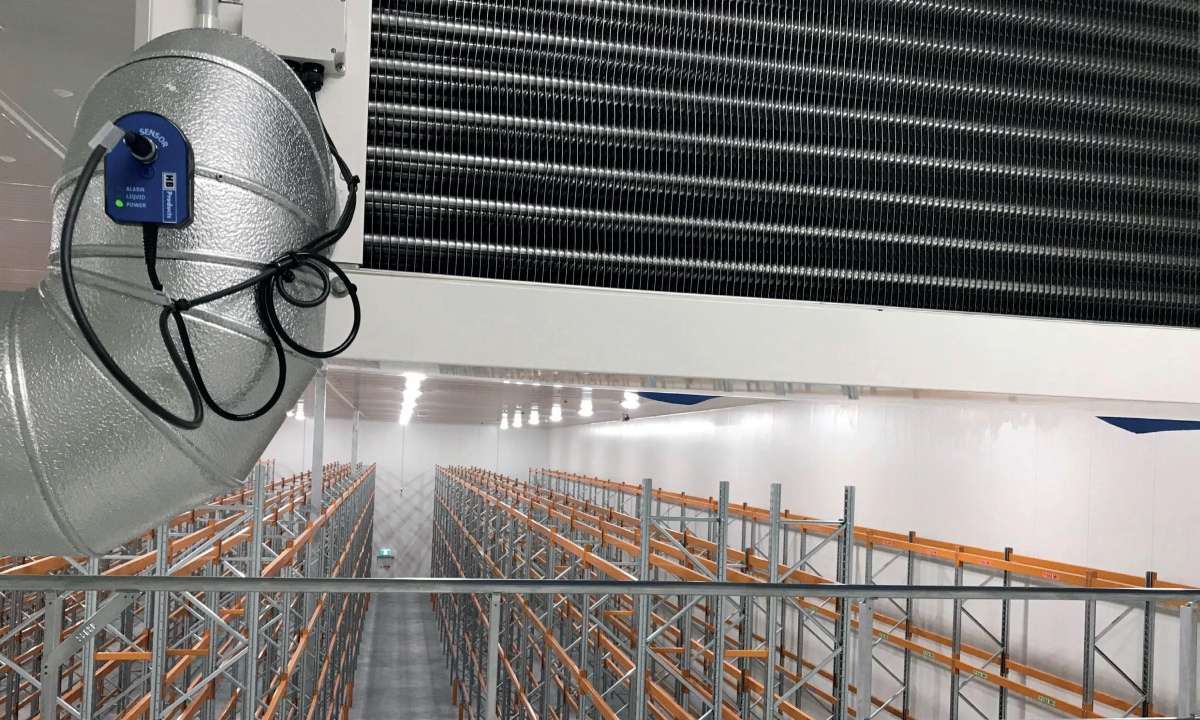
HB Products has attributed the superior efficiency of the DX system to the use of its vapor quality sensors, enabling more precise control over the refrigeration process. Installed across the system’s 19 evaporators, the vapor sensors continuously monitor the gas-to-liquid ratio in the suction line. This allows for real-time system adjustments, which is crucial under variable load conditions.
The DX system achieves this performance using significantly less refrigerant – just 2.2 metric tons of ammonia compared to five used in the neighboring overfeed system. This lower charge not only improves safety but also contributes to lower operational costs.
DX vs. overfeed
The facility is large, with more than 92,800m3 (3.27 million ft3) of refrigerated storage. It operates at three suction temperatures: −42°C (−45.4°F) for blast freezing, −32°C (−25.6°F) for cold storage and −10°C (14°F) for the docking area. Recovered heat is used for underfloor heating and an air curtain system, further improving energy efficiency.
Initially, the site operator had planned to use a traditional pumped overfeed system, which is well-suited for handling partial loads and avoiding issues like flooded evaporators and wet suction lines, noted HB Products. However, incorporating HB Products’s sensors on each of the system’s evaporators enabled a more efficient DX system to be installed.
“The operator was convinced to try this new approach, and [they have] been so pleased with the results that they have expanded the use of ammonia DX refrigeration systems with HB Products sensors to other facilities,” the company explained.
“The operator was convinced to try this new approach, and [they have] been so pleased with the results that they have expanded the use of ammonia DX refrigeration systems with HB Products sensors to other facilities.”
HB Products
Vapor control
Vapor quality sensors work by detecting the ratio of gas to liquid in the suction line, providing more accurate feedback than traditional superheat-based control. This can help reduce the risk of liquid reaching the compressor, which can cause damage over time.
The manufacturer has stressed the importance of sensor installation location, with the ideal positioning being at the bottom of horizontal pipes – where liquid accumulates – and away from welds or bends to prevent signal interference.
In addition to ammonia, the sensor technology is compatible with a variety of refrigerants, including CO2 (R744) and hydrocarbons, and fits pipe diameters of 50–200mm (2–7.9in).