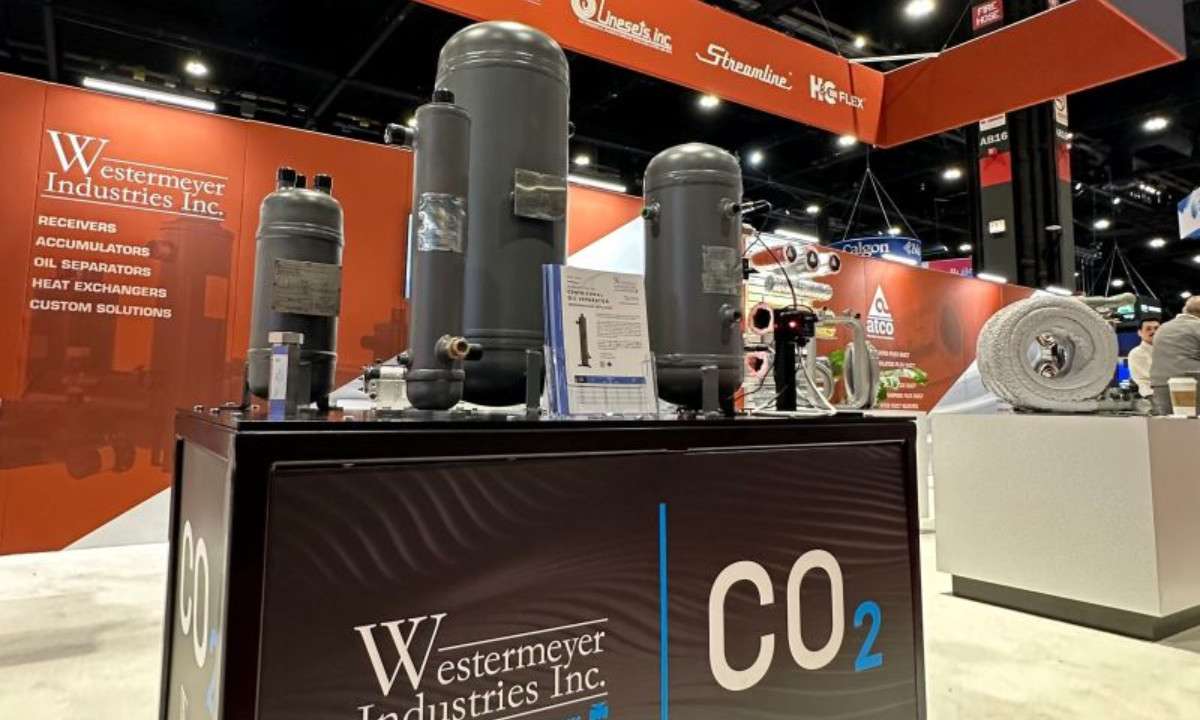
The new transcritical CO2 (R744) centrifugal oil separator produced by the U.S.-based HVAC&R component manufacturer Westermeyer Industries operates with a fluid temperature rating from −20 to 500°F (−28.9 to 260°C), according to Sales Manager Adam Chapman.
The unit operates with a pressure rating of up to 130bar (1,885psi).
“With over 20 years of experience producing centrifugal oil separators, the technology needed development to perform with the higher pressures/temperatures of CO2,” Chapman told Natural Refrigerants.com in an email where he shared details from the company’s recently completed patent application.
Chapman said the unit, called a “first-of-its-kind” oil separator by the company, primarily uses centrifugal force as its separating method, with some secondary stripping media ‒ not coalescing ‒ to assist with lower velocity separation.
Additional design details outlined by Chapman include an offset inlet. ”This design characteristic and internal geometers collectively support laminar flow and efficient separation,” he said.
A similar but differently designed product, the TURBOIL-R-P14 oil separator produced by French HVAC&R component manufacturer Carly, is recommended for low-temperature CO2 applications with a a maximum working pressure of up to 140bar (2,030psi) at 160°C (320°F). According to Carly, its unit separates oil using a mixture of methods, including “breaking speed, change of direction, centrifugation and coalescence.”
Benefits of centrifugal separation
Chapman explained that not using coalescing media provides two main benefits: effective oil separation and lower OEM and service costs.
“During high-ambient conditions, the industry is seeing high compressor oil carry-over rates, which are not conducive for effective oil separation using coalescing media,” he said. “When oil concentration is too high, this translates to lower separation rates and higher pressure drops.”
Chapman told NatualRefrigerants.com that Westermeyer has “several customers” currently testing or lined up to test the new technology in CO2 systems.
Other components recently developed by the company to support transcritical CO2 refrigeration include an electronic oil filter monitor and an oil strainer. Both products, released in February 2023, simplify service diagnostics for high-pressure operations. The monitor indicates when to change a coalescing oil separator’s filter by accurately measuring the pressure drop across it, and the hermetically sealed sight glass on the strainer, rated for 140bar, allows service techs to see if oil is flowing back to the compressor from the oil separator.