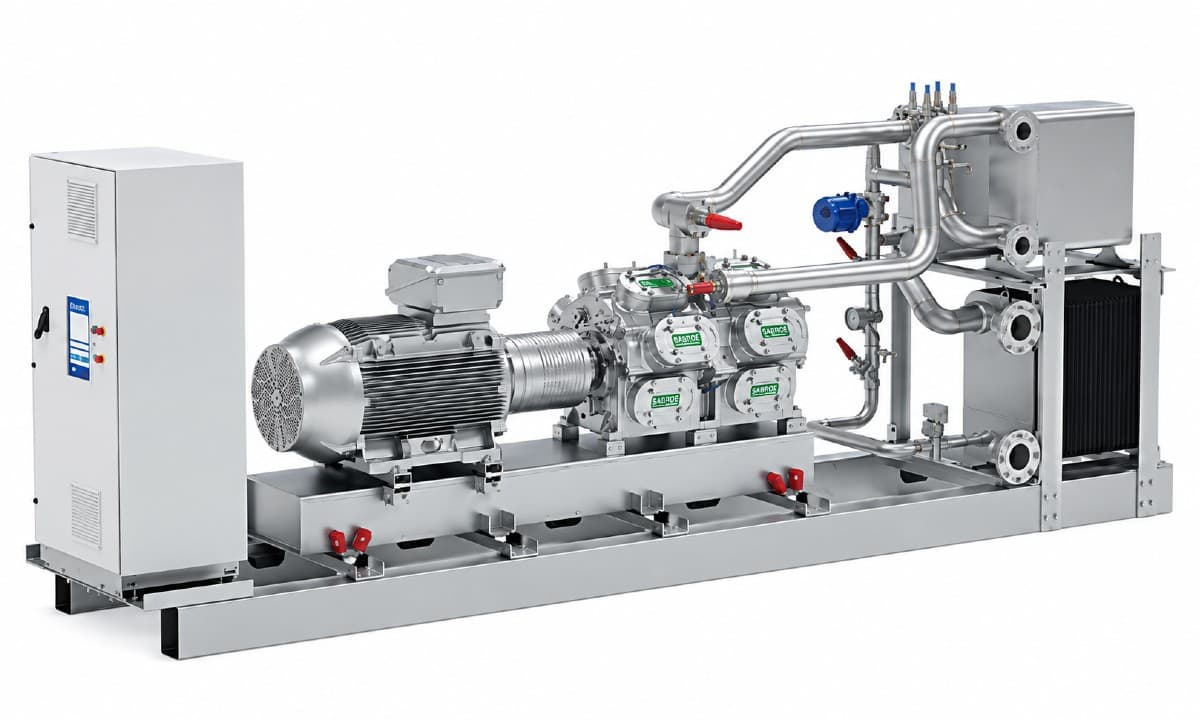
Canadian OEM Vitalis has shared more details about its upcoming district energy project with the University of British Columbia Okanagan (UBCO) campus in Kelowna that will use its Coolshift CO2 (R744) reversible air-source heat pump with a heating capacity of 1.5MW (426.5TR).
The project: UBCO currently operates a medium-temperature district energy system (MDES) serving older buildings and a low-temperature district energy system (LDES) serving newer buildings. Vitalis’s CO2 heat pump will be connected to the LDES.
- In the current setup, the LDES supplies ambient temperature water between 8 and 25°C (46.4 and 77°F) to individual reversible hydronic heat pumps in each building. Buildings in heating mode take heat from the loop while buildings using cooling reject heat into the loop.
- Natural gas boilers provide the majority of heat to the LDES, which also receives heat from the MDES, an open-loop geothermal system and fluid coolers.
- The Coolshift CO2 heat pump will become the primary heat source for the LDES, providing 98.4% of the total heating demand and 99.9% of auxiliary cooling demand, with the fluid coolers acting as the primary cooling source.
By the numbers: Vitalis’s heat pump has a capacity of 1.5MW at −10°C (14°F) and can operate in outdoor temperatures between −20 and 40°C (−4 and 104°F).
- The annual heating COP is 3.5, and the annual cooling COP is 3.6.
- According to Vitalis, the heat pump will be able to operate in subcritical mode “most of the year.” Summer temperatures in Kelowna, which is also home to Vitalis, average 23.8°C (75°F) with highs reaching 28.3°C (83°F).
- While the heat pump is designed with a nominal capacity of 1.5MW, James Seabrook, President of Vitalis, said during a presentation at the ATMOsphere (ATMO) America Summit 2024 that it could be scaled up to 2.5MW (710.8TR). ATMOsphere is the publisher of NaturalRefrigerants.com.
Emissions reductions: UBCO’s goal is to reduce its greenhouse gas emissions 65% by 2030 compared to 2013 levels.
- Vitalis’s CO2 heat pump is forecasted to cut campus emissions by 815 metric tons.
- The company also notes that, as a natural refrigerant, CO2 is PFAS (per- and polyfluoroalkyl substances)-free.
Expansion opportunities: The UBCO project could be the first of many with Canadian universities, according to Seabrook.
- At ATMO America 2024, Vitalis’s president said many of the country’s universities use district energy systems. “There are many universities in Canada we’re talking to,” he said.
Quotable: “We are thrilled to work with UBCO on this groundbreaking project,” said Seabrook in a Vitalis LinkedIn post. “Our Coolshift technology is designed to be both highly efficient and environmentally friendly, helping to protect the place we call home from forever chemicals.”