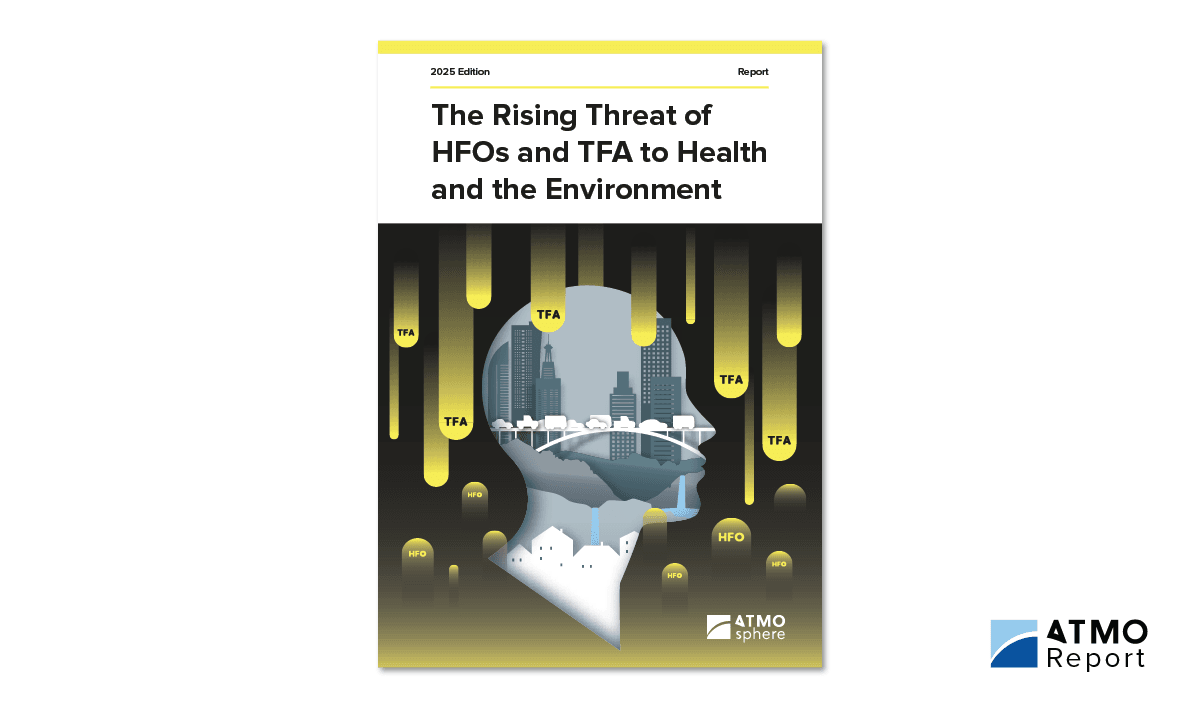
ATMOsphere, publisher of NaturalRefrigerants.com, has released its second report on the rising threat posed by commonly used HFOs, particularly HFO-1234yf, and their atmospheric byproduct, trifluoroacetic acid (TFA), to human health and the environment.
The new report, available for free here, also covers the steps being taken in the EU and North America to regulate HFOs and TFA as PFAS (per- and polyfluoroalkyl substances), a group of chemical pollutants prevalent in the environment. Many f-gas refrigerants and TFA fall under the widely accepted definition of PFAS as chemicals with at least one fully fluorinated carbon atom.
The report will be discussed on July 10 at an ATMOsphere-hosted side event during the 47th meeting of the Open-Ended Working Group (OEWG) of the Parties in Bangkok. The event will be held 6 pm to 8 pm ICT in the United Nations Conference Centre’s Asia Pacific Foyer. More information on the event can be found here.
Since ATMOsphere’s first report on this topic was published in 2022, there has been a torrent of research, discussion and regulatory action focused on the environmental proliferation of TFA, driven by refrigerants and other sources and its potential harm to human health. The new report takes a comprehensive look at the activity over the past year, including condensed versions of many articles previously published in NaturalRefrigerants.com.
“In this report we show how TFA has become the most widespread PFAS in the world and the focus of great concern, with a direct link to the HVAC&R industry,” said Marc Chasserot, Founder and Publisher of ATMOsphere.
Increasing concentrations of TFA
When HFO-1234yf and some other f-gases escape into the atmosphere, they produce TFA, which is extremely mobile and water-soluble and is absorbed in rainfall and other precipitation. Once it lands on Earth, TFA, an ultrashort-chain (two-carbon) PFAS, spreads throughout the environment and builds up due to its extreme persistence. TFA can also form trifluoroacetate salts by reacting with calcium or sodium minerals, resulting in a similar environmental effect.
The report provides data on TFA’s consistent upward trend in concentrations in surface water (rivers, streams, lakes and wetlands, as well as ice in arctic regions), rainwater, soil and other environmental media.
TFA ultimately ends up in drinking water, beverages such as wine and food such as bread and cereal products, the report explains. It also includes data on TFA’s presence in the human bloodstream, which has raised concerns about its potential health impacts, especially long term.
“In this report we show how TFA has become the most widespread PFAS in the world and the focus of great concern, with a direct link to the HVAC&R industry.”
Marc Chasserot, Founder and Publisher of ATMOsphere
Two key studies on the potential health threats to human health are reviewed. One discussed the German government’s assessment of TFA and its trifluoroacetate salts as reproductively toxic, which has been officially submitted to the European Chemicals Agency (ECHA) for consideration under the EU’s CLP (classification, labelling and packaging) regulation. The other reaches the conclusion that TFA represents a “planetary boundary threat.”
The report explains the different approaches taken by major regulatory agencies to HFOs and TFA. For example, while the U.S. Environmental Protection Agency (EPA) does not regard f-gases and TFA as PFAS, the state of Maine has enacted a PFAS law banning f-gas refrigerants in 2040, including possible action on TFA in 2032, with exceptions for cases of “currently unavoidable use.”
In addition, Minnesota, under its PFAS law, is engaged in rulemaking to establish a process to determine whether PFAS refrigerants and other products are “essential” to avoid prohibition in 2032; the state is also doing a toxicity review of trifluoroacetate. In Canada, the government is collecting feedback on its proposal to regulate PFAS as a class, excluding fluoropolymers but including HFOs
The biggest regulatory effort is being undertaken by the EU, as the European Chemicals Agency (ECHA) evaluates PFAS proposals from five countries to restrict PFAS as a class, including f-gases and TFA. ECHA has also started its consultation and expert evaluation of the German proposal to classify TFA as reproductively toxic under the CLP regulation.
In the meantime, several European countries have issued guidelines for acceptable levels of TFA in drinking water and food. The European Food Safety Authority (EFSA) is reviewing the toxicological values for TFA in cooperation with the ECHA at the request of the European Commission.
The report presents the position of the chemical industry, which has aggressively defended the use of HFOs like HFO-1234yf and downplayed the threat potentially posed by TFA. It also offers responses from a host of leading scientists.
Eliminate TFA precursors
In light of the evidence of potential harm from the growing proliferation of TFA worldwide, the report supports a global effort to eliminate, where possible, the precursors of TFA like HFO-1234yf and other f-gases, as well as TFA-generating pesticides and pharmaceuticals. Effective alternatives to these precursors, such as natural refrigerants, are widely available.
In addition, a number of other steps are needed for TFA, including continuous environmental monitoring, detection improvements, toxicological studies, water treatment research and regulatory limits, said the report, adding that polluters should be required to pay for cleanup.