The adoption of transcritical CO2 (R744) refrigeration in Japan’s food retail sector increased by 46% in 2024 to reach 12,250 stores, up from 8,385 in 2023, according to Natural Refrigerants: State of the Industry 2024, a report from ATMOsphere, publisher of NaturalRefrigerants.com.
While this growth was driven predominantly by installations in convenience stores, a significant number of supermarkets also installed R744-based refrigeration systems last year.
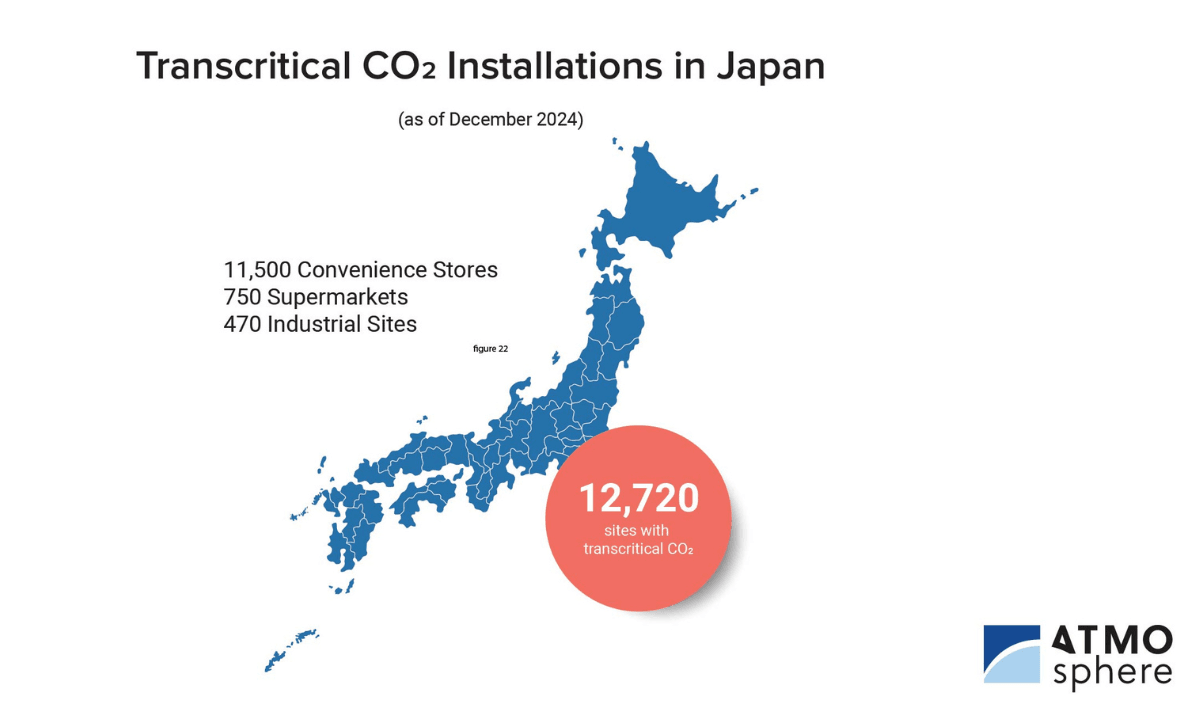
A total of 11,500 convenience stores (known locally as konbini) and 750 supermarkets now have transcritical CO2 refrigeration in Japan, compared to just 7,800 and 585, respectively, in 2023. The market penetration of the technology is roughly 20% in the country’s convenience stores and 3.5% in its supermarkets.
The adoption of transcritical CO2 is also increasing in Japan’s industrial refrigeration sector, with an estimated 470 sites using the technology, up from a reported 400 in 2023. The majority of the sites are cold storage facilities.
Retailers, cold storage operators and manufacturers operating in Japan have attributed the country’s adoption of transcritical CO2, in large part, to the government’s natural refrigerant subsidy project.
In addition to sharing data from the Japanese market, the report covers Europe, North America, Australia and New Zealand, and Latin America, along with insights into global refrigeration trends.
The full report can be downloaded for free here.
Convenience stores
Across Japan, one in every five convenience stores now use transcritical CO2 refrigeration.
Lawson, one of the country’s major konbini chains, is leading the charge, with 46.5% of its 14,608 sites using the technology. By December 2024, 6,800 of Lawson stores had installed a R744-based refrigeration system, an increase of 28% from 2023.
Other leading convenience store chains, including FamilyMart and 7-Eleven, are transitioning to transcritical CO2 equipment. Around 10.5% of FamilyMart’s 15,311 stores and 5.8% of 7-Eleven’s 21,651 stores have installed the technology. Approximately half of 7-Eleven’s new stores are using CO2.
At the end of last year, there were an estimated 55,692 convenience stores across Japan, and in 2023, convenience stores accounted for roughly 29% of food retail sales.
Cold storage facilities
In the industrial refrigeration sector, nearly three-quarters of Japan’s transcritical CO2 systems are found in cold storage facilities, the report shows. The remaining 27% are used in process cooling, freezing and food processing applications.
Of these transcritical CO2 installations, most consist of condensing units, like those manufactured by Nihon Netsugen Systems, Panasonic and Mitsubishi Heavy Industries.
According to Japan’s Association of Refrigerated Warehouses (JARW), 51.4% of the warehouses operated by its member organizations – which represent 90% of the sector in Japan – used natural refrigerants in 2023, up from 40% the year prior. Since 2015, the number of natural refrigerant-based systems installed across the sector has more than doubled.
Despite nearly half of the country’s refrigerated warehouses still using f-gases, the number of CFC- and HCFC-based systems in operation continues to fall, while the use of HFCs is stagnating.
Of the cold storage facilities using natural refrigerants in 2023, 67.6% used ammonia (R717)/CO2 secondary systems, 18.9% used just ammonia, 12.6% used transcritical CO2, and 0.9% used air-(R718) based technologies.
While ammonia/CO2 systems – like those installed at frozen tuna producer Marine Access’s refrigerated warehouse – make up the majority of natural refrigerant installations in Japan’s cold storage sector, CO2 is seeing the highest growth rate, which has nearly quadrupled since 2019. The number of ammonia systems has decreased by around 10% over the same period.
Japan’s cold storage market is expected to grow by around 20% over the coming years as existing facilities near capacity and demand for biopharmaceuticals and frozen and chilled goods increases, according to the report. In the Greater Tokyo and Osaka areas alone, 20 multi-tenant facilities are already slated for completion by the end of 2026. New regulation limiting truck driver hours could also necessitate the development of new cold storage facilities between larger cities.
In addition to building new cold storage warehouses, widespread facility retrofits are also expected as efficiency standards and f-gas restrictions require the redevelopment of Japan’s existing logistics properties, 54% of which are more than 30 years old.
Government subsidies
In 2023, the Japanese Ministry of the Environment (MOE) announced it would extend its natural refrigerant subsidy project through fiscal year 2027 with a budget of ¥7 billion ($49 million/€43.2 million) for fiscal year 2023.
Several aspects of the program were amended to make the funding more accessible to small- and medium-sized enterprises (SMEs). Updates include simplifying the application process, relaxing equipment installation schedules and increasing the funding available from one-third of construction costs to one-half.
Since enacting those changes to the program, the MOE has seen a 10% increase in the number of SMEs receiving subsidies and a 10% increase in the number of food retailer renovation projects. The increase in funding available for each project has been the driving force behind these trends, according to Teruo Kogu, Director of the Office of Fluorocarbons Control Policy at the MOE.
Across 2023 and 2024, a total of 267 applicants received funding for 695 projects.