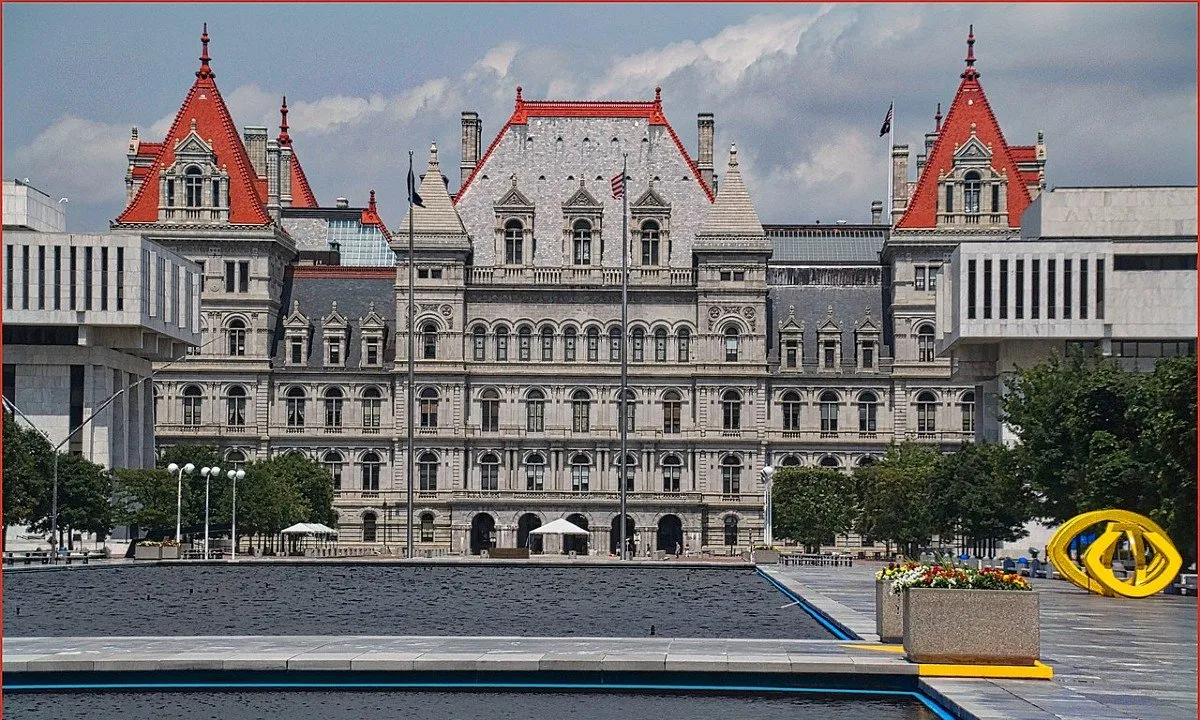
An effort is underway in the New York State Legislature to roll back regulations on HFCs finalized finalized in late 2024 by the New York State Department of Environmental Conservation (NYDEC) so that they match federal HFC regulations established by the U.S. Environmental Protection Administration (EPA).
New York’s HFC regulations amend a state law known as 6 NYCRR Part 494, Hydrofluorocarbon Standards and Reporting. The EPA’s HFC regulations are largely encompassed by the American Innovation and Manufacturing (AIM) Act, which includes a phase down of HFC production and imports, rules on leaks and maintenance and a Technology Transitions rule that is being reconsidered.
Two sets of bills are being considered in the New York Senate (S) and Assembly (A): S235/A3661 and S9066/A9596. In the Assembly, William Conrad III (Democrat) is the lead sponsor for both bills, while in the Senate it’s Patrick Gallivan (Republican) for S235 and Christopher Ryan (Democrat) for S9066.
The difference between the bills is that S235/A3661 requires New York’s HFC regulations to be the same as the EPA’s rules, while S9066/A9596 requires New York to conform specifically to the AIM Act as of October 1, 2025. The bills say they don’t restrict programs addressing energy efficiency, electrification, refrigerant reclamation, or other measures consistent with New York’s Climate Leadership and Community Protection Act (CLCPA). Both sets of bills are currently in environmental conservation committees in the Assembly and the Senate.
In a statement supporting S9066/A9596, the Business Council of New York State said that without this legislation “New York residents and business owners will be forced to pay significant, unnecessary replacement costs.” The statement listed 20 other trade groups and businesses, including the Air-Conditioning, Heating, and Refrigeration Institute (AHRI), Heating Air-Conditioning Refrigeration Distributors International (HARDI) and the Food Alliance of New York State.
However, Part 494 does not require the replacement of existing equipment prior to the end of its useful life; and, according to the NYDEC, the EPA has calculated that the Part 494 regulations could save $540 million (€460 million) in energy costs. Moreover, many of the Part 494 regulations are already aligned with the AIM Act, though the New York regulations are acknowledged to be more ambitious than those in the AIM Act and other states, particularly in the use of a 20-year GWP (GWP20) value for gases rather than the 100-year GWP (GWP100) value.
“This is an attempt to shackle the states from setting their own rules.”
Richie Kaur, the Natural Resources Defense Council
Opponents of the bills include New Yorkers for Cool Refrigerant Management and the Natural Resources Defense Council (NRDC). “This is an attempt to shackle the states from setting their own rules,” said Richie Kaur, Senior Super Pollutant Reduction Advocate, Climate & Energy for the NRDC. “It is important for states to be able to step in if the EPA waffles. “
Moreover, said Kaur, “states can incubate really good, ambitious policy, which can be scaled at the federal level.” California, for example, established GWP100 limits of 150 for commercial and industrial applications before they were adopted by the AIM Act.
The Part 494 regulations were designed to help implement the CLCPA, a 2019 law that mandates a 40% reduction in greenhouse gas emissions from 1990 levels by 2030 and an 85% reduction by 2050. New York Governor Kathy Hochul has recently proposed amending the CLCPA to allow more time to reach these goals and to switch from the 20-year GWP to the more widely used 100-year GWP. However, even with changes in the CLCPA most of the Part 494 regulations would still be supported by a number of provisions in New York’s Environmental Conservation Law (ECL), noted Kaur.
Trade groups appeal
In a separate action, on January 20 the AHRI and HARDI appealed a court decision in December rejecting their action to void the updated Part 494 HFC regulations in New York in their entirety. The December decision came from the New York State Supreme Court, County of Albany, in a case brought by AHRI and HARDI against the NYSDEC. The NRDC has intervened in the original suit brought by AHRI and HARDI and in their appeal.
In the December decision, Justice Richard J. McNally, Jr., found that “DEC’s adoption of amended Part 494 was not arbitrary and capricious, DEC complied with the State Administrative Procedure Act, and DEC did not act in excess of its jurisdiction.” In addition, McNally noted that amended Part 494 “includes a variance process which permits entities, including small businesses, to apply for temporary relief from certain requirements if the entity cannot comply.”
Part 494 established a GWP20 limit of 10 starting January 1, 2034, for new commercial and industrial systems with 50lbs (23kg) or more of refrigerant. Under the EPA’s Technology Transitions Rule, retail food supermarkets with more than 200lbs (91kg) will face a GWP100 limit of 150 as of January 1, 2027, which would be extended to January 1, 2032 under the reconsideration of the rule.
While the GWP20 limit of 10 in New York will restrict end users largely to natural refrigerants, the federal GWP100 limit of 150 allows the use of HFO blends such as R454C, R455A and R471A, which are also allowed in New York until 2034 (because they have a GWP20 under 580). However, these refrigerants include an HFC (R32) that is being phased down and HFOs (such as R1234yf and R1234ze) that produce the trifluoroacetic acid (TFA), a PFAS chemical that may be subject to regulation.
The New York regulations in Part 494 also banned virgin refrigerant with a GWP100 of more than 2,200 (notably R404A and R507A) in 2025 and will prohibit virgin product with more than 1,500 GWP in 2030 and more than 750 in 2033.
NYDEC agreed with HARDI not to enforce the 2025 ban for bulk virgin sales of R404A and R507A for 15 months; then HARDI was granted a temporary restraining order extending the delay until the court could decide whether a longer pause on enforcement was warranted. The trade group has requested a preliminary injunction that would halt the ban until the outcome of the appeal is decided.
EPA requires reclaimed HFCs to be used as of 2028 for servicing or repair of stand-alone retail food refrigeration supermarket systems, refrigerated transport and automatic commercial ice makers. (This does not apply to residential and commercial HVAC.)
Phasedown alignment
The Part 494 regulations are already aligned with the phasedown schedule for GWP-weighted virgin HFCs established in the AIM Act and the Kigali Amendment to the Montreal Protocol. Under this schedule, a 40% reduction in production and import was implemented in 2024, to be followed by a 70% cut in 2029, 80% in 2034 and 85% in 2036.
“The HFC phasedown is happening,” said Kaur. “Any supermarkets or other users that stay stuck on obsolete high warming refrigerants will pay high prices and will be exposed to market uncertainties in the future.”
“Many supermarket companies are recovering and banking reclaimed refrigerant for their own use, supplementing reclaimed refrigerant available on the market,” said Kaur. Some are retrofitting to lower GWP alternatives like R448A or R449A, “or if they can convert to CO₂ or other ultra-low GWP alternatives, which are exempt from the AIM Act.”
California has banned the sale and distribution of virgin HFC refrigerants with a GWP of 2,200 or greater since January 1, 2025 without significant industry pushback. ”If it hasn’t harmed the retail food industry in California, why would it harm the same industry in New York?” asked Kaur.
Suzanne Hagell, Chief of GHG Mitigation in the NYDEC’s Office of Climate Change, will be speaking about Part 494 regulations and related matters at the ATMOsphere America Summit 2026, scheduled for June 2–3 in the New York City area. The conference is organized by ATMOsphere, publisher of NaturalRefrigerants.com.