In a retrofit application, M&M Carnot, a subsidiary of Johnson Controls, supplied CO2 (R744) chillers to cool approximately 1.3MW (370TR) of IT heat load at Evocative’s Santa Clara, California, edge colocation data center.
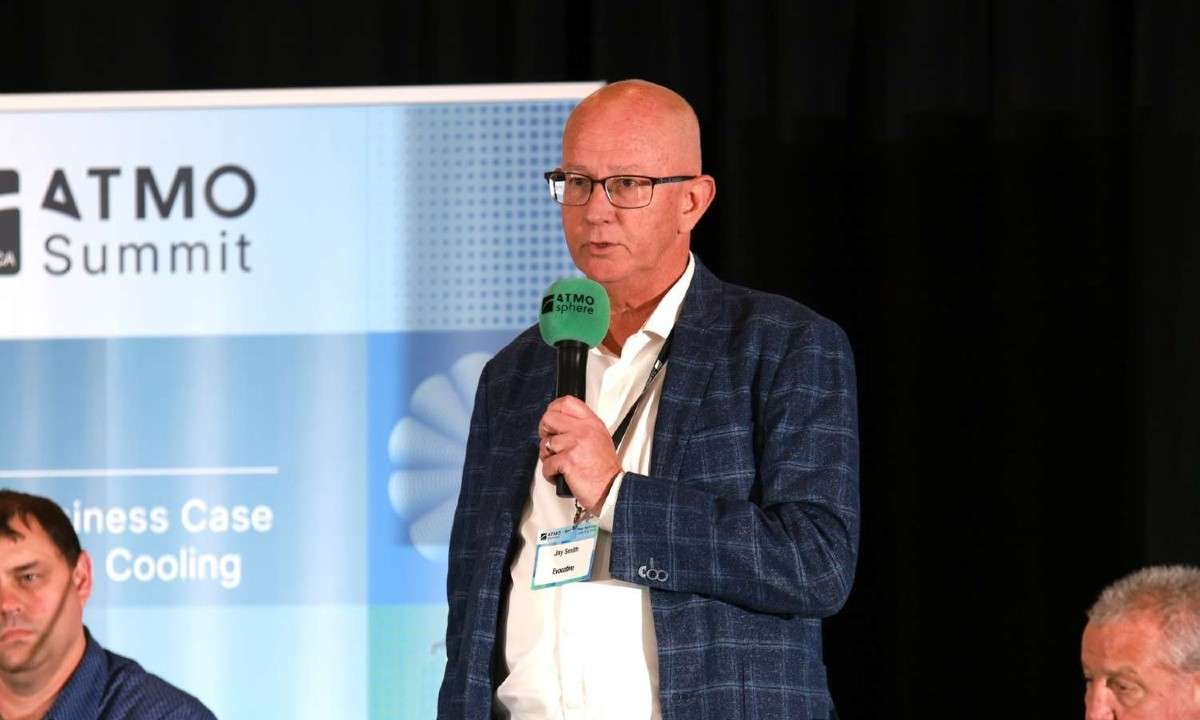
Jay Smith, Vice President of Operations and Engineering at Evocative, and Thomas Parker, Regional Sales Manager USA of CO2 Data Centers at M&M Carnot, outlined the project in a presentation at ATMOsphere America Summit 2026. The event, organized by ATMOsphere, publisher of NaturalRefrigerants.com, took place June 2‒3 in Tarrytown, New York.
“Roughly three years ago a client at our Santa Clara legacy data center — still using cooling towers and an R22-based HVAC — asked us to support AI workloads,” Smith explained. “With the CO2 solution, we’ve added AI and reduced the site’s PUE [power usage effectiveness] from as high as 1.8 in summer to generally below 1.5.”
The setup: With a high-density layout, the facility houses 20 IT racks within about 700ft2 (65m2) of white space, with each rack generating 64kW (18.2TR) of IT load.
- The design required rack-level liquid cooling with rear door heat exchangers.
- Other challenges included limited space for new equipment while keeping the AI nodes close to the existing data for low-latency access, as well as California’s Title 24 design requirements, which disfavor air-cooled chillers, according to Smith.

The solution: M&M Carnot’s CO2 chillers, each providing about 500kW (142.2TR) of cooling capacity per module, were installed within the facility’s existing white space, close to the chilled-water loop.
- A secondary loop delivers chilled water to the rear door heat exchangers mounted on the back of each AI rack.
- “Our AC80 [CO2] product was a perfect fit to enable AI at this facility, delivering a high-density load in a very compact space,” said Parker. “It’s a basic, reliable CO2 system that’s simple to operate and maintain.”
- Looking at future projects, Smith said that, in the right circumstances, Evocative could supply waste heat from its data center operations to local energy providers for district heating in some locations, citing Seattle and Atlanta as potential sites.
Growing market: “The future looks really bright for CO2,” said John Miranda, Vice President of Sales at M&M Carnot, in a different presentation at the event as part of a commercial HVAC market trends panel.
- Miranda estimates that 50% of today’s installed base of data centers is nearing end of life, most of which use synthetic-refrigerant cooling systems. He added that new greenfield data center projects are predicted to grow at a 30% compound annual growth rate over the next decade.
- Since installing its first CO2 data center cooling system in 2014, M&M Carnot has deployed more than 260 CO2 systems in the sector in North America.
- The company expects CO2 equipment deployments for data center cooling to roughly double each year over the next six years. It forecasts installing 100 CO2 computer-room air conditioners (CRAC) units in 2027, rising to 1,600 in 2031; 24 CO2 chiller/heat pumps in 2027, increasing to 560 in 2031; and 20 CO2 in-row units in 2027, growing to 320 in 2031.
Quotable: “Our client is thrilled and already planning to expand capacity,” Smith said. “We’ve also engaged with Carnot to use their CO2 chiller technology for heat exchange at multiple other facilities across North America.”
“With the CO2 solution, we’ve added AI and reduced the site’s PUE [power usage effectiveness] from as high as 1.8 in summer to generally below 1.5.”
Jay Smith, Vice President of Operations and Engineering at Evocative