Over the past decade, New Zealand refrigeration contractor CoolLogic has installed very few f-gas systems for its industrial customers.
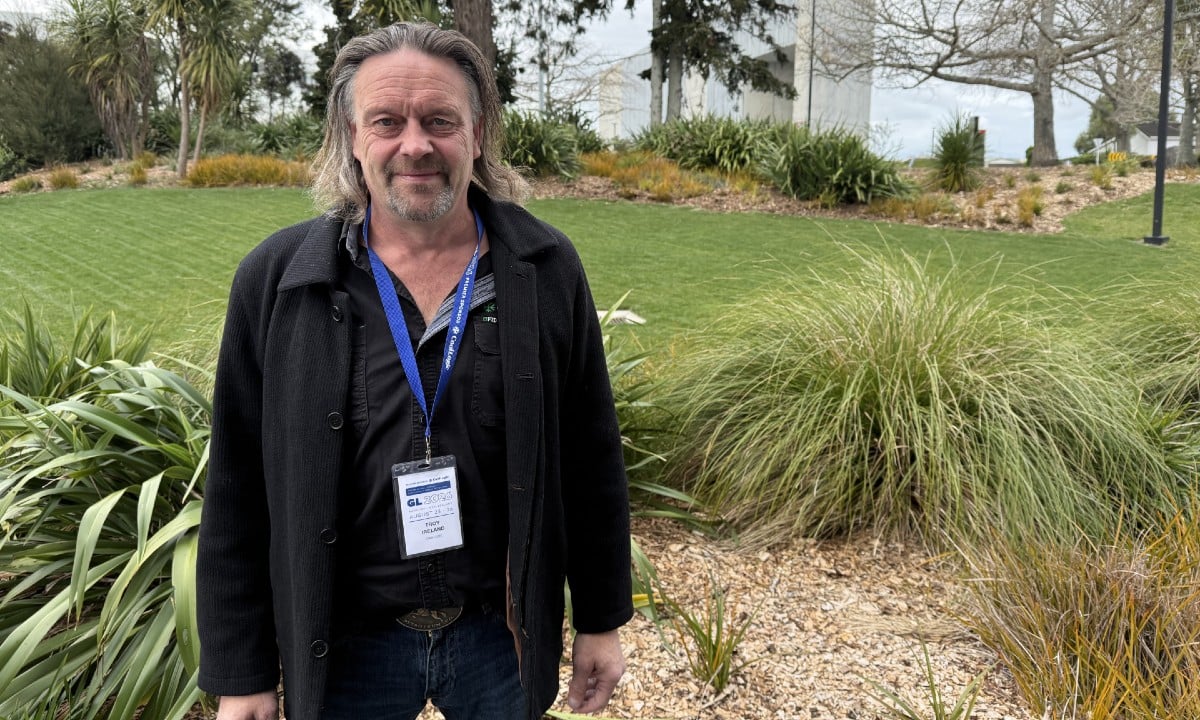
“If we get backed into a corner around compliance, or because it’s an existing site that we’re retrofitting, we will put in a very micro charge of synthetic, but that’s only when we have absolutely no way out,” said Troy Ireland, General Manager, Refrigeration. “But if it’s a greenfield site, it will be CO2 [R744] or ammonia [R717].”
The government of New Zealand has been proactive about regulating HFCs and paving the way for natural refrigerants. It is one of the few countries in the world to tax imports of products containing HFCs.
Ireland, a 38-year veteran of industrial refrigeration, spoke to NaturalRefrigerants.com at the 17th IIR-Gustav Lorentzen Conference on Natural Refrigerants, held August 23–26 in Hamilton, New Zealand.
Based in Christchurch, CoolLogic, originally named Hawkins Refrigeration, was founded in 1977 and sold to Ireland in 1999. He managed it until 2014, when it was sold to Horizon Energy Group; it was rebranded as CoolLogic in 2016. Over the past decade, the company has made acquisitions and expanded throughout New Zealand.
CoolLogic serves a wide range of industries: meat, dairy, poultry, cold storage, winery, brewing, leisure and education. Its many blue-chip industrial customers include Frontera, Silver Fern Farms, the Alliance Group, Sealord and Talley’s Group.
“We’re very proud to say we’ve engineered every discipline in natural refrigerants.”
Troy Ireland, CoolLogic
“So whether it’s apples, kiwifruit, fish, red meat, whatever their needs are, we design and build specific refrigeration systems for them,” said Ireland. CoolLogic works for virtually every red meat company in New Zealand and “they are moving quite quickly.” The kiwi industry “has been amazing – we have put probably 25 megawatts of cooling into the kiwi industry.”
CoolLogic designs a wide range of industrial refrigeration systems, including ammonia (overfeed, low-charge DX and glycol chillers), ammonia in combination with CO2 (secondary or cascade) and transcritical CO2. The contractor has also designed systems using propane (R290). “We’re very proud to say we’ve engineered every discipline in natural refrigerants,” said Ireland.
Over the past couple of years, Ireland said, CoolLogic has installed two large-scale ammonia systems using pump overfeed. A more common ammonia configuration for the contractor is low-charge ammonia with secondary CO2 or glycol, of which there have been many more installations.
In addition, the contractor put in a megawatt-scale subcritical ammonia/CO2 cascade system last year (with another on the way) as well as a number of other cascade systems in recent years. In addition, CoolLogic has done multiple transcritical installations in the last few years.
CoolLogic designs virtually all of its refrigeration projects, with one or two per year done by a consultant. The choice of refrigerant and system is usually based on Ireland’s recommendation. “I will say, ‘This is the direction I think we should go and these are the reasons why.” Factors that he weighs include capacity (400kW/114TR is the starting point for ammonia, generally less than that for CO2), cost, efficiency, expected age of the system, water-cooled or air-cooled, safety and whether it is a greenfield or brownfield project. “It’s a balancing act; it’s like filling in all the spokes on a wheel to get the balance,” he said.
Ammonia designs
Ireland provided details on its natural refrigerant systems For example, in an ammonia/secondary CO2 system, the ammonia could evaporate at -42°C (-44°F), enabling the CO2 to circulate at -40°C (-40°F) – a “two-degree approach.”
“The secondary CO2 in that application is extremely good because there’s no oil, and it’s volatile,” he explained. “We send it out as a liquid and it comes back to the separator as a saturated vapor. Then we recondense it with a thermosyphon back into the separator. It works so well.” The Donut Factory is one of the customers for this application.
One challenge for ammonia/secondary CO2 is defrosting. For that CoolLogic uses a warm glycol fluid along with large evaporation coils and more circuits, which increases the cost of the system. “It’s a very good system, very efficient, using free waste heat!,” he said.
Ammonia/CO2 cascade systems, where CO2 undergoes compression, are typically used in large-scale, low-temperature projects. In one installation in Auckland for Americold, a global cold-storage operator, CoolLogic designed a cascade system that employed glycol as a secondary condensing fluid between the ammonia and CO2; this prevents the possibility of contact between the ammonia and CO2 in the presence of water, forming ammonium carbonate, a crystal that would jam the system.
“There’s going to be a big market for semi-hermetic screw compressors with a small charge of ammonia.”
Troy Ireland, CoolLogic
But many ammonia/cascade systems use a shell-and-plate heat exchanger without the glycol intermediary, improving efficiency. “It’s a trade-off,” he said. “Do you want to be conservative for safety, or do you want efficiency?”
The direct ammonia/CO2 cascade without glycol in between, along with hot-gas defrost, is Ireland’s preferred system. “That system works very well,” he said. “We’re the first people to do it that I know of.” Lineage Logistics, another global cold-storage operator, uses this system.
Glycol can also serve as a secondary fluid in medium-temperature ammonia chillers. Bakker Bulbs, a producer of lily and tulip plants, employs an ammonia glycol chiller designed by CoolLogic. The system features semi-hermetic screw compressors with no shaft seals, a capacity of 750kW (213TR) and an ammonia charge of just 65kg (143lbs). It is housed in a 4.9 by 12m (16 by 39ft) plant room consisting of two linked shipping containers; the room meets the New Zealand safety code IL (importance level) 3, which means it can withstand natural disasters like earthquakes.
The semi-hermetic screw compressors are a sealed system that minimizes the risk of ammonia leaks. “There’s going to be a big market for semi-hermetic screw compressors with a small charge of ammonia,” said Ireland. “That’s what I’ve been designing. We installed three of those plants last year alone.”
In its traditional liquid overfeed ammonia-only systems, CoolLogic employs an expansion device like a Danfoss valve to reduce the amount of ammonia used. “Direct ammonia in the field is still a very effective refrigerant, and it’s on large scale,” said Ireland. “We’ve got one plant where we do 17 [metric] tons [37,479lbs] of peas per hour, and that’s direct ammonia pumped overfeed into the field. But we’re seeing less and less of it because of the health and safety concerns.”
The contractor has begun to design DX (direct expansion) ammonia systems, a configuration that has been widely deployed in Australia.
Massive CO2 system
One of CoolLogic’s premier projects in New Zealand was a 5MW (1,422TR) transcritical CO2 refrigeration system for Maersk, a global shipping company, at its new 18,000m2 (193,750ft2) cold-storage facility near Hamilton that opened in 2024. This is one of the largest transcritical CO2 systems in the world. “It was a big achievement for us,” said Ireland.
Because of the large capacity of the project, Ireland recommended at least some ammonia but Maersk was adamant about using only transcritical CO2, supplied by OEM Advansor. (Both Advansor and Maersk are headquartered in Denmark.) CoolLogic designed a CO2 system with adiabatic gas coolers located close to the cold rooms, blast freezers and the environmental load area. “It’s running efficiently,” said Ireland. “Maybe once or twice it’s gone transcritical.”
For another customer, CoolLogic designed a 400kW (114TR) transcritical CO2 system that is water-cooled (using ground-sourced water) and never operates in transcritical mode.
In general, New Zealand, with its mild temperatures, supports running CO2 in subcritical mode. The South Island in particular “is a great climate for CO2,” noted Ireland.