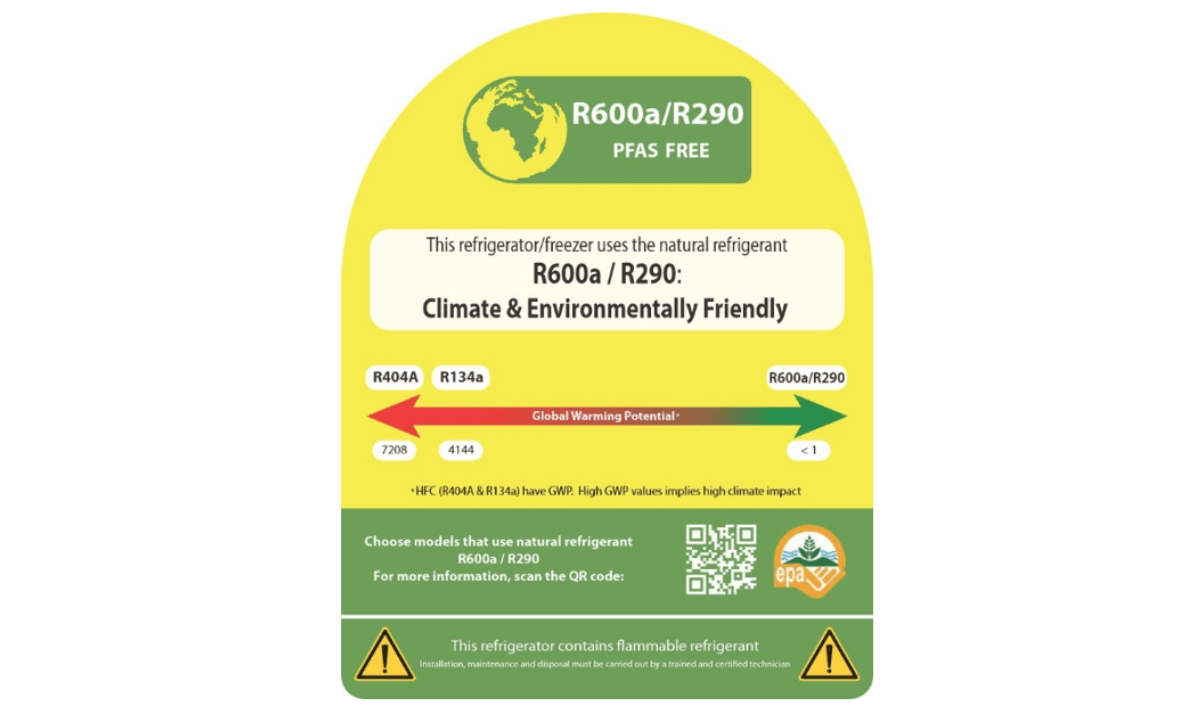
The National Ozone Unit of Ghana’s Environmental Protection Authority (EPA) has introduced new voluntary “green” refrigerant labels to help consumers and end users identify natural refrigerant cooling equipment for residential and commercial applications.
The government agency offers two refrigerant labels: one for propane (R290) air conditioners (ACs) and another for domestic and commercial refrigerators and freezers using isobutane (R600a) or propane (R290).
“Conventional ACs or refrigerators use synthetic HCFC/HFC refrigerants (R22, R410A, R32, R404A, R134a) which are harmful to the ozone layer (R22 only) and/or have negative climate, environmental or human health impacts,” the EPA said. “The purpose of the refrigerant labels is to inform users about the ozone layer, climate and environmental impact of the equipment to help them choose wisely.”
Duly noted: The graphics on both labels provide consumers with a quick comparison of the global warming potential (GWP) of synthetic and hydrocarbon refrigerants, along with a QR code for additional information.
- The labels underscore R600a and R290 as PFAS (per- and polyfluoroalkyl substances)-free options, reflecting Ghana’s concern over the potential harmful impacts of forever chemicals on human health and the environment. In particular, the agency cites the “persistent, increasing concentration of TFA (trifluoroacetic acid),” a PFAS formed through the atmospheric breakdown of HFOs, including R404A and R134a.
- The AC label also identifies R22 as an ozone-depleting substance, with the agency noting that Ghana banned the importation of ACs containing the refrigerant in January 2025.
International support: Ghana’s EPA, in collaboration with the GIZ (the German Society for International Cooperation), outlined a transition to environmentally friendly cooling solutions in its April 2022 “Refrigeration and Air Conditioning Roadmap.”
- The publication identifies eco-labels as a tool to steer the market towards environmentally friendly products by supporting customer decision-making.
- The GIZ introduced 380 R290 split AC units to the Ghanaian market under its Cool Contributions Fighting Climate Change (C4) Projects. Chinese manufacturer Midea partnered with the GIZ to train local AC technicians on safe installation, servicing and repair procedures.
- In December 2024 the GIZ, under its Green Cooling Initiative, installed Ghana’s “first” propane-based chiller for air-conditioning. The 115kW (32TR)-capacity unit, installed at the Energy Commission’s new near-zero-emissions building in Accra, has a total refrigerant charge of 8kg across two refrigeration circuits.
In Kenya: In October 2023 German-based manufacturer CCR, formerly Carrier Commercial Refrigeration, with support from the GIZ, agreed to establish the “first-ever” East African transcritical CO2 (R744) supermarket training center in Nairobi.
- Along with building the facility, the company will provide training in Kenya, Germany and online for African trainers and technicians.
- “Setting up the first regional CO2 transcritical supermarket training center in Kenya and providing training in cooperation with local Kenyan partners and [CCR] is an important cornerstone toward the promotion of green cooling in Africa,” said Philipp Denzinger, Project Manager of GIZ Proklima, a climate program within the GIZ.
Quotable: “R290 ACs and R600a/R290 refrigerators/freezers have a higher energy efficiency compared to standard conventional (HCFC/HFC) ACs and (HFC) refrigerators/freezers,” Ghana’s EPA said, adding that the hydrocarbon refrigerants reduce electrical consumption and therefore operating costs.
“The purpose of the refrigerant labels is to inform users about the ozone layer, climate and environmental impact of the equipment to help them choose wisely.”
Ghana’s Environmental Protection Authority