The first set of field data from a CO2 (R744) heat pump-chiller system installed at a new 87-room hotel in Goa, India, has confirmed the technology can efficiently deliver hot water and air-conditioning in tropical climates, according to the project’s development team.
Initial observations have shown the system can successfully produce hot water at 80°C (176°F) while simultaneously providing glycol-water at 2°C (35°F) for air-conditioning. It can deliver heating and cooling capacities of roughly 152kW (43.2TR) and 110kW (31.3TR), with average COPs of 3.6 and 2.6, respectively.
“These results affirm that CO2 heat pump-chiller systems offer a promising solution for Indian hotels currently dependent on separate heating and cooling systems,” noted Sarun Kumar Kochunni, a postdoctoral fellow at the Norwegian University of Science and Technology (NTNU).
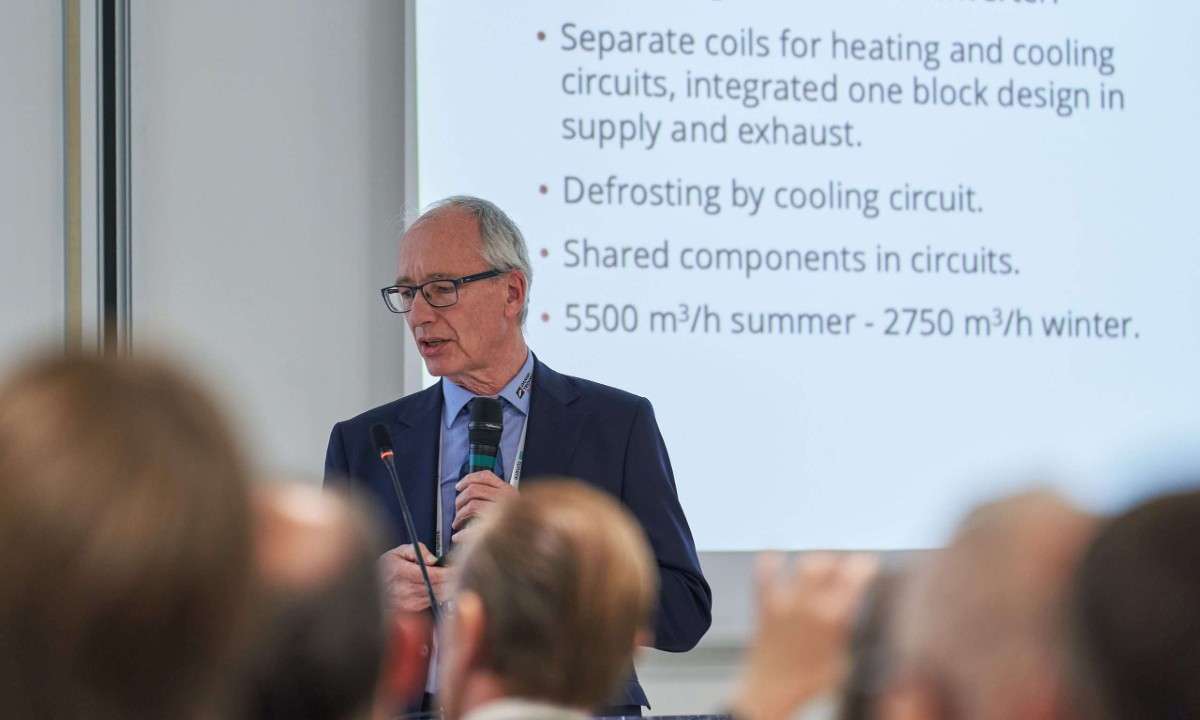
Kochunni shared details of the system’s performance during his presentation at the International Institute for Refrigeration (IIR)’s inaugural International Conference on Refrigeration Adapting to Rising Temperatures (Adaptation 2025). The conference was held August 10–13 in Manchester, England, and hosted by the Institute of Refrigeration UK (IoR).
“These results affirm that CO2 heat pump-chiller systems offer a promising solution for Indian hotels currently dependent on separate heating and cooling systems.”
Sarun Kumar Kochunni, postdoctoral fellow at NTNU
Data collection
Operational data was collected in December 2024 and January 2025 to evaluate the system’s performance under real-world conditions. For the study presented at Adaptation 2025, a representative dataset from January 11 – when the system ran continuously for seven hours under stable conditions – was used as the basis of analysis.
Following the successful operation of the CO2 heat pump-chiller at the Goa hotel, the system’s manufacturer, Medors Renewable Energy, has received requests to produce an additional 15 units. While many of these are for other hotel installations, the company said it has delivered a similar system for a diary application.
“We have seen a really good interest because this site is working really well,” said Kumodak Sharma, Managing Director at Medors, who participated in the presentation’s Q&A. “For this type of application, we are promoting CO2 as a primary product now.”
System architecture
The CO2 system combines heating and cooling functions within a single unit, supported by a 6,000L (1,585gal) hot water tank and a 1,000L (264gal) cold water tank. A thermal energy storage (TES) unit on the heating loop buffers excess hot water and applies thermal stratification to maintain stable supply temperatures. Automated controls ensure reliable operation under fluctuating hotel demand.
Key components include a variable frequency drive compressor, plate-type gas cooler, internal heat exchanger and ejector. The ejector enhances efficiency during transcritical operation, a frequent condition in tropical climates.
During operation, compressor discharge temperatures averaged 104°C (219.2°F). The gas cooler maintained outlet water near 80°C, assisted by the TES and control system to balance varying loads.
Cooling is delivered through two evaporators in series: the first gravity-fed and the second controlled by an electronic expansion valve. This staged setup enables return water at 15°C (59°F) to be cooled effectively to as low as 1.5°C (34.7°F). A glycol–water mixture circulates in the closed cooling loop, transferring chilled fluid through the evaporators and the hotel’s air-handling ducts.
To ensure replicability, the manufacturer tried to keep system design simple, explained Sharma.
“We have seen a really good interest because this site is working really well. For this type of application, we are promoting CO2 as a primary product now.”
Kumodak Sharma, Managing Director at Medors
Made in India
An important aspect of the Goa hotel project is its domestic development. Medors Renewable Energy designed and manufactured most of the CO2 heat pump-chiller system in India, including the control system and key mechanical components. This allowed the unit to be tailored to the demands of a hotel in a tropical climate while also minimizing costs.
The control platform, based on a Siemens PLC with a proprietary SCADA interface, enables continuous data logging and remote monitoring. This ensures stable operation despite the hotel engineers’ limited familiarity with CO2 systems and allows adjustments to be made in response to varying demand patterns such as morning peaks in hot water use and higher cooling loads during the day. On the hardware side, Medors fabricated the liquid receiver, oil-level controls, valves and other components locally, while only the compressor, ejector and plate heat exchanger were sourced from abroad.
INDEE+ project
The hotel installation was carried out under NTNU’s INDEE+ project, an Indo-Norwegian initiative funded by Norway’s Ministry of Foreign Affairs. The program aims to demonstrate the feasibility of natural refrigerants in India’s HVAC&R sector through real-world applications.
Traditionally, Indian hotels have depended on HFC-based chillers for cooling and fossil fuel boilers for hot water in showers, kitchens and laundry. By contrast, a CO2 heat pump-chiller integrates both functions, recovering heat from the cooling process to simultaneously supply hot water, thereby improving overall energy efficiency.
Despite this potential, adoption in India has been limited due to concerns over system performance in high ambient conditions and the lack of operational data from commercial buildings.
“Such data is crucial to validate their low-emission performance, assess real-world efficiency and promote cost-effective sustainable heating and cooling solutions in India’s commercial building sector,” the project team explained.
Earlier modeling under INDEE+ suggested that a hotel in Chennai could reduce annual operating costs by 93% and CO2 emissions by 80% by replacing diesel-fired water heaters with R744-based heat pumps combined with thermal storage. The current field results in Goa provide the first publicly available validation of the technology’s potential.
Future studies under the INDEE+ project’s follow-up program – INDEE3 – will examine operational flexibility under varying seasonal load conditions.