
The potential of natural refrigerant high-temperature heat pumps to decarbonize industry was a major focus during several presentations at the 2026 Chillventa Congress.
Chillventa is the one of the world’s largest HVAC&R trade shows and is being held in Nuremberg from October 13 to 15. The Congress, an event where manufacturers, researchers and industry share updates, was held October 12. It featured presentations from leading manufacturers, research organizations and trade groups from across the HVAC&R industry.
There was a dedicated heat pump track, where SRMTec and Danfoss presented on their latest work with, and future outlook for, natural refrigerant industrial heat pumps to decarbonize European industry.
Manufacturers share their insights
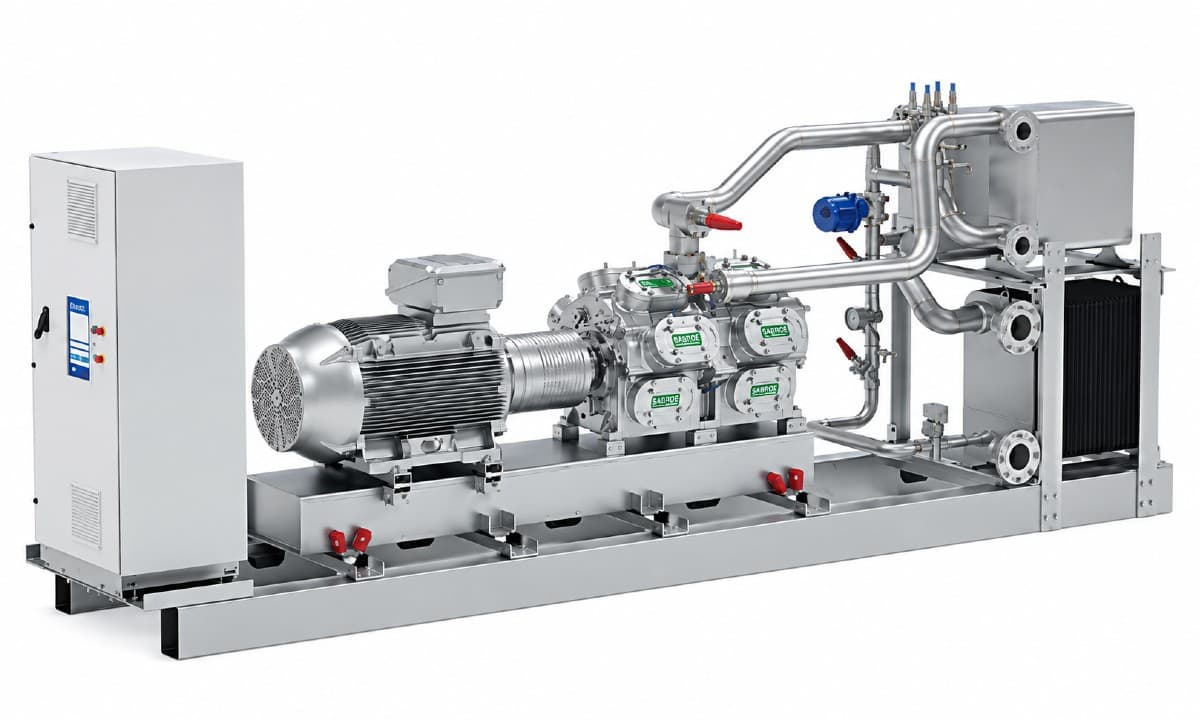
Swedish compressor manufacturer SRMTec, part of the Snowman Group, shared information about the six ammonia (R717) heat pump modules it’s developing for a project in Denmark. The application involves an industrial facility that is installing carbon capture equipment. The facility’s flue gas is cooled prior to entering the carbon capture equipment. Its waste heat is used in a local district heating system, where it’s lifted to 84°C (183°F). The system has 20MW (5,686TR) of heating capacity and 15MW (4,265TR) of cooling capacity, with a heating COP of 4.57.
“We are using ammonia because of its excellent thermodynamic properties and zero ozone depletion and global warming potential,” said Rüdiger Rudischhauser, Sales Director at SRMTec, who presented the project. “I’m very proud to say that we’re working with our partner on a similar project that is double the size of this one.”
Ivan Rangelov, Director of Industrial Heat Pump Solutions at Danfoss, said his company’s research has found that the current decarbonization opportunity in Europe alone for heat pumps is 100GW, with food and beverage making up 67% of that total. Rangelov said Danfoss believes industrial processes requiring temperatures up to 150°C (302°F) can be decarbonized with heat pumps. His presentation included several presentations on projects featuring the company’s natural refrigerant heat pumps.
“Regarding capacities and temperatures, there are natural refrigerant solutions available for all industrial heat pump applications out there.”
Benjamin Zühlsdorf, Innovation Director at DTI
This included a project for Dutch beer manufacturer Gulpener, where an ammonia chiller was replaced with a reversible propane (R290) heat pump for process cooling, with the system working in cascade with an isobutane (R600a) heat pump that lifts the waste heat to 95°C (203°F). Another butane (R600) heat pump is used to generate steam at 131°C (267°F) from 60°C (140°F) waste water.
In addition to food and beverage, Danfoss’ heat pumps are also being used in district energy networks, including for a project at a university in the U.K. The unnamed institution has its own district energy network, and Danfoss is providing CO2 (R744) and isobutane heat pumps in cascade to produce up to 10MW (2,843TR) of heating.
The state of the industry
Along with manufacturers, the Danish Technological Institute (DTI) and Germany’s Fraunhofer Institute presented progress from the IEA’s (International Energy Agency) ongoing Project 68. The project aims to gather information to accelerate the deployment and adoption of high-temperature industrial heat pumps.
Benjamin Zühlsdorf, Innovation Director at DTI, noted that, of the more than 50 heat pumps reviewed as part of the program, 75% use natural refrigerants. About one-third of the projects recorded as part of Project 68 are in the food and beverage sector.
“From a technical point of view, regarding capacities and temperatures, there are natural refrigerant solutions available for all applications out there,” said Zühlsdorf.
Ursula Wittstadt Senior Engineer, Heating and Cooling Technologies at Fraunhofer, highlighted Germany’s role in Project 68. More than 25% of the listed high-temperature heat pump suppliers are from the country. However, only six demonstration cases out of 50 total are in Germany: four in the industrial sector (process heating) and two in district heating.
“There are a lot of people supplying this equipment and researching this in Germany, but the market isn’t moving very fast, and that’s something we’re looking at,” said Wittstadt.