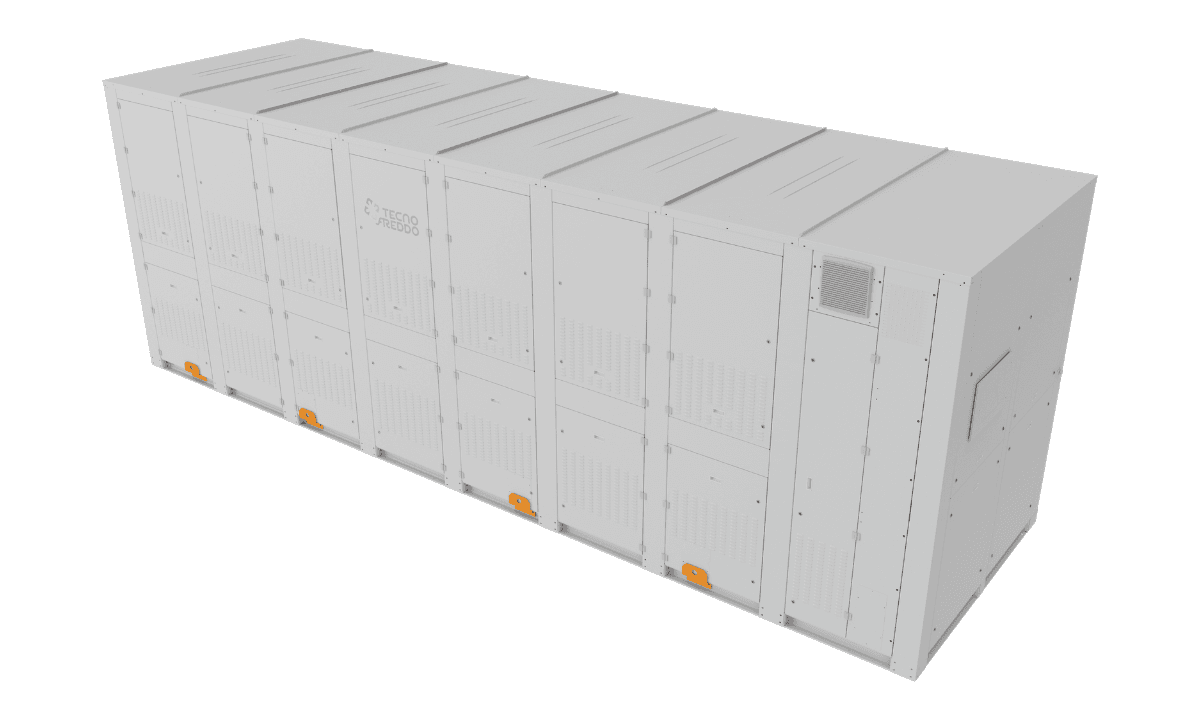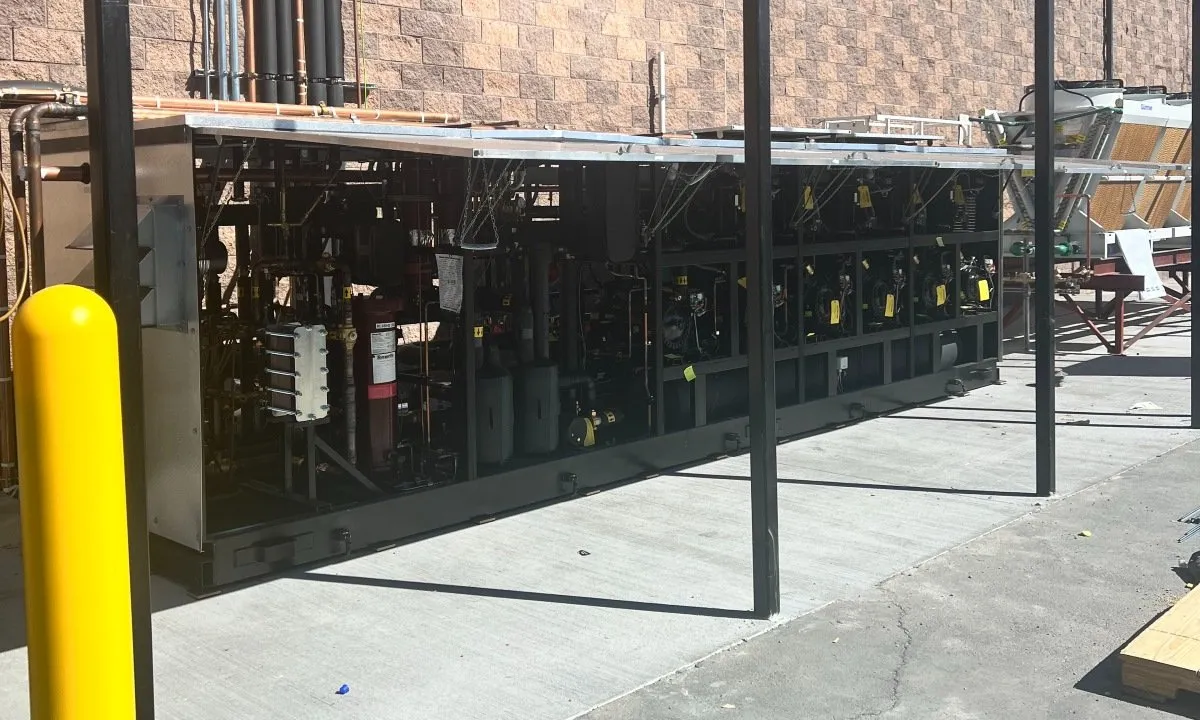
U.S. OEM Zero Zone has installed one of its transcritical CO2 (R744) refrigeration systems at a supermarket in Palmdale, California, replacing its previous HFC-based equipment.
While the manufacturer did not name the end user, it says in a LinkedIn post that the installation was for the “world’s largest retailer.”
“The customer chose CO2 to meet sustainability goals that were driven by their internal GWP initiatives,” Chris McCarty, Zero Zone’s Director of Business Development, told R744.com. “They made the decision to go with CO2 to get ahead of the curve and set themselves up to meet long-term sustainability goals.”
Installed in October 2023, Zero Zone’s dual-temperature Genesys CO2 transcritical system with parallel compression serves the 100,000ft2 (9,290m2) store’s four large walk-in cold rooms and more than 20 remote refrigerated cabinets.
It provides around 140kW (39.8TR) of cooling capacity for the store’s low-temperature (LT) applications and 190kW (54TR) for its medium-temperature (MT) applications.
Waste heat from the refrigeration system is also reclaimed for hot water production, according to the manufacturer.
The system consists of evaporators from Heatcraft and Keeprite, an adiabatic gas cooler from Güntner and 11 Copeland compressors – six for MT and five scroll compressors for LT. It also includes case controllers and related sensors for the store’s cold rooms and refrigerated cases. A seismic kit was installed with the unit to prevent injury to people and damage to the equipment and multiple leak detectors are located throughout the system.
Zero Zone said that the transcritical CO2 system includes three racks for risk mitigation.
“There was great coordination between the OEM, suppliers and contractors [during installation] that set the project up for success,” McCarty said. “There was no blown charge at startup.”
While the end user expects its new refrigeration system to be as energy efficient as its previous system, if not more, the total cost of ownership was the real driving factor during the decision-making process, he added.
Stores of all sizes
In addition to larger supermarkets, Zero Zone has previously said that it is seeing CO2-based refrigeration technologies being adopted in a wide variety of small-format retailers, including convenience stores. That comment was made by Dan O’Brien, President of Zero Zone, at the Food Industry Association (FMI) Energy and Store Development Conference in October 2023.
O’Brien defined a small-format retailer as one operating a store with a footprint of 25,000ft2 (2,323m2) or less that requires a refrigeration system with a cooling capacity of around 30TR (105.5kW).
“We can apply [CO2] in basically everything and anything; it’s not just for the big box stores anymore,” O’Brien said.
At the FMI event, O’Brien said Zero Zone had installed CO2 refrigeration systems – featuring Copeland supervisory controls – in stores across the country, including Kwik Trip, Walgreens, ALDI US and Natural Grocers.