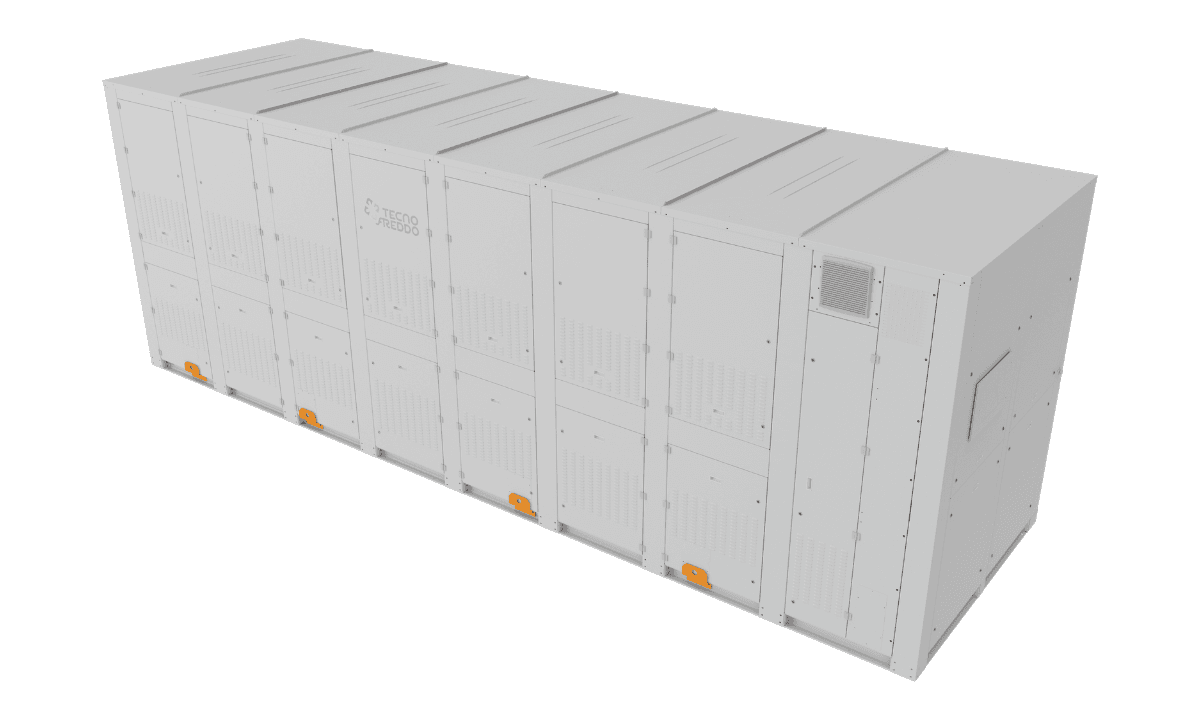
SCM Ref NZ, a subsidiary of Beijer Ref, has designed, built and tested what it believes is one of the “first” CO2 (R744) ice builder packages, according to Chris Gibbons, Product Development Manager at the company.
The unit generates and stores cooling capacity as an ice bank for dairy farmers at night when energy costs are low in New Zealand, Gibbons told NaturalRefrigerants.com in an exclusive interview. During the day, when energy costs are high, cold water circulates through from the ice bank tank to a heat exchanger where it absorbs heat from warm milk to cool it down to the required 4°C (39°F) storage temperature.
“With over 30 years of experience with evaporative synthetic ice builders, I built a unit with K65 copper coils instead of soft drawn copper to handle the higher pressures of CO2,” Gibbons said. “Unlike a synthetic unit, the CO2 ice builder requires precise welding at every pipe bend, which amounts to hundreds of welds.”
In the unit’s commissioning test, conducted at the manufacturer’s facility in Auckland at an ambient temperature of 14°C (57°F), it supplied consistent ice, with the compressor operating at minimum speed while still maintaining the designed SST, Gibbons said. “It is rated to 80bar [1,160psi] and tested to 90bar [1,305psi], making it well suited for our mild climate where temperatures rarely climb above 30°C [86°F],” he added.
Sector specifics: New Zealand’s dairy industry is made up of 10,485 farms, milking 4.7 million cows to produce 20.5 billion liters (5.4 billion gallons) of milk annually, as of 2024, according to the industry organization DairyNZ.
- Fresh milk exits a cow at roughly 36°C (96.8°F).
- Normally, it is precooled to 16‒20°C (60.8‒68°F) with ground water through a heat exchanger and then further cooled with a secondary fluid, usually glycol or water, through a heat exchanger to enter the milk vat below 6°C, Gibbons explained.
The design: Gibbons used an insulated box, manufactured by Irish company Kilkenny Cooling Systems, to form the base of the CO2 ice builder. It accommodates the air bubbler and submersible water pump.
- SCM Ref NZ designed and constructed the evaporator coils and linked the unit to its New Zealand-built SMTDX10 transcritical CO2 refrigeration pack, with a CO2 charge of 14kg.
- “Four Danfoss AKV expansion valves on a single Danfoss case controller keep the evaporator stable and maximized without the risk of low superheat to the compressor,” Gibbons said.
- The unit, slated for installation in a South Island dairy farm, holds roughly 500kg (1,100lbs) of ice reserves. A 1,000kg (2,200lbs) unit is under development, with other dairies showing interest in the product, according to Gibbons.
CO2 pros/cons: Gibbons outlined the benefits and disadvantages of CO2 in New Zealand, including energy efficiency, refrigerant costs and upfront system costs.
- “CO2 systems in the country operate subcritical 90% of the year or more with a COP that can rise to between 4 and 5,” he said. “When it does slip transcritical, the COP drops to around 2, which is similar to synthetics in the higher ambients.”
- In New Zealand, CO2 refrigerant is currently 96% cheaper than R404A and 92% cheaper than R449A.
- Initial costs remain the biggest disadvantage, with CO2 equipment running three to four times more expensive than synthetic units due to the material and plant costs required for the higher pressures.
Quotable: “With natural refrigerants currently the only permanent future-proof solution, I am constantly looking for ways to expand the use of CO2 in New Zealand,” Gibbons said. “It’s a highly efficient solution for our climate. No one in my professional groups had ever heard of an ice builder with CO2 refrigerant. As soon as I raised the possibility of developing one, the interest I got in New Zealand was stronger than I expected.”
“With natural refrigerants currently the only permanent future-proof solution, I am constantly looking for ways to expand the use of CO2 in New Zealand.”
Chris Gibbons, Product Development Manager at SCM Ref NZ