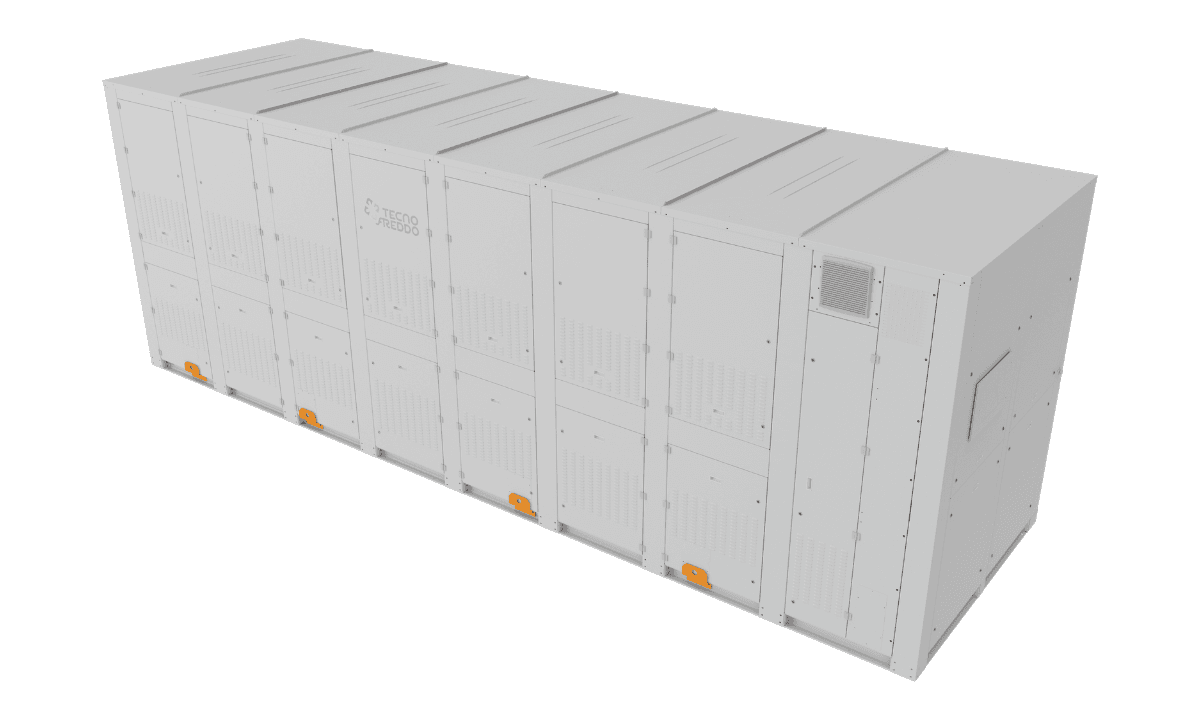
A commercial CO2 (R744) refrigeration system equipped with indirect evaporative technology managed to operate in subcritical mode even in ambient temperatures up to 43°C (109°F), said Alemu Tiruneh, Senior HVAC Engineer at Glaciem Cooling Technologies, during a presentation at Refcon 25.
The unique refrigeration system, dubbed “dew point CO2 (DP-CO2)” by its creators, Dr. Tim Lau and his team at the University of South Australia (UNISA) and HVAC&R contractor Glaciem Cooling Technologies, leverages dew point coolers found in Seeley air-conditoning units. Roughly six years ago, UNISA collaborated with Glaciem to build a “lab scale” DP-CO2 system. Australian supermarket chain Coles installed the novel system, which Glaciem has since patented, at a new Adelaide supermarket in 2023.
“On February 12, the hottest day in Adelaide in the 2024‒2025 summer season, the ambient temperature was above 30°C [86°F] during store operating hours and peaked at 43°C [109°F],” Tiruneh said. “However, the DP-CO2 system condensed at less than 26°C [79°F] the entire day, with a maximum 66bar [957psi] discharge pressure.”
In his evaluation of the DP-CO2 system, Tiruneh shared roughly 18 months of operational data from the Adelaide store. Refcon 25 was organized by the Air Conditioning & Mechanical Contractors’ Association of Australia and held on March 24 in Melbourne.
Store details: The CO2 system included 34kW (9.6TR) of low-temperature capacity, 185kW (52.6TR) of medium-temperature, 250kW (71TR) of high-temperature for air-conditioning and 60kW (17TR) of heat recovery.
- The CO2 side of the refrigeration system remained relatively untouched, according to Lau, who spoke with NaturalRefrigerants.com about the project in August 2024.
- Tiruneh said that the DP-CO2 system uses indirect cooling to cool the incoming ambient air, followed by evaporative cooling to reduce the temperature to 12.5°C (55°F).
- The cooled air is then passed over the CO2 refrigeration system’s gas cooler coil to maintain a condensing temperature of 21°C (70°F).
Technology comparison: Tiruneh compared the pressure and enthalpy of various technologies designed to improve CO2 operation in high ambient temperatures, including flash gas bypass, parallel compressors, mechanical subcooling, high-pressure ejectors and adiabatic gas coolers.
- “With DP-CO2, the flash gas produced at the receiver is only 15% compared to up to 53% for the other technologies,” he said.
- When comparing the modeled results of an equivalent adiabatic gas cooler, the DP-CO2 system used 11% less energy annually, according to Tiruneh. Moreover, it reduced the peak demand by 20%.
- The system also negates the need for a high-pressure ejector since the entrainment ratio is zero up to a 68bar (986psi) discharge pressure, according to a chart produced by Danish component manufacturer Danfoss
Things to consider: Tiruneh estimated a 3- to 5-year payback for the technology compared to adiabatic gas cooling.
- “The effectiveness of the dew point cooler increases as the dew point temperature of air increases, making the technology also ideal for hot and humid climates,” Tiruneh said.
- He did not account for the water consumption of the new system. In ambient temperatures above 30°C, he indicated it would use less water than adiabatic cooling but would also require water at lower temperatures than the standard technology.
Quotable: “The beauty with this system is when the dew point temperature of the incoming gas is high, the dew point effectiveness is close to 100%,” Tiruneh said. “It’s amazing. We can keep a CO2 system operating subcritical in high ambient temperatures.”
“When the dew point temperature of the incoming gas is high, the dew point effectiveness is close to 100%.”
Alemu Tiruneh, Senior HVAC Engineer at Glaciem Cooling Technologies