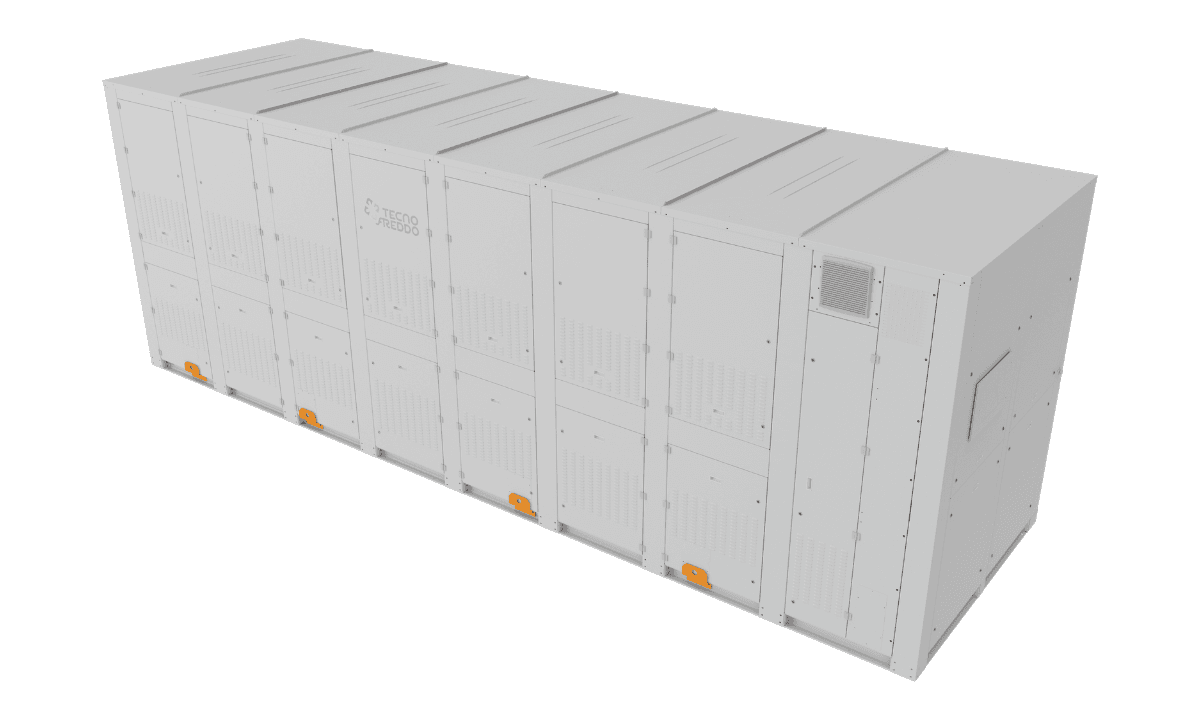
U.S. OEM Hillphoenix, a division of Dover Food Retail, reports that 85% of its new transcritical CO2 (R744) racks are being sold with ChargeSecure, a charge preservation system that began shipping last November.
Designed specifically for Hillphoenix’s transcritical CO2 systems, ChargeSecure minimizes downtime during power outages and service events by maintaining the CO2 charge, enabling the system to restart immediately.
“So far we have orders [of ChargeSecure] in the hundreds with a mix of both new installs and retrofits,” said Senthilkumar Shanmugam, Senior Product Manager, Dover Food Retail.
As interest in transcritical CO2 systems continues to grow in North America, Hillphoenix has become the leading provider of these systems. The OEM has sold approximately 2,000 transcritical CO2 systems, mostly to supermarkets and to some industrial facilities. These installations are being targeted for retrofits with ChargeSecure, said Ousama Sabra, Systems Senior Product Manager, Dover Food Retail. “That’s our next phase, focusing on the existing racks.”
Already orders of ChargeSecure over the next year for existing CO2 installations “are very encouraging,” more than double what has been sold so far, said Sabra.
ChargeSecure is suitable for any of Hillphoenix’s CO2 rack systems, which include three Advansorflex models (Flex Mini, Flex, Flex Max) for stores and the larger industrial platform. Most of the ChargeSecure systems are in stores, though about five industrial facilities have them. In almost all installations, one ChargeSecure unit is sufficient; for a very large industrial rack, more than one unit could be necessary.
ChargeSecure addresses a major concern about CO2 systems – that they are vulnerable to losing refrigerant charge in prolonged power outages, which cause a pressure build-up of CO2 and a discharge of the gas. ChargeSecure effectively prevents pressures from exceeding discharge thresholds so that a system can resume functioning when power is restored.
“Customers definitely see the added value of having their rack up and running immediately after the power outage” versus waiting for a shipment of new CO2 gas, said Sabra. “So it’s a time saver, and it’s also a cost saver.”
About one month after a recent ChargeSecure retrofit at a store in Columbus, Ohio, there was a power outage that left the store without power for more than nine hours. “The ChargeSecure did its job and protected the charge,” said Shanmugam. “They were able to start the rack immediately after.”
Increasing the pressure rating
ChargeSecure is not the only method for preserving CO2 charge in a power outage. Another way is to increase the pressure rating for system piping so that it can withstand the rise in pressure that occurs when the system loses power.
High-side rack pressure ratings are already at a high pressure – 120 or 130bar (1,740 or 1,885psi) – but the industry standard for in-store piping such as liquid supply lines is currently 45bar (653psi), with medium-temperature suction piping also at 45bar and low-temperature suction piping at 30bar (435psi).
Concerns about CO2 charge preservation have led some U.S. foods retailers to ask if the pressure rating of piping in transcritical systems should be raised significantly – up to 90bar (1,305psi) – throughout the system, including the suction piping.
The majority of European OEMs use 60bar (870psi) in liquid lines, while 20% employ 80bar (1,160psi). In suction lines, the majority have 52bar (754psi) for medium temperature and 30bar for low temperature.
However, raising the pressure rating for in-store piping would increase the cost of the system. For example, 90bar piping would require the use of high-pressure copper piping, upgraded evaporator coils, flash tank, valves, suction filters and low-temperature compressors.
Shanmugam pointed out that the ChargeSecure system, which saves 70% of the CO2 charge during a lengthy power outage, provides almost the same function as a CO2 system with high-pressure piping (which saves up to 100%), but at a significantly lower cost.
“So far we have orders [of ChargeSecure] in the hundreds with a mix of both new installs and retrofits.”
Senthilkumar Shanmugam, Senior Product Manager, Dover Food Retail
ChargeSecure is focused on preserving the charge on the liquid side because it is the area where the pressure rises quickly, Shanmugam explained. On the suction side, depending on ambient conditions, a power outage would have to last “at least five to seven hours” before the pressure increased to the point where the CO2 gas would be released. Thus, increasing the pressure rating for suction piping is only beneficial during very long power outages, he added.
Hillphoenix does offer 90bar liquid line and suction piping for customers who require different levels of protection. It really helps in rural areas where technicians may not be available and power outages could extend to 12 or more hours. “That’s where the high-pressure system works very well,” said Shanmugam.
In terms of return-on-investment (ROI), ChargeSecure offers end users a potentially quick payback on its investment in the event of a power outage, compared to a scenario where no charge-maintenance system was in place and there is a significant loss of product, noted Shanmugam. “If you lost the charge on the liquid side completely and are unable to start the rack and waiting for the charge [replacement] and that causes product loss, then the return on investment can be instant.”
The extent to which ChargeSecure is used depends on factors like the length of the power outage and ambient conditions. A short power outage may require little or no usage, while an outage in a warm southern climate like Florida may require more usage than one in a cooler one like Connecticut, explained Sabra.
How it works
ChargeSecure employs about 1.8amps, supplied by either a battery-equipped UPS provided by Hillphoenix or a small generator.
As ChargeSecure is focused on the liquid side of a transcritical CO2 system, it senses the pressure in the flash tank and activates when that pressure passes a certain threshold. “When the pressure increases [during a power outage], ChargeSecure minimizes or reduces the pressure, and it is kept under the relief valve pressure so that the charge will not be released from the system,” said Shanmugam.
It accomplishes this by taking the CO2 gas from the flash tank, compressing it and then discharging it into the gas cooler. “We don’t need to run the gas cooler because the mass flow that is taken out of the flask tank is very tiny when compared to your gas cooler volume,” said Shanmugam.
After the pressure increases in the gas cooler, a bypass solenoid valve expands the gas, releasing it back to the flash tank. The process repeats if necessary to keep the pressure in the flash tank below the release level.